Fundamental
Prepare and test your skills

Fundamental
Prepare and test your skills
Asynchronous Execution of Cloud Storage Lifecycle Rules
Free sample question with answers and detailed explanation below. The Associate Cloud Engineer practice bank has an additional 2,014 practice questions.Try 10 free realistic questions: instant score, no credit card, and no account required.
An administrator configures an Object Lifecycle Management policy on a Cloud Storage bucket with a rule set to delete all log files once their age exceeds 30 days.
Shortly after an object reaches 31 days of age, an engineer notices that the file is still listed in the bucket and remains downloadable.
What explains this behavior, and how does Cloud Storage handle lifecycle policy actions?
Explanations
Lifecycle delete rules are ignored unless Object Versioning is explicitly enabled on the Cloud Storage bucket.
Lifecycle delete rules are ignored unless Object Versioning is explicitly enabled on the Cloud Storage bucket.
What Object Versioning Is
Object Versioning is a Cloud Storage feature that maintains multiple historical variants of an object whenever it is overwritten or deleted, creating live and noncurrent object generations.
Why It Doesn't Meet the Requirement
- Independent functionality: Object Lifecycle Management works on buckets regardless of whether Object Versioning is enabled or disabled.
- Standard live deletion: On a bucket with versioning disabled, a lifecycle rule with an
agecondition and aDeleteaction simply purges the live object directly once executed. - Versioning-specific conditions: Only conditions like
numNewerVersions,isLive: false, ordaysSinceNoncurrentTimedepend on versioning.
Key Characteristics and Limitations
- Broad applicability: Lifecycle actions like
DeleteandSetStorageClassoperate across all standard bucket configurations. - Behavior with versioning disabled: Live objects matching the rule are removed without retaining historical versions.
- Behavior with versioning enabled: Deleting a live object transitions it to noncurrent status, which may then require secondary rules to delete permanently.
This Answer Would Be Correct If
The lifecycle policy specifically relied on conditions such as numNewerVersions or daysSinceNoncurrentTime, which are only satisfied when versioning creates noncurrent generations.
Additional Context
Basic lifecycle policies (such as deleting files older than a specified number of days) are commonly used on non-versioned buckets for ephemeral log storage and temporary data pipelines.
Lifecycle rules only define policies and require administrators to execute a manual trigger command via the Google Cloud CLI to apply deletions.
Lifecycle rules only define policies and require administrators to execute a manual trigger command via the Google Cloud CLI to apply deletions.
What Manual Lifecycle Execution Implies
This option suggests that Object Lifecycle Management acts merely as a template or dry-run definition that requires scheduled external invocation through the Google Cloud CLI (gcloud storage) or API calls.
Why It Doesn't Meet the Requirement
- Fully automated system: Cloud Storage lifecycle management is a fully managed, automated service. It does not require manual triggers, cron jobs, or external scheduling scripts.
- Incorrect operational model: Once a lifecycle JSON or XML configuration is applied to a bucket, Google Cloud's internal control plane automatically handles inspection and action execution.
Key Characteristics and Limitations
- Bucket configuration state: Lifecycle rules are active metadata properties on the bucket resource itself.
- No trigger APIs: Cloud Storage does not expose an "execute lifecycle rule now" trigger endpoint; inspection intervals are managed internally by Google Cloud.
- CLI role: The CLI is used solely to set, update, export, or remove the bucket's lifecycle policy configuration.
This Answer Would Be Correct If
The scenario involved a custom script running on Compute Engine or Cloud Run using the gcloud storage rm command on a scheduled Cloud Scheduler trigger rather than native bucket lifecycle management.
Additional Context
A common misconception is assuming Cloud Storage operates like an external batch script. In reality, native lifecycle management is fully automated once enabled on the target bucket.
Objects satisfying delete conditions are automatically placed into a 30-day quarantine state where they remain visible for an entire billing cycle before final purging.
Objects satisfying delete conditions are automatically placed into a 30-day quarantine state where they remain visible for an entire billing cycle before final purging.
What a Quarantine State Is
Some archival or enterprise content management systems move flagged records into a visible quarantine partition or pending-purge holding area for administrative review before permanent deletion occurs.
Why It Doesn't Meet the Requirement
- No visible quarantine: Cloud Storage does not place live objects into a visible quarantine state when lifecycle conditions are reached.
- Immediate target state: When the asynchronous lifecycle worker reaches the object, it initiates the delete action directly without an artificial 30-day waiting period.
- Misunderstanding soft delete: While Cloud Storage offers a Soft Delete feature, soft-deleted objects are moved out of live object listings and cannot be directly read or downloaded via standard object URLs without restoration.
Key Characteristics and Limitations
- Direct deletion: Lifecycle rules execute the configured action directly (e.g., permanent deletion or version retirement).
- Billing alignment: Deletions do not wait for the end of a monthly billing cycle to execute.
- Object versioning differences: Under object versioning, a live object becomes a noncurrent version rather than entering a quarantine status.
This Answer Would Be Correct If
The bucket had a custom legal hold or retention policy configuration requiring manual administrative approval queues prior to object disposition.
Additional Context
Do not confuse operational processing lag (which is a matter of hours during asynchronous background scans) with structured retention policies or quarantine holds.
Cloud Storage runs lifecycle management rules asynchronously via periodic bucket inspections, resulting in an operational lag between when a condition is met and when the action executes.
Cloud Storage runs lifecycle management rules asynchronously via periodic bucket inspections, resulting in an operational lag between when a condition is met and when the action executes.
What Object Lifecycle Management Execution Is
Object Lifecycle Management in Google Cloud Storage provides automated background evaluation of bucket contents against defined condition rules, such as object age, storage class, and version status.
How It Explains the Scenario
- Asynchronous evaluation: Cloud Storage regularly inspects all objects in a bucket and performs all applicable actions asynchronously rather than triggering instantaneously the second a timestamp condition is met.
- Operational lag: Because lifecycle scans occur on a periodic schedule across distributed storage infrastructure, there can be a noticeable delay between the exact moment an object satisfies a condition (such as reaching 30 days of age) and when the corresponding Delete or SetStorageClass action is physically executed.
- Application expectations: Applications and operational workflows must not rely on lifecycle deletions or transitions occurring immediately upon reaching a condition boundary; objects remain visible and readable until the asynchronous process completes.
Async Lifecycle Lag Timeline
Timeline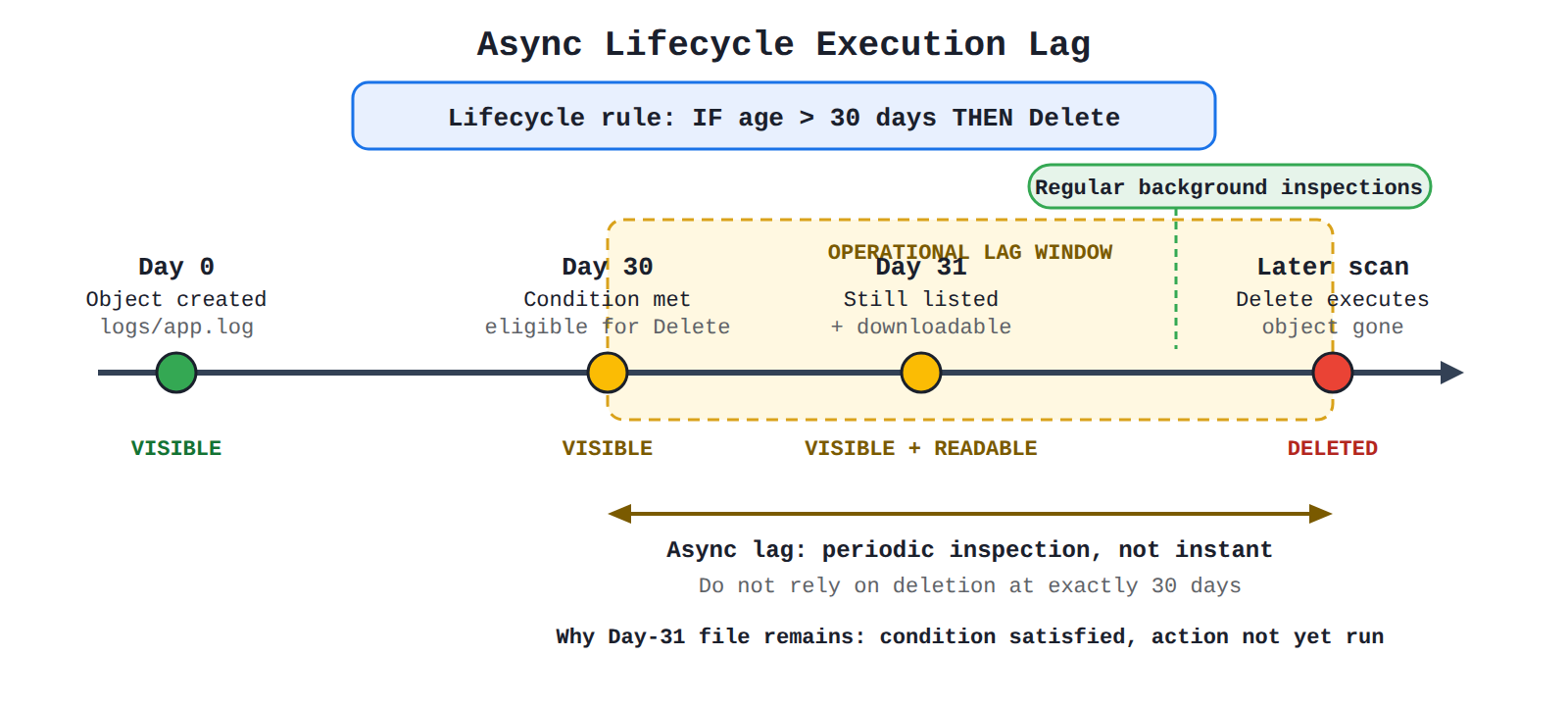
Key Operational Mechanics
- Periodic inspection cycles: Scans run in the background without requiring user intervention or manual execution.
- Visibility during lag: Objects remain accessible for download and viewing until the asynchronous action is completed.
- Cost protections: In cases where soft delete is disabled and standard age conditions trigger deletion, at-rest storage charges can be waived during the lag window according to Cloud Storage billing rules.
- Non-blocking workload impact: Running lifecycle actions asynchronously ensures that standard read and write performance on active bucket operations is not degraded by massive batch updates.
Why This Is Optimal
Understanding that lifecycle policies execute asynchronously helps engineers design resilient architectures that do not depend on real-time synchronous execution for data deletion or tier transitions.
Try 10 interactive questions like this one, free
Answer them yourself and get your score the moment you finish. No account needed.
Full access includes
- 2,014 practice questions across all 4 exam domains
- Every answer explained: why it is right, and why the others are not
- Scout, an AI tutor that answers your follow-up questions
- Readiness tracking by domain, so you know when to book the exam
Related free sample questions
Keep the momentum going with these hand-picked practice scenarios
FundamentalAssociate Cloud Engineer
NumNewerVersions and IsLive Conditions
Setting object lifecycle management policies for Cloud Storage buckets
FundamentalAssociate Cloud Engineer
Cloud Run Traffic Splitting
Deploying new versions of a Cloud Run application
FundamentalAssociate Cloud Engineer
kubectl describe vs kubectl get
Viewing current running GKE cluster inventory (e.g., nodes, Pods, Services)
FundamentalAssociate Cloud Engineer
Persistent Disk Snapshot Deletion Behavior
Working with snapshots and images (e.g., create, view, and delete images or snapshots; schedule a snapshot)
FundamentalAssociate Cloud Engineer
Static External IP with Cloud DNS A Record
Setting up cloud networking
IntermediateProfessional Cloud Developer
GENERATED_COOKIE Session Affinity
Enabling session affinity for performant content delivery
Last updated