Fundamental
Prepare and test your skills

Fundamental
Prepare and test your skills
Canary Releases With Cloud Run Revisions
Free sample question with answers and detailed explanation below. The Associate Cloud Engineer practice bank has an additional 2,014 practice questions.Try 10 free realistic questions: instant score, no credit card, and no account required.
Your company hosts a public REST API on Google Cloud Run. You have developed an update with performance improvements, but you want to test it safely in production before doing a full rollout.
You need to implement a canary deployment where:
- Exactly 10% of incoming live traffic is directed to the newly deployed revision.
- 90% of live traffic continues to go to the current stable revision.
- You can gradually increase or immediately roll back the traffic percentage without redeploying the application.
What should you do?
Explanations
Update the existing revision in place and set the maximum instance limit on that revision to handle 10% of normal daily concurrency.
Update the existing revision in place and set the maximum instance limit on that revision to handle 10% of normal daily concurrency.
What This Option Is and Does
This option attempts to overwrite an existing revision and use Cloud Run instance limits (--max-instances) to throttle the number of requests processed by the new code.
Why It Doesn't Meet the Requirement
- Revisions are immutable: In Cloud Run, revisions cannot be modified in place. Every configuration change or new container deployment automatically generates a new, distinct revision.
- Instance limits do not split traffic: The
max-instancessetting restricts concurrency ceiling; it does not distribute a percentage of total incoming live requests between different code versions. - Causes service disruption: If traffic exceeds the capacity of the capped instances, Cloud Run will queue requests and eventually return HTTP
429 Too Many Requestsor503 Service Unavailableerrors to clients rather than routing them to older code.
Key Characteristics and Limitations
- Revisions are immutable snapshots of container images and environment settings.
- Instance scaling limits control autoscaling boundaries, not routing percentages.
- Does not provide a fallback or dual-version operational state.
This Answer Would Be Correct If
The goal was to protect downstream databases or external services from being overwhelmed by setting an upper bound on compute concurrency, rather than performing a canary rollout.
Deploy the updated container image to a new, separate Cloud Run service and configure an external Application Load Balancer with weighted backend services.
Deploy the updated container image to a new, separate Cloud Run service and configure an external Application Load Balancer with weighted backend services.
What This Option Is and Does
This approach provisions two distinct Cloud Run services (e.g., api-prod and api-canary) behind an external Application Load Balancer with serverless Network Endpoint Groups (NEGs), using backend service weighting to split traffic.
Why It Doesn't Meet the Requirement
- Unnecessary operational overhead: Cloud Run natively supports traffic splitting between multiple revisions inside a single service. Creating multiple services duplicates DNS configurations, IAM permissions, environment variables, and scaling parameters.
- Higher infrastructure cost: Deploying an external Application Load Balancer introduces additional hourly and per-gigabyte costs that are unnecessary for standard Cloud Run canary rollouts.
- Complex management: Managing two independent services makes cleanup and lifecycle tracking significantly more complicated than adjusting revision traffic splits in a single service.
Key Characteristics and Limitations
- Treats separate revisions as separate services rather than lifecycle stages of one service.
- Requires provisioning Serverless NEGs, URL maps, and forwarding rules.
- Increases time-to-rollback compared to native revision traffic switching.
This Answer Would Be Correct If
You needed to split traffic across services deployed in different Google Cloud regions, across hybrid on-premises endpoints, or if you required specialized advanced security policies (like Cloud Armor) across multi-region serverless NEGs.
Create a Pub/Sub topic to intercept 10% of HTTP API requests and push them asynchronously to the new revision.
Create a Pub/Sub topic to intercept 10% of HTTP API requests and push them asynchronously to the new revision.
What This Option Is and Does
This option introduces Cloud Pub/Sub as a message broker between clients and the Cloud Run service, attempting to sample 10% of incoming messages and push them to the new revision.
Why It Doesn't Meet the Requirement
- Breaks synchronous REST API contracts: Cloud Pub/Sub is an asynchronous messaging system. Synchronous HTTP client requests (which require an immediate HTTP response) cannot be intercepted and completed via Pub/Sub push subscriptions without breaking standard REST communication.
- Architectural mismatch: Pub/Sub is not a reverse proxy or HTTP traffic router. It has no native mechanism to randomly sample 10% of synchronous user requests for canary routing.
- Unnecessary latency and complexity: Introducing an asynchronous queuing layer adds substantial latency and requires complete client-side redesign.
Key Characteristics and Limitations
- Pub/Sub is designed for event-driven, decoupled, asynchronous communication.
- Does not support standard client-server request/response HTTP semantics.
- Is entirely separate from Cloud Run's native revision traffic allocation plane.
This Answer Would Be Correct If
The application was an asynchronous background worker processing event payloads from a queue, and you wanted to test worker logic by consuming messages from a canary subscription.
Deploy the new revision with no immediate traffic assigned, and then configure Cloud Run traffic splitting to allocate 10% of traffic to the new revision and 90% to the previous revision.
Deploy the new revision with no immediate traffic assigned, and then configure Cloud Run traffic splitting to allocate 10% of traffic to the new revision and 90% to the previous revision.
What Cloud Run Traffic Splitting Is
Cloud Run traffic splitting is a built-in feature that enables users to divide incoming request traffic between two or more active revisions of the same service using precise percentages that sum to 100%.
How It Meets the Requirements
- 10% canary testing: Cloud Run allows you to deploy a revision with
--no-traffic(or without routing 100% immediately) and explicitly allocate 10% of traffic to the new revision while keeping 90% on the current production revision. - Risk mitigation: If metrics show elevated errors or latency, you can instantly dial the traffic allocation back to 0% on the new revision without modifying code or redeploying container images.
- Gradual rollout: Once verified, you can shift the traffic allocation to 25%, 50%, and eventually 100% with a single
gcloud run services update-trafficcommand or via the Google Cloud Console.
Cloud Run Canary 90/10 Traffic Split
System Architecture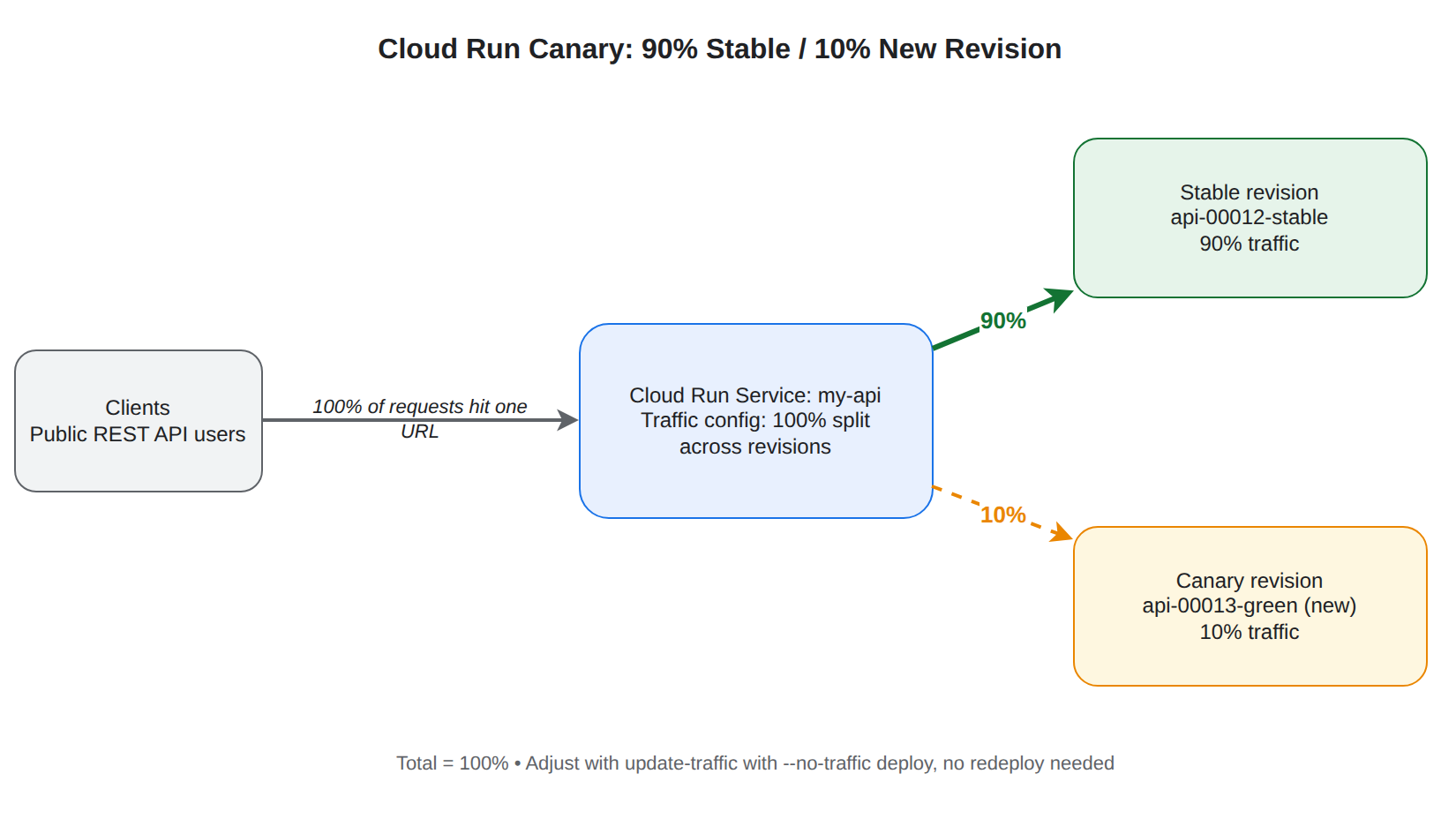
Key Advantages and Capabilities
- Native capability: Operates entirely within the Cloud Run service control plane without requiring external load balancers or proxy layers.
- Instant reconfiguration: Traffic split changes take effect in seconds with zero service downtime.
- Immutable revisions: Each revision represents a fixed container image and configuration snapshot, ensuring predictable and rollback-safe operations.
- Revision tagging: Revisions can be assigned URL tags for direct testing alongside percentage-based traffic splits.
Why This Is Optimal
This approach leverages Cloud Run's native, serverless traffic allocation mechanism. It achieves the exact percentage distribution required for canary releases with minimal operational overhead and zero extra architectural complexity.
Try 10 interactive questions like this one, free
Answer them yourself and get your score the moment you finish. No account needed.
Full access includes
- 2,014 practice questions across all 4 exam domains
- Every answer explained: why it is right, and why the others are not
- Scout, an AI tutor that answers your follow-up questions
- Readiness tracking by domain, so you know when to book the exam
Related free sample questions
Keep the momentum going with these hand-picked practice scenarios
FundamentalAssociate Cloud Engineer
Cloud Run Immutable Revisions
Deploying new versions of a Cloud Run application
FundamentalAssociate Cloud Engineer
Shared VPC Subnet-Level IAM
Creating a VPC with subnets (e.g., custom mode VPC, Shared VPC)
FundamentalAssociate Cloud Engineer
gcloud Billing Projects Link
Linking projects to a billing account
FundamentalAssociate Cloud Engineer
IAM Roles at Project vs Bucket Level
Managing and securing objects in Cloud Storage buckets
FundamentalAssociate Cloud Engineer
Cloud Logging and Monitoring IAM Roles
Viewing the Personalized Service Health dashboard
FundamentalCloud Digital Leader
TCO Hidden On-Premises Operational Costs
Explain how an organization’s transition from an on-premises environment to the cloud shifts their capital expenditures (CapEx) to operational expenditures (OpEx), and how that affects their total cost of ownership (TCO).
Last updated