Intermediate
Prepare and test your skills
Intermediate
Prepare and test your skills
Vertex AI Flex Start Queuing for GPU Training
Free sample question, answered and explained below. The Professional Cloud Architect practice bank has 2,335 more like it. Try 10 free: instant score, no account.
An organization is designing an automated, event-driven machine learning workflow on Google Cloud. The architecture must satisfy the following technical requirements:
- Event-Driven Trigger: Automatically initiate the pipeline whenever a new training dataset is uploaded to a designated Cloud Storage bucket.
- Serverless Orchestration & Training: Run custom distributed model training scripts in custom containers using high-demand NVIDIA A100/H100 GPU accelerators via Vertex AI.
- Capacity Management & Cost Optimization: Accommodate GPU capacity constraints gracefully by queuing jobs and utilizing Dynamic Workload Scheduler (DWS) with a Flex Start scheduling strategy rather than failing immediately when on-demand quota is constrained.
- Automated Artifact Management: Upload model artifacts and deploy the trained model to a Vertex AI Endpoint.
Which architectural approach should you implement?
Explanations
Configure a Cloud Scheduler cron job to trigger a Vertex AI Batch Prediction job every hour to ingest Cloud Storage files and execute model fine-tuning with Triton Inference Server.
Configure a Cloud Scheduler cron job to trigger a Vertex AI Batch Prediction job every hour to ingest Cloud Storage files and execute model fine-tuning with Triton Inference Server.
What the Option Is/Does
This approach uses Cloud Scheduler on a fixed time interval (cron) to launch a Vertex AI Batch Prediction job using NVIDIA Triton Inference Server containers.
Why it Doesn't Meet the Requirement
- Event-Driven vs. Scheduled: A periodic cron job introduces ingestion latency and unnecessary executions, failing the requirement for an event-driven workflow triggered immediately by Cloud Storage file uploads.
- Training vs. Inference: Batch Prediction and Triton Inference Server are specialized for serving model inference requests across large datasets, not for training or fine-tuning custom machine learning models.
- Dynamic Workload Scheduling: Batch Prediction jobs do not support custom training scheduling strategies like
FLEX_STARTwith configurablemax_wait_durationon training worker pools.
Key Characteristics and Limitations
- Triton Inference Server is an optimized model-serving runtime rather than a distributed training harness.
- Cloud Scheduler cannot natively respond instantaneously to asynchronous object creation events.
This Answer Would Be Correct If
The objective was to perform scheduled, offline inference over tabular or unstructured datasets using an already trained model.
Create a Compute Engine VM with attached NVIDIA A100 GPUs running a continuous polling daemon that monitors Cloud Storage using gsutil and executes local Python training scripts.
Create a Compute Engine VM with attached NVIDIA A100 GPUs running a continuous polling daemon that monitors Cloud Storage using gsutil and executes local Python training scripts.
What the Option Is/Does
This approach deploys a dedicated Compute Engine virtual machine configured with physical GPU accelerators that runs a continuous background script (daemon) to check Cloud Storage for new datasets.
Why it Doesn't Meet the Requirement
- Serverless Architecture: Maintaining a continuously running Compute Engine VM violates the requirement for a serverless execution pattern and incurs high idle compute costs for expensive GPU resources.
- Capacity & Scheduling Optimization: Running dedicated VMs cannot leverage Vertex AI Dynamic Workload Scheduler (DWS)
FLEX_STARTcapabilities or serverless preemptible quota models. - Automated Pipeline Integration: Polling via custom scripts lacks native lifecycle orchestration, automated retries, and streamlined model registry deployment provided by Vertex AI.
Key Characteristics and Limitations
- Requires manual provisioning, OS patching, driver management, and GPU CUDA maintenance.
- Continues to incur full hourly billing even when no training jobs are active.
- Does not provide automated queuing mechanisms when GPU instances require re-creation.
This Answer Would Be Correct If
The workload required a persistent, interactive development environment where developers constantly fine-tune models interactively on a single static server.
Configure an Eventarc trigger on the Cloud Storage bucket to invoke a Cloud Run function that submits a Vertex AI CustomJob configured with FLEX_START scheduling strategy and max_wait_duration, then deploys the resulting model artifact to a Vertex AI Endpoint upon completion.
Configure an Eventarc trigger on the Cloud Storage bucket to invoke a Cloud Run function that submits a Vertex AI CustomJob configured with FLEX_START scheduling strategy and max_wait_duration, then deploys the resulting model artifact to a Vertex AI Endpoint upon completion.
What the Solution Is
This architecture combines Eventarc, Cloud Run functions, and Vertex AI Custom Training using the Dynamic Workload Scheduler (DWS) with the FLEX_START scheduling strategy to create an automated, resilient, serverless machine learning orchestration pipeline.
How it Meets the Requirements
- Event-Driven Trigger: Eventarc monitors object finalization events in the Cloud Storage bucket and immediately invokes a serverless Cloud Run function without requiring long-running polling infrastructure.
- Serverless Orchestration & Training: The Cloud Run function uses the Vertex AI SDK or REST API to provision a custom training container on demand, executing on high-performance compute without managing virtual machines directly.
- Capacity Management & Cost Optimization: By setting
scheduling.strategytoFLEX_STARTand defining amax_wait_duration, Vertex AI queues the job until the requested accelerator resources (such as NVIDIA A100 or H100 GPUs) become available, consuming preemptible quota allocation while running the job to completion reliably. - Automated Artifact Management: The pipeline uploads the resulting model binaries as a Vertex AI Model resource and deploys it to a Vertex AI Endpoint for online or batch inference.
Event-Driven Serverless ML Pipeline
Process Flow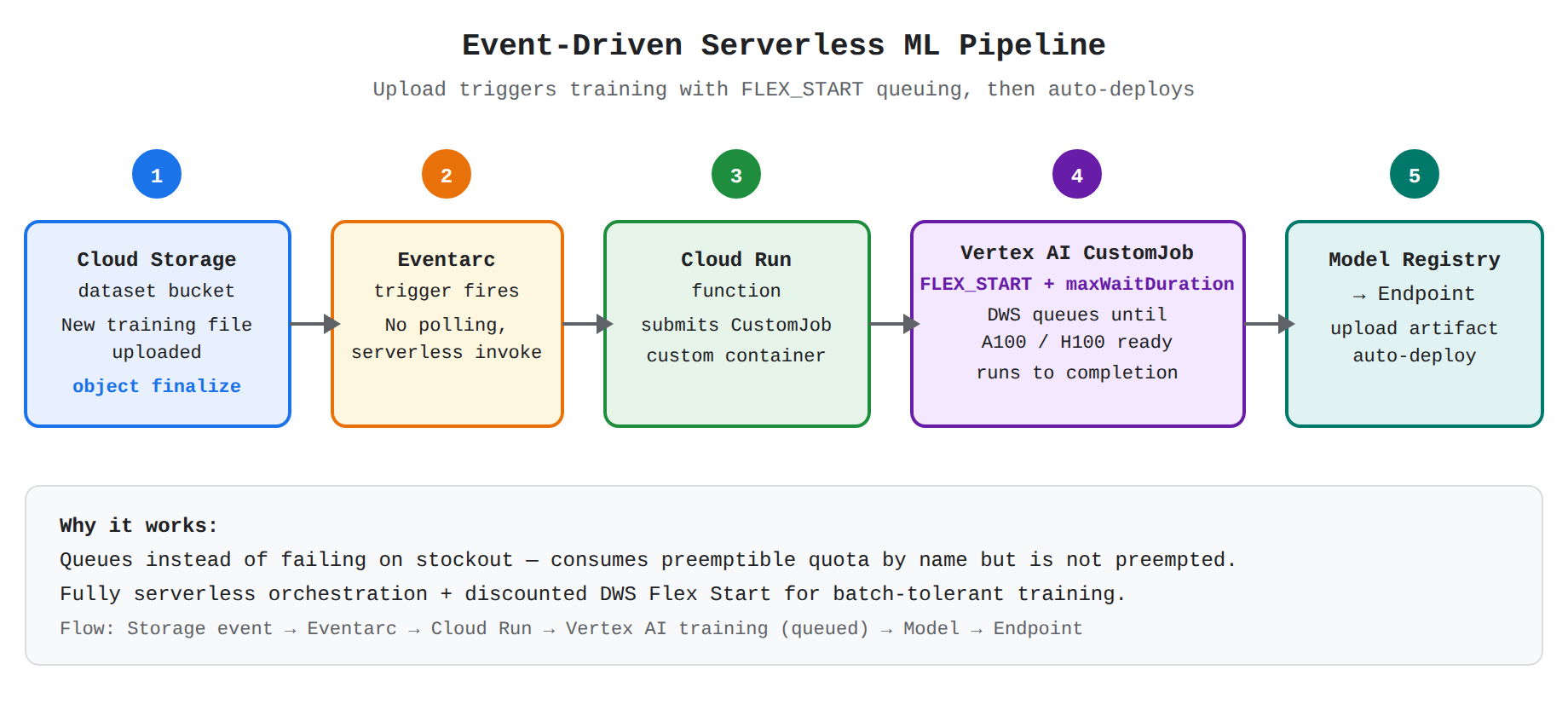
Key Advantages and Capabilities
- Fully Serverless Execution: Eliminates idle compute costs for orchestrator infrastructure.
- Dynamic Resource Scheduling: Mitigates stockout errors for high-demand AI accelerator infrastructure.
- Cost Efficiency: DWS Flex Start provides discounted compute pricing for batch-tolerant training workloads.
- Seamless Deployment: Native integration between Vertex AI custom jobs, Model Registry, and Endpoints.
Deploy a Google Kubernetes Engine (GKE) Autopilot cluster and use Cloud Logging export sinks to deploy models directly into a Vertex AI Model resource without training worker pool configurations.
Deploy a Google Kubernetes Engine (GKE) Autopilot cluster and use Cloud Logging export sinks to deploy models directly into a Vertex AI Model resource without training worker pool configurations.
What the Option Is/Does
This configuration proposes using Google Kubernetes Engine (GKE) Autopilot paired with Cloud Logging log sinks to handle incoming data events and attempt model registration directly.
Why it Doesn't Meet the Requirement
- Missing Training Pipeline: Uploading model artifacts directly based on log sinks bypasses the actual training workload and fails to configure custom training worker pools with GPU acceleration.
- Improper Event Triggering: Cloud Logging export sinks are designed for log routing and SIEM integration, not for triggering event-driven ML data transformation and training workflows.
- No Dynamic Workload Scheduling: It does not use Vertex AI's native
FLEX_STARTscheduler for queuing and managing scarce GPU training capacity.
Key Characteristics and Limitations
- GKE Autopilot manages Kubernetes pod infrastructure but introduces operational complexity compared to native Vertex AI serverless custom jobs.
- Log sink routing cannot pass rich event payload context necessary to execute parameter-driven ML pipelines.
This Answer Would Be Correct If
The workload was centered around Kubernetes-native microservices requiring real-time log ingestion and analysis rather than an automated Vertex AI training workflow.
Try 10 interactive questions like this one, free
Answer them yourself and get your score the moment you finish. No account needed.
Full access includes
- 2,335 practice questions across all 6 exam domains
- Every answer explained: why it is right, and why the others are not
- Scout, an AI tutor that answers your follow-up questions
- Readiness tracking by domain, so you know when to book the exam
Related questions
Keep the momentum going with these hand-picked practice scenarios
IntermediateProfessional Cloud Architect
TensorFlow steps_per_execution Parameter
Using AI Hypercomputer (e.g., using AI Hypercomputer, Cloud Run functions, and Vertex AI for ML/AI workloads; integrating GPUs and TPUs in ML model training and serving; optimizing for different consumption models; and running large-scale AI model training
IntermediateProfessional Cloud Architect
Flex-start (Dynamic Workload Scheduler)
Using AI Hypercomputer (e.g., using AI Hypercomputer, Cloud Run functions, and Vertex AI for ML/AI workloads; integrating GPUs and TPUs in ML model training and serving; optimizing for different consumption models; and running large-scale AI model training
IntermediateProfessional Cloud Architect
Google Cloud Cost Optimization CUDs Spot VMs Rightsizing
Cost optimization/resource optimization (CapEx/OpEx)
IntermediateProfessional Cloud Architect
GCVE Route Summarization and Filtering
Cloud-native network configuration for compute resources (e.g., Compute Engine, GKE, serverless networking, and Google Cloud VMware Engine)
IntermediateProfessional Cloud Architect
Dialogflow CX State Machine
Differentiating between the Google AI APIs (e.g., Search, Conversation, Vision, Image, Video, and Audio)
AdvancedProfessional Data Engineer
Cloud Monitoring Log-Based Anomaly Detection
Data validation
Last updated