Intermediate
Prepare and test your skills
Intermediate
Prepare and test your skills
Dialogflow CX State Management for Voice Agents
Free sample question, answered and explained below. The Professional Cloud Architect practice bank has 2,335 more like it. Try 10 free: instant score, no account.
A retail enterprise is designing an automated interactive voice response (IVR) customer service system. The virtual agent must support multi-turn conversations, track session state across branching paths, extract user parameters like order numbers, and trigger backend webhooks to fulfill customer requests.
The engineering team needs to choose an architecture that minimizes custom state-machine development while delivering full conversational AI capabilities.
Which solution should the team implement?
Explanations
Implement Dialogflow CX to manage conversational flows, intent detection, session state, and webhook fulfillment, with built-in speech recognition and synthesis
Implement Dialogflow CX to manage conversational flows, intent detection, session state, and webhook fulfillment, with built-in speech recognition and synthesis
What Dialogflow CX is
Dialogflow CX is an enterprise-grade conversational AI platform specifically designed to orchestrate complex, multi-turn human-to-machine interactions. It provides native state-machine modeling through visual flows, pages, intent routing, condition evaluation, and integrated webhook fulfillments.
Voice Agent Orchestration with Dialogflow CX
Process Flow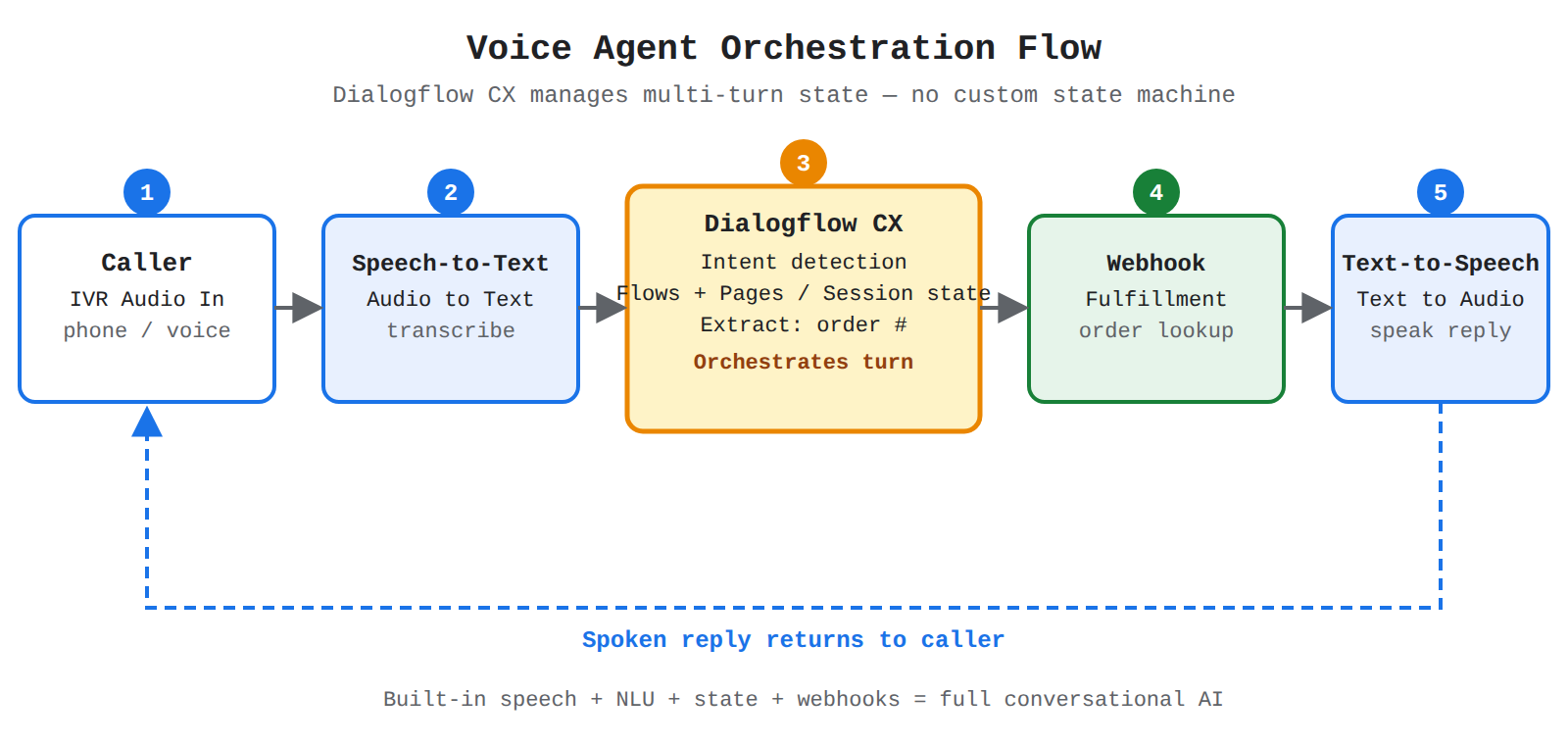
How it meets the requirements
- Multi-turn conversation and session state: Dialogflow CX natively handles session variables, state transitions, and branching conversation paths using flows and pages without requiring custom application code.
- Entity and parameter extraction: It automatically identifies and parses structured data (such as order IDs, dates, and amounts) from user utterances.
- Fulfillment and integration: It offers native webhook triggers to invoke backend systems (e.g., Cloud Functions or Cloud Run) for real-time order processing.
- Speech support: Dialogflow CX natively incorporates speech-to-text recognition and text-to-speech audio synthesis, removing the operational overhead of managing separate audio pipelines.
Key advantages
- Visual flow builder: Simplifies designing and updating multi-turn conversation logic.
- Built-in state management: Persists session entities and parameters automatically across conversation turns.
- Integrated telephony and messaging: Connects seamlessly to IVR systems and digital channels.
- Operational efficiency: Reduces developer overhead by combining natural language understanding (NLU), speech processing, and fulfillment orchestration into a single managed service.
Why this is optimal
Rather than requiring engineers to manually build and maintain custom finite state machines, integrate raw speech APIs, and handle conversation context, Dialogflow CX delivers a purpose-built platform that fulfills all conversational AI requirements out of the box.
Combine the Cloud Natural Language API with Cloud Run to parse syntactic grammar and trigger backend fulfillment webhooks directly
Combine the Cloud Natural Language API with Cloud Run to parse syntactic grammar and trigger backend fulfillment webhooks directly
What the Cloud Natural Language API is
The Cloud Natural Language API provides pre-trained models for analyzing text structure, extracting document-level entities, performing sentiment analysis, classifying content into categories, and analyzing syntax (parts of speech and dependency trees).
Why it doesn't meet the requirement
- No conversational flow management: The Natural Language API analyzes individual, isolated blocks of text. It has no mechanism for managing multi-turn dialogue, tracking session state, or orchestrating conversation pages.
- No native speech processing: It accepts only text inputs and cannot process inbound voice streams or synthesize audio responses without integrating additional services.
- Not designed for intent classification: While it extracts generic entities (e.g., PERSON, LOCATION), it is not tailored to conversational parameter extraction or mapping user utterances to actionable agent intents.
Key limitations
- Stateless text analysis: Evaluates single text inputs without maintaining context across multiple interactions.
- No built-in fulfillment: Lacks native webhook integration concepts tailored to conversational agent lifecycles.
- Lacks audio interfaces: Requires separate pipelines for audio ingest and audio response generation.
This answer would be correct if
The scenario required analyzing customer reviews, feedback emails, or support ticket transcripts for sentiment and document classification rather than running a live interactive virtual agent.
Deploy Vertex AI Search to index backend order documentation and route raw audio streams to fulfillment APIs using semantic search matching
Deploy Vertex AI Search to index backend order documentation and route raw audio streams to fulfillment APIs using semantic search matching
What Vertex AI Search is
Vertex AI Search is an enterprise retrieval and discovery service that enables generative and semantic search over structured and unstructured unstructured content (such as PDFs, HTML pages, and corporate databases).
Why it doesn't meet the requirement
- Information retrieval vs. conversational orchestration: Vertex AI Search is designed for answering queries by extracting answers from documents, not for managing stateful, transactional multi-turn conversations like IVR call flows.
- No voice pipeline handling: It does not natively ingest raw streaming audio from telephony networks or perform dynamic text-to-speech rendering for IVR callers.
- Lacks transactional state machines: While it can surface answers to informational questions, it cannot track variable states across structured task-oriented branches or manage parameter validation loops.
Key limitations
- Search-focused architecture: Primarily retrieves matching knowledge rather than orchestrating stateful task execution.
- No native IVR telephony integration: Lacks out-of-the-box support for telephony protocols and interactive voice prompts.
- No slot-filling workflow engine: Cannot collect and validate required inputs step-by-step from an end user.
This answer would be correct if
The organization needed to build an internal knowledge discovery portal or search engine allowing employees to quickly find information across internal order-processing documentation.
Chain the Speech-to-Text API and Text-to-Speech API using Cloud Functions, writing custom application logic to manage state and session context in Cloud Memorystore
Chain the Speech-to-Text API and Text-to-Speech API using Cloud Functions, writing custom application logic to manage state and session context in Cloud Memorystore
What this option is
This approach uses the standalone Speech-to-Text API to transcribe incoming voice audio into text and the Text-to-Speech API to generate synthetic spoken replies, using Cloud Functions to execute custom business logic and Cloud Memorystore (Redis) as an external cache to store session state.
Why it doesn't meet the requirement
- High development and maintenance overhead: Chaining standalone APIs requires building natural language understanding (NLU), intent classification, context management, slot filling, and state transition logic entirely from scratch.
- Lacks native conversational orchestration: Standalone speech APIs are point solutions designed strictly for converting audio to text and vice versa; they possess no built-in awareness of conversation context or branching dialogue.
- Complex failure handling: Managing multi-turn edge cases, fallback intents, and contextual repair in custom code significantly increases operational complexity compared to using Dialogflow CX.
Key limitations
- No built-in NLU: Requires implementing custom ML models or rule engines to interpret user intent.
- High engineering burden: Developers must handle complex audio streaming protocols and state synchronization manually.
- Difficult scaling and iteration: Updating conversational flows requires code changes and deployments rather than visual configuration.
This answer would be correct if
The goal was simply to perform batch audio transcription or one-off text-to-speech conversion without needing conversational natural language understanding, state tracking, or dialogue management.
Try 10 interactive questions like this one, free
Answer them yourself and get your score the moment you finish. No account needed.
Full access includes
- 2,335 practice questions across all 6 exam domains
- Every answer explained: why it is right, and why the others are not
- Scout, an AI tutor that answers your follow-up questions
- Readiness tracking by domain, so you know when to book the exam
Related questions
Keep the momentum going with these hand-picked practice scenarios
IntermediateProfessional Cloud Architect
Cloud Vision vs Cloud Video Intelligence vs Imagen
Differentiating between the Google AI APIs (e.g., Search, Conversation, Vision, Image, Video, and Audio)
IntermediateProfessional Cloud Architect
Vertex AI Search vs Vertex AI Conversation
Differentiating between the Google AI APIs (e.g., Search, Conversation, Vision, Image, Video, and Audio)
IntermediateProfessional Cloud Architect
Dual-Region Cloud Storage and Premium Tier
Configuration for data transfer and latency
IntermediateProfessional Cloud Architect
Private Service Connect Published Services
Cloud-native networking (e.g., virtual private cloud [VPC], peering, firewalls, load balancers, routing, container networking, shared VPC, and Private Service Connect)
IntermediateProfessional Cloud Architect
SRE Error Budget Change Management
Change management
AdvancedProfessional Cloud Security Engineer
Cloud Secure Web Proxy
Deploying Secure Web Proxy.
Last updated