Intermediate
Prepare and test your skills
Intermediate
Prepare and test your skills
TensorFlow steps_per_execution for Cloud TPU Throughput
Free sample question, answered and explained below. The Professional Cloud Architect practice bank has 2,335 more like it. Try 10 free: instant score, no account.
A machine learning engineering team is training a large-scale deep learning model on Google Cloud TPU accelerators using TensorFlow. During performance profiling with TensorBoard, the team observes that the TPU cores experience frequent idle periods and low Matrix Multiply Unit (MXU) utilization.
Further analysis indicates that the TPU accelerator is waiting on frequent communication handshakes with the host CPU after every individual batch step.
Which configuration change should the team make to reduce host-device communication overhead and maximize training throughput?
Explanations
Increase the steps_per_execution parameter in the Model.compile configuration
Increase the steps_per_execution parameter in the Model.compile configuration
What steps_per_execution is
In TensorFlow Keras, the steps_per_execution parameter in Model.compile controls the number of consecutive training batches processed by accelerator hardware (such as Cloud TPUs or NVIDIA GPUs) inside a single execution loop before control and metrics are returned to the host CPU.
How it meets the requirement
When training on dedicated hardware accelerators like Cloud TPUs, transferring execution context back to the host CPU introduces latency across the PCIe or interconnect bus:
- By default,
steps_per_executionis set to1, meaning a host callback occurs after every single training step. - Increasing
steps_per_execution(for example, setting it to100or the number of steps in an epoch) packages multiple forward and backward passes together. - This drastically cuts down the frequency of host-device synchronization barriers, allowing the TPU's Matrix Multiply Units (MXUs) to continuously process batches without idling.
Batching Host Syncs to Keep TPUs Busy
Sequence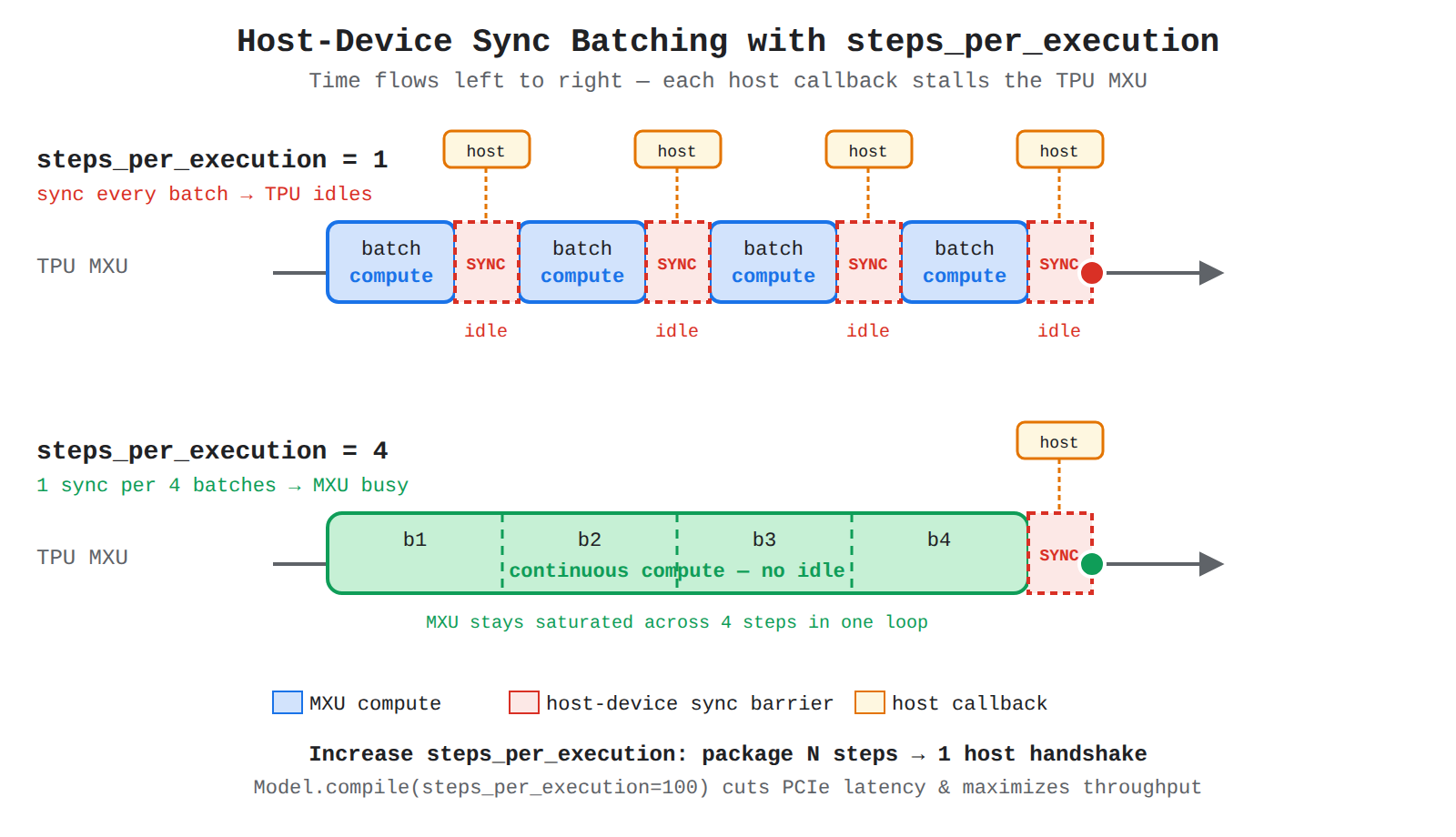
Key advantages and capabilities
- Reduced Latency Overhead: Minimizes Python and host CPU runtime communication overhead across PCIe/network interfaces.
- Higher Accelerator Utilization: Keeps Cloud TPU cores fully saturated with tensor operations.
- Flexible Chunking: Allows practitioners to balance logging frequency (e.g., metric updates and checkpointing) with raw computation throughput.
- Scalable Distributed Training: Optimizes multi-core execution profiles across TPU pods and GPU clusters.
Why this is optimal
Increasing steps_per_execution directly targets the root cause of the performance bottleneck: excessive communication between the TPU server host CPU and the TPU accelerator device. It maximizes training throughput with a simple configuration adjustment in the high-level framework without degrading model convergence or accuracy.
Convert the input dataset from binary TFRecord files into uncompressed CSV files
Convert the input dataset from binary TFRecord files into uncompressed CSV files
What this option does
This approach replaces optimized binary storage formats with plain-text comma-separated value (CSV) files for dataset ingestion.
Why it doesn't meet the requirement
- Input Bottlenecks: CSV parsing requires significant string decoding and CPU-bound text tokenization during ingestion. Switching from TFRecord to plain CSV increases host CPU workload and slows data delivery to the TPU.
- Exacerbates Accelerator Idling: If the input pipeline takes longer to parse data than the TPU takes to compute the backward pass, the TPU remains completely stalled waiting for the next data batch.
- Does Not Address Host Callbacks: Host-device step communication frequency is determined by framework execution parameters (
steps_per_execution), not the source file format on disk.
Key characteristics and limitations
- TFRecord format: Uses serialized
tf.train.Exampleprotocol buffers that stream sequentially and efficiently into memory. - CSV format: Lacks efficient binary serialization, resulting in larger file sizes, increased I/O bandwidth requirements, and high deserialization latency.
- TPU Ingestion Best Practice: Cloud TPU pipelines recommend binary formats like TFRecord paired with
tf.dataprefetching and interleaving.
This answer would be correct if
The goal was to simplify human readability of raw dataset samples during local development and exploratory debugging on lightweight CPU environments.
Set the per-core batch size to non-multiples of 8 to bypass hardware padding steps
Set the per-core batch size to non-multiples of 8 to bypass hardware padding steps
What this option does
This configuration attempts to use arbitrary, non-aligned batch sizes across TPU cores under the false assumption that avoiding TPU matrix dimensions avoids padding overhead.
Why it doesn't meet the requirement
- TPU Architecture Constraints: Cloud TPU Matrix Multiply Units (MXUs) operate natively on 128x128 or 8x128 systolic arrays of registers.
- Performance Penalty: If the per-core batch size is not a multiple of 8 (and total batch size a multiple of 64), the XLA compiler must inject additional tensor padding to align matrix dimensions. This inflates memory consumption and reduces computational throughput rather than improving it.
- Unresolved Host Latency: Altering the batch alignment does nothing to resolve the frequent step-level synchronization between the host CPU and the TPU device.
Key characteristics and limitations
- Cloud TPUs perform most efficiently when tensor dimensions and batch sizes are evenly divisible by 8 (per core) and 64 (globally).
- Tensor padding introduces wasted floating-point operations on dummy values.
- Misaligned batch sizes exacerbate memory pressure rather than alleviating host communication overhead.
This answer would be correct if
The scenario required demonstrating how to intentionally trigger tensor padding warnings and sub-optimal MXU utilization during XLA compilation.
Reduce the total global batch size below 64 to decrease memory allocation per step
Reduce the total global batch size below 64 to decrease memory allocation per step
What this option does
This approach reduces the global batch size below 64 to lower memory usage on accelerator memory registers.
Why it doesn't meet the requirement
- Counterproductive to Throughput: Smaller batch sizes provide fewer parallel computations for TPU systolic arrays, severely degrading MXU utilization.
- Host Communication Unchanged: Reducing batch size actually increases the total number of batches per epoch, causing even more frequent host callbacks unless
steps_per_executionis increased. - Resource Inefficiency: A total batch size under 64 fails to meet the recommended minimum allocation of 8 samples per TPU core on standard 8-core TPU accelerator topologies.
Key characteristics and limitations
- Reducing batch size is a valid mitigation for Out-Of-Memory (OOM) errors, not for host-to-device communication bottlenecks.
- High-throughput accelerator architectures like Cloud TPUs and NVIDIA GPUs require large batch sizes (e.g., 1024 or higher) to achieve high arithmetic intensity.
- Excessively small batch sizes leave execution units underutilized and increase overall epoch completion times.
This answer would be correct if
The primary problem was an out-of-memory error caused by intermediate activation storage during forward and backward passes.
Try 10 interactive questions like this one, free
Answer them yourself and get your score the moment you finish. No account needed.
Full access includes
- 2,335 practice questions across all 6 exam domains
- Every answer explained: why it is right, and why the others are not
- Scout, an AI tutor that answers your follow-up questions
- Readiness tracking by domain, so you know when to book the exam
Related questions
Keep the momentum going with these hand-picked practice scenarios
IntermediateProfessional Cloud Architect
Flex-start (Dynamic Workload Scheduler)
Using AI Hypercomputer (e.g., using AI Hypercomputer, Cloud Run functions, and Vertex AI for ML/AI workloads; integrating GPUs and TPUs in ML model training and serving; optimizing for different consumption models; and running large-scale AI model training
IntermediateProfessional Cloud Architect
Vertex AI CustomJob Flex Start Scheduling
Using AI Hypercomputer (e.g., using AI Hypercomputer, Cloud Run functions, and Vertex AI for ML/AI workloads; integrating GPUs and TPUs in ML model training and serving; optimizing for different consumption models; and running large-scale AI model training
IntermediateProfessional Cloud Architect
Cloud FinOps
Business use cases and product strategy
IntermediateProfessional Cloud Architect
Workload Validation Protocol
Using migration methodologies, workload testing, network planning, and dependency planning
IntermediateProfessional Cloud Architect
Cloud Run Serverless Containers
Design decision trade-offs
FundamentalGenerative AI Leader
VPC Service Controls Service Perimeters
Explaining security throughout the ML lifecycle
Last updated