Intermediate
Prepare and test your skills
Intermediate
Prepare and test your skills
Global External Load Balancing with Regional MIGs
Free sample question, answered and explained below. The Professional Cloud Architect practice bank has 2,335 more like it. Try 10 free: instant score, no account.
An enterprise is designing a multi-tier, mission-critical web application on Google Cloud that serves users globally over HTTPS. The architecture must satisfy the following reliability and traffic management requirements:
- Automatically route end-users to the geographically closest healthy backend instances to minimize latency.
- Automatically steer traffic away to another region if the primary region's backend instances become unhealthy or exceed capacity.
- Automatically detect application software crashes on backend virtual machines (VMs) and self-heal by recreating unhealthy instances without manual intervention.
- Provide zone-level resilience within each deployed region.
Which architecture should you deploy to meet these requirements?
Explanations
Deploy individual Regional External Application Load Balancers in each region with unmanaged instance groups, and configure a Cloud DNS failover routing policy to steer traffic between regions.
Deploy individual Regional External Application Load Balancers in each region with unmanaged instance groups, and configure a Cloud DNS failover routing policy to steer traffic between regions.
What This Architecture Is
This design uses independent Regional External Application Load Balancers deployed in separate regions, relying on Cloud DNS routing policies to detect regional outages and point client requests to the active regional IP endpoint.
Why It Fails the Requirements
- Lack of proximity-based traffic steering: A basic active-passive DNS failover setup routes all primary traffic to one region rather than dynamically routing global users to their nearest healthy region based on proximity and real-time backend capacity.
- DNS caching delays: Cross-region failover depends on DNS TTLs and client DNS resolver compliance. When a regional disruption occurs, clients caching stale DNS records will experience connection failures until TTLs expire.
- No automated self-healing: Unmanaged instance groups do not support automated instance lifecycle management, auto-scaling, or auto-healing health check policies. If an application process crashes, the VM must be diagnosed and repaired manually.
- Zonal resilience overhead: Unmanaged instance groups cannot automatically balance and maintain instance distribution across multiple zones.
Key Limitations
- Unmanaged instance groups lack automated recreation and scaling capabilities.
- Separate regional load balancers lack unified global capacity-based load distribution.
- DNS-based routing cannot respond instantaneously to sudden backend capacity exhaustion.
This Answer Would Be Correct If
The workload were subject to strict regulatory or jurisdictional compliance constraints requiring all network configurations, traffic processing, and TLS termination to be strictly confined within specific regional boundaries.
Deploy a Global External Application Load Balancer fronting regional Managed Instance Groups (MIGs) across multiple regions, configure load balancing HTTP health checks on the backend service, and attach an auto-healing health check policy to each regional MIG.
Deploy a Global External Application Load Balancer fronting regional Managed Instance Groups (MIGs) across multiple regions, configure load balancing HTTP health checks on the backend service, and attach an auto-healing health check policy to each regional MIG.
What Global External Application Load Balancers and Regional MIGs Provide
A Global External Application Load Balancer operates at Layer 7 using Google's global Anycast IP infrastructure to terminate connections close to users at edge Points of Presence (PoPs). When paired with regional Managed Instance Groups (MIGs), the architecture provides multi-region redundancy, automated traffic steering, and self-healing infrastructure.
How It Meets the Requirements
- Proximity-based routing and low latency: The Global External Application Load Balancer in Premium Tier automatically terminates user traffic at the closest edge PoP and routes incoming requests to the nearest backend MIG with available capacity.
- Automated cross-region failover: The load balancer uses backend service health checks to continuously monitor instance health. If all backend instances in the closest region become unhealthy or reach their capacity limits, the load balancer automatically shifts traffic to the next closest healthy region with capacity.
- Application self-healing: Applying an auto-healing policy with an application-level HTTP health check to each MIG allows Compute Engine to monitor application health and automatically recreate instances that fail consecutive health probes.
- Zonal resilience: Regional MIGs automatically distribute VM instances evenly across multiple zones within each region, protecting against single-zone infrastructure failures.
Global LB Multi-Region Failover with MIGs
System Architecture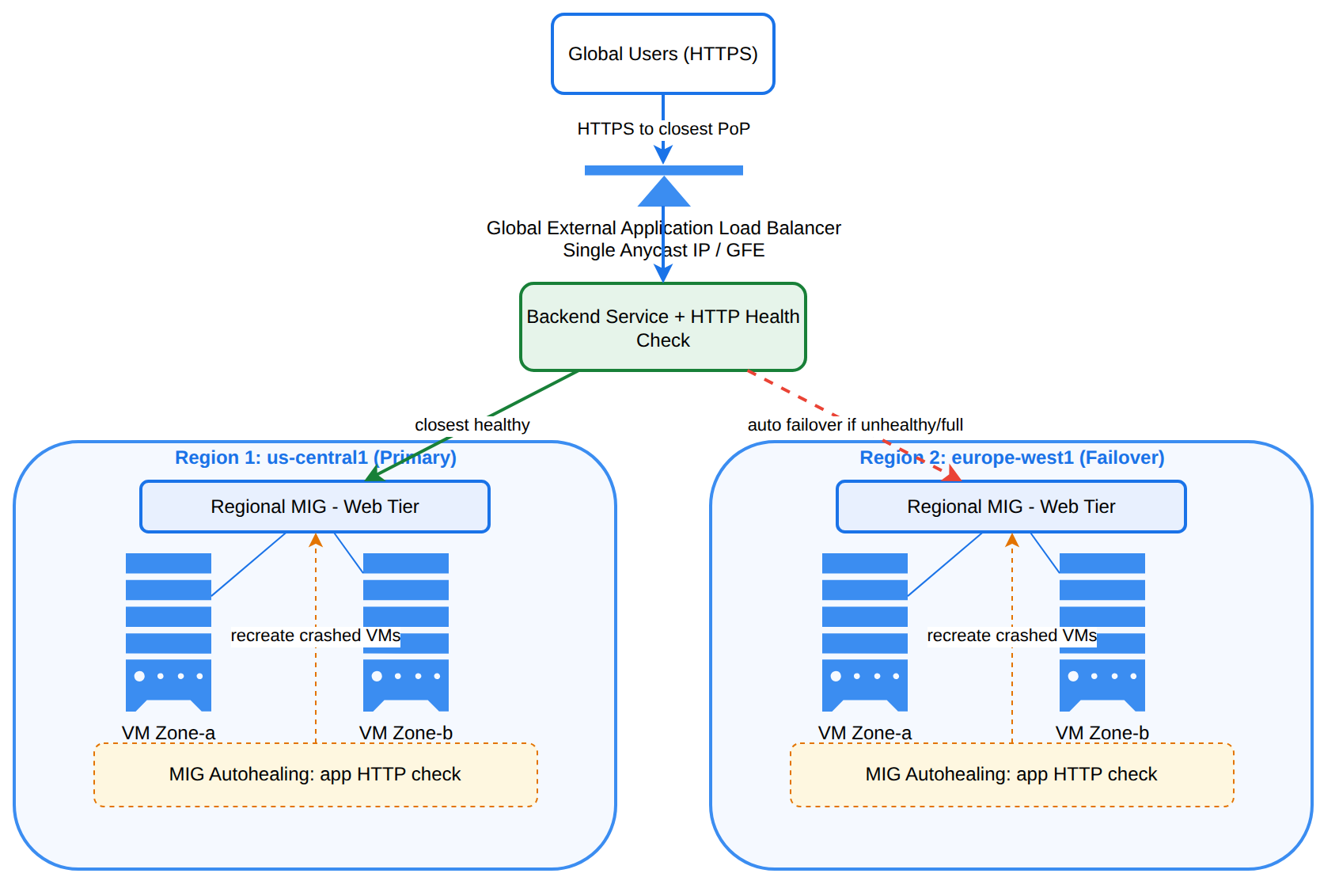
Key Advantages
- Seamless multi-region failover: Failover occurs transparently at the Google Front End (GFE) proxy level without relying on client-side DNS cache expiration.
- Separation of concerns: Enables independent health checking for traffic distribution (load balancer health check) and VM lifecycle management (MIG auto-healing health check).
- High availability in depth: Provides automated recovery across application, instance, zonal, and regional failure scenarios.
- Capacity-aware load balancing: Prevents backend overloading by shedding excess traffic to other available regions.
Why This Is Optimal
This architecture leverages fully managed Google Cloud native services to automate global routing, high availability, and self-healing infrastructure, meeting all recovery time and availability requirements with zero manual intervention.
Deploy a Cross-Region Internal Application Load Balancer with regional Managed Instance Groups, and configure global URL map weighted traffic splitting between regions.
Deploy a Cross-Region Internal Application Load Balancer with regional Managed Instance Groups, and configure global URL map weighted traffic splitting between regions.
What This Architecture Is
A Cross-Region Internal Application Load Balancer is a Layer 7 proxy load balancer designed for internal private traffic originating from within VPC networks, connected on-premises networks, or peered VPCs across multiple regions.
Why It Fails the Requirements
- Inaccessible to public internet users: The scenario specifies an application serving global users over the internet. Internal Application Load Balancers use private RFC 1918 IP addresses and cannot receive incoming traffic directly from public internet clients.
- Wrong traffic management tool: Weighted traffic splitting in URL maps is used for canary deployments, A/B testing, and progressive version migration by percentage. It is not an automated failover mechanism designed to dynamically redirect traffic based on real-time health checks or regional capacity depletion.
- Misaligned scope: Even though it uses global backend services and global URL maps, its frontend endpoints are strictly internal to Google Cloud.
Key Limitations
- Cannot attach public forwarding rules to accept external HTTPS requests.
- Static traffic split percentages do not automatically shift 100% of traffic away when backends become unhealthy.
- Intended for multi-tier microservice middleware architectures rather than public edge ingress.
This Answer Would Be Correct If
The workload was an internal middleware service or enterprise ERP system accessed exclusively by private VMs or internal client applications distributed across multiple Google Cloud regions.
Deploy an External Passthrough Network Load Balancer in each region with zonal Managed Instance Groups, and configure primary and failover backend pools with OS-level restart scripts.
Deploy an External Passthrough Network Load Balancer in each region with zonal Managed Instance Groups, and configure primary and failover backend pools with OS-level restart scripts.
What This Architecture Is
An External Passthrough Network Load Balancer is a regional Layer 4 load balancer built on Maglev and Andromeda that routes TCP/UDP traffic directly to backend VMs without proxying connections or terminating TLS. It supports primary and failover backend pools within a single region.
Why It Fails the Requirements
- Regional scope limitation: Passthrough Network Load Balancers are regional resources and cannot natively route global traffic or automatically steer traffic to backend VMs in other regions during a full regional outage.
- No global Anycast edge routing: Because it is a regional Layer 4 load balancer, it cannot terminate HTTPS traffic at global edge PoPs to optimize user latency.
- Zonal MIG limitations: Using zonal rather than regional Managed Instance Groups exposes the deployment to single-zone outages unless multiple zonal groups are manually configured and managed in every zone.
- Inefficient self-healing: Relying on custom in-guest OS scripts to restart application daemons is fragile and cannot self-heal underlying VM hardware failures, hypervisor crashes, or OS kernel panics like native MIG auto-healing does.
Key Limitations
- Does not provide Layer 7 HTTP(S) routing, URL mapping, or global traffic management.
- Failover policies on passthrough load balancers only transition traffic between pools located in the same region.
- In-guest recovery scripts lack orchestration with Compute Engine infrastructure APIs.
This Answer Would Be Correct If
The application required non-HTTP protocols (e.g., raw TCP, UDP, or GRE) with direct server return (DSR) and needed to preserve the client's original source IP address without proxy encapsulation.
Try 10 interactive questions like this one, free
Answer them yourself and get your score the moment you finish. No account needed.
Full access includes
- 2,335 practice questions across all 6 exam domains
- Every answer explained: why it is right, and why the others are not
- Scout, an AI tutor that answers your follow-up questions
- Readiness tracking by domain, so you know when to book the exam
Related questions
Keep the momentum going with these hand-picked practice scenarios
IntermediateProfessional Cloud Architect
Cloud SQL High Availability and Cross-Region Read Replica
High availability and fail-over design
IntermediateProfessional Cloud Architect
Cloud Spanner Germany Dual-Region Configuration
High availability and fail-over design
IntermediateProfessional Cloud Architect
Dynamic Workload Scheduler Flex-start
Choosing compute resources (e.g., spot VMs, custom machine types, and specialized workload)
IntermediateProfessional Cloud Architect
Vertex AI Pipelines Lineage Tracking
Using Vertex AI pipelines to automate and orchestrate the ML lifecycle
IntermediateProfessional Cloud Architect
Cold Standby with Managed Instance Group
Backup and recovery
AdvancedProfessional Cloud DevOps Engineer
Gemini Cloud Assist API and IAM Roles
Employing Gemini Cloud Assist for trace analysis
Last updated