Intermediate
Prepare and test your skills
Intermediate
Prepare and test your skills
How Cloud KMS Rotation Preserves Decryptable Data
Free sample question, answered and explained below. The Professional Cloud Architect practice bank has 2,335 more like it. Try 10 free: instant score, no account.
A financial enterprise uses Cloud Key Management Service (Cloud KMS) to manage customer-managed encryption keys (CMEK) that protect sensitive workloads across multiple Google Cloud storage services. The enterprise uses envelope encryption where Cloud KMS manages the Key Encryption Keys (KEKs) that wrap individual Data Encryption Keys (DEKs).
To comply with regulatory standards and minimize the impact of potential key compromise, the security team needs to implement an automated key rotation schedule for their KEKs. They also must ensure that all previously stored data remains accessible after key rotation occurs.
What happens when an automated rotation schedule rotates a Cloud KMS key, and what administrative action is required to ensure existing data remains readable?
Explanations
Cloud KMS generates a new Key Encryption Key (KEK) resource in the key ring and automatically deletes the previous KEK resource after a 30-day grace period.
Cloud KMS generates a new Key Encryption Key (KEK) resource in the key ring and automatically deletes the previous KEK resource after a 30-day grace period.
What This Option Describes
This option confuses creating a new key version within an existing Cloud KMS CryptoKey resource with creating an entirely new CryptoKey resource and scheduling deletion of the old resource.
Why It Doesn't Meet the Requirement
- Incorrect Object Hierarchy Level: Key rotation occurs within a single CryptoKey resource by adding new versions. It does not create new named KEK resources in the KeyRing.
- Permanent Data Loss Risk: Automatically deleting older KEK resources would lead to unrecoverable data loss for any DEKs or payloads that were not re-encrypted under the new resource.
Key Characteristics and Limitations of Cloud KMS Object Hierarchy
- The Cloud KMS hierarchy consists of KeyRing -> CryptoKey -> CryptoKeyVersion.
- Rotation operates at the CryptoKeyVersion level, preserving the CryptoKey resource path, IAM policies, and service associations.
This Answer Would Be Correct If
A security policy mandated provisioning entirely separate CryptoKey URIs and updating all resource CMEK configurations across Google Cloud manually.
Cloud KMS creates a new primary key version for future encryption operations while retaining older key versions in the enabled state to allow ongoing decryption without manual re-encryption.
Cloud KMS creates a new primary key version for future encryption operations while retaining older key versions in the enabled state to allow ongoing decryption without manual re-encryption.
What Cloud KMS Key Rotation and Versioning Is
In Cloud Key Management Service (Cloud KMS), keys are structured as multi-version resources. When managing Key Encryption Keys (KEKs) under an envelope encryption model, a key contains one or more key versions. One version is designated as the primary key version, which is automatically used for all new encryption operations.
How It Meets the Requirements
- Automated Key Rotation Schedules: When an automated rotation schedule triggers, Cloud KMS automatically generates a new key version and sets it as the primary version.
- Data Accessibility: Cloud KMS retains all prior key versions in the Enabled state unless administratively disabled or destroyed. This ensures that previously wrapped Data Encryption Keys (DEKs) or ciphertexts can still be decrypted transparently without requiring immediate manual re-encryption.
- Minimizing Key Compromise Impact: Limiting the lifespan of any single key version reduces the total volume of data protected by a single cryptographic key material.
KMS Rotation: New Primary, Old Stays Enabled
Timeline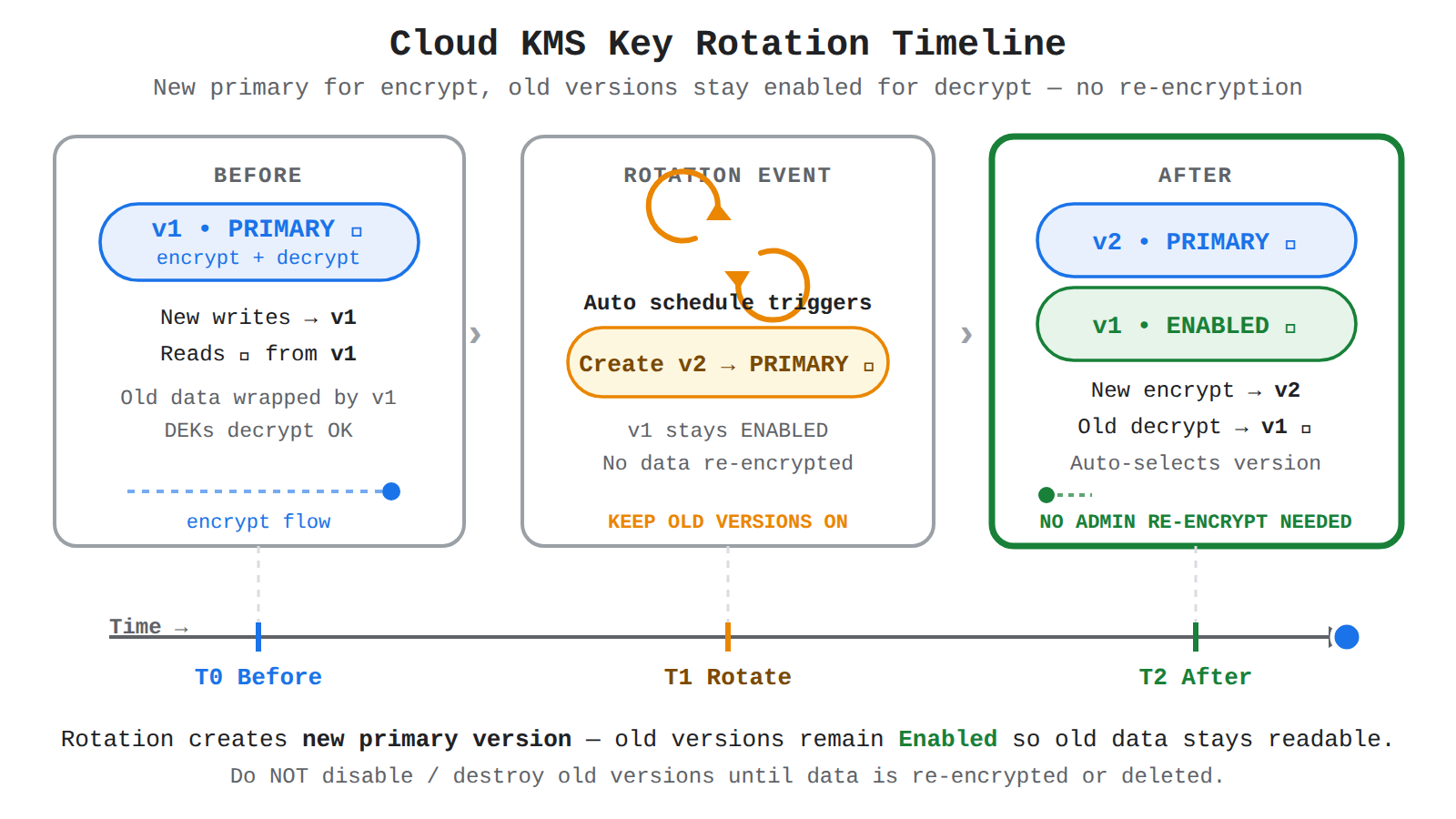
Key Advantages and Capabilities
- Seamless Decryption: The Cloud KMS decryption API automatically selects the correct historical key version associated with the ciphertext metadata.
- Granular State Control: Key versions can transition between
Enabled,Disabled,Scheduled for destruction, andDestroyedstates. - Envelope Encryption Efficiency: Cloud KMS KEKs wrap DEKs locally generated by workloads, ensuring centralized governance and rotation without transferring actual payload data.
Why This Is Optimal
This architecture guarantees business continuity and zero downtime for read operations while enforcing strict cryptographic hygiene and compliance through automated versioning.
Cloud KMS generates a new key version and automatically transitions all historical key versions to the Disabled state, requiring administrators to re-enable old versions during read requests.
Cloud KMS generates a new key version and automatically transitions all historical key versions to the Disabled state, requiring administrators to re-enable old versions during read requests.
What This Option Describes
This option incorrectly asserts that rotating a key automatically sets historical key versions to the Disabled state upon creation of a new primary version.
Why It Doesn't Meet the Requirement
- Disruption of Read Access: If Cloud KMS automatically disabled older key versions during rotation, applications attempting to decrypt data or unwrap DEKs encrypted under earlier versions would immediately fail with permission or invalid state errors.
- Manual Overhead: Cloud KMS is designed to keep older versions in the Enabled state precisely to prevent manual administrative intervention whenever older data needs to be retrieved.
Key Characteristics and Limitations of Cloud KMS States
- Transitioning a key version to Disabled prevents both encryption and decryption operations using that specific version.
- Disabling a key version is a manual administrative action or incident-response procedure, not an automated side-effect of rotation.
This Answer Would Be Correct If
The organization had an explicit security incident response requiring the quarantine of prior key versions to block all read operations immediately.
Cloud KMS overwrites the existing key material with new cryptographic material, requiring an immediate batch re-encryption of all historical Data Encryption Keys (DEKs).
Cloud KMS overwrites the existing key material with new cryptographic material, requiring an immediate batch re-encryption of all historical Data Encryption Keys (DEKs).
What This Option Describes
This option describes an in-place destructive key overwrite model, which is fundamentally contrary to how versioned cryptographic key management systems operate.
Why It Doesn't Meet the Requirement
- Destruction of Key Material: In Cloud KMS, rotating a key does not overwrite existing key material. Overwriting the key material would instantly render all previously encrypted ciphertexts and wrapped Data Encryption Keys (DEKs) permanently unreadable.
- Unnecessary Re-encryption Overhead: Automated key rotation in Cloud KMS does not force an immediate batch re-encryption because prior key versions remain accessible for decryption operations.
Key Characteristics and Limitations of Cloud KMS
- Cloud KMS keys maintain an immutable sequence of key versions.
- Each key version preserves its own distinct cryptographic material until explicitly destroyed by an administrator following a scheduled destruction period.
This Answer Would Be Correct If
A system used single-state, unversioned static symmetric keys where key update procedures required immediate in-place replacement and data re-wrapping.
Try 10 interactive questions like this one, free
Answer them yourself and get your score the moment you finish. No account needed.
Full access includes
- 2,335 practice questions across all 6 exam domains
- Every answer explained: why it is right, and why the others are not
- Scout, an AI tutor that answers your follow-up questions
- Readiness tracking by domain, so you know when to book the exam
Related questions
Keep the momentum going with these hand-picked practice scenarios
IntermediateProfessional Cloud Architect
Cloud KMS Admin vs CryptoKey Encrypter/Decrypter
Managing customer-managed encryption keys with Cloud Key Management Service (Cloud KMS)
IntermediateProfessional Cloud Architect
Blameless Post-Mortem
Troubleshooting/root cause analysis best practices
IntermediateProfessional Cloud Architect
Global External Load Balancer with Regional MIGs Auto-Healing
High availability and fail-over design
IntermediateProfessional Cloud Architect
Sensitive Data Protection, Resource Location Policies, VPC Service Controls
Legislation and regulation (e.g., health record privacy, children's privacy, data privacy, ownership, and data sovereignty)
IntermediateProfessional Cloud Architect
MIG Auto-healing and Simulate Maintenance Event
Testing and validation of software and infrastructure
AdvancedProfessional Data Engineer
Dataproc Autoscaling Policy Configuration
Minimizing costs per required business need for data
Last updated