Fundamental
Prepare and test your skills
Fundamental
Prepare and test your skills
Purpose and Benefits of Secure AI Framework
The six core pillars of the Secure AI Framework (SAIF) are six security principles that extend traditional security practices to AI ecosystems including generative AI. The pillars harmonize controls across organizational boundaries so teams protect AI models, data, and workflows while supporting business objectives.
The Six Pillars of SAIF
The six pillars of SAIF are peer areas of guidance that cover foundations, detection, automation, coordination, adaptation, and business context. Each pillar addresses a different part of securing AI:
- Expand strong security foundations to the AI ecosystem. Apply existing practices such as identity (opens in a new tab), access, and data protection to AI systems and their data.
- Extend detection and response to bring AI into an organization's threat universe. Monitor AI systems for threats and include them in incident detection and response.
- Automate defenses to keep pace with existing and new threats. Use automation to respond quickly as threats evolve.
- Harmonize controls to maximize security and accelerate AI adoption. Align security controls across teams and boundaries so AI can be adopted without conflicting rules.
- Adapt controls to adjust mitigations and create faster feedback loops for AI deployment. Update controls as AI systems change and use feedback to improve security.
- Contextualize AI system risks in surrounding business processes. Understand AI risks in the context of the business processes they support and align security with business objectives.
How the Six Pillars Work Together
How the pillars work together is a layered relationship where foundations support detection and automation, coordination keeps adoption consistent, and business context guides decisions. The first pillar establishes security foundations for AI, while the second and third pillars add detection, response, and automation on top of those foundations. The fourth and fifth pillars harmonize controls across organizational boundaries and adapt those controls over time as AI systems change. The sixth pillar ties AI risk to business processes, so security decisions protect AI systems from malicious attacks and misuse while enabling safe adoption.
AI-specific risk mitigation and threat response is the practice of protecting generative AI systems from attacks and misuse that do not exist in traditional software. The Secure AI Framework (SAIF) provides the strategy for this work by extending core security practices to AI data, models, and prompts and by aligning those protections with business objectives.
Unique AI Vulnerabilities in Generative Systems
Unique AI vulnerabilities in generative systems are weaknesses that come from how a model learns from data and follows instructions in prompts. Prompt injection happens when a malicious instruction hidden in input tries to make the model ignore its rules. Data poisoning happens when bad data in training or retrieval corrupts what the model learns. Harmful generation happens when the model produces dangerous, harassing, hateful, or sexually explicit content in response to a user. SAIF treats these as system-level risks, so mitigation must cover the prompt going in, the model doing the work, and the generated content going out.
Automated Defenses With Safety Settings
Automated defenses with safety settings (opens in a new tab) are controls in Vertex AI that evaluate every generation and block unsafe output without human review. Data flows from the application to the model, in this case the Gemini model gemini-2.5-flash, as a package containing the user prompt, an optional system instruction, and a list of safety settings. The model returns candidates that contain generated text plus safety ratings, and each rating reports its category, whether it was blocked, and its probability and severity scores. When a rating meets or exceeds its configured threshold, generation is blocked before it reaches the user.
Vertex AI Safety Filter Sequence
Sequence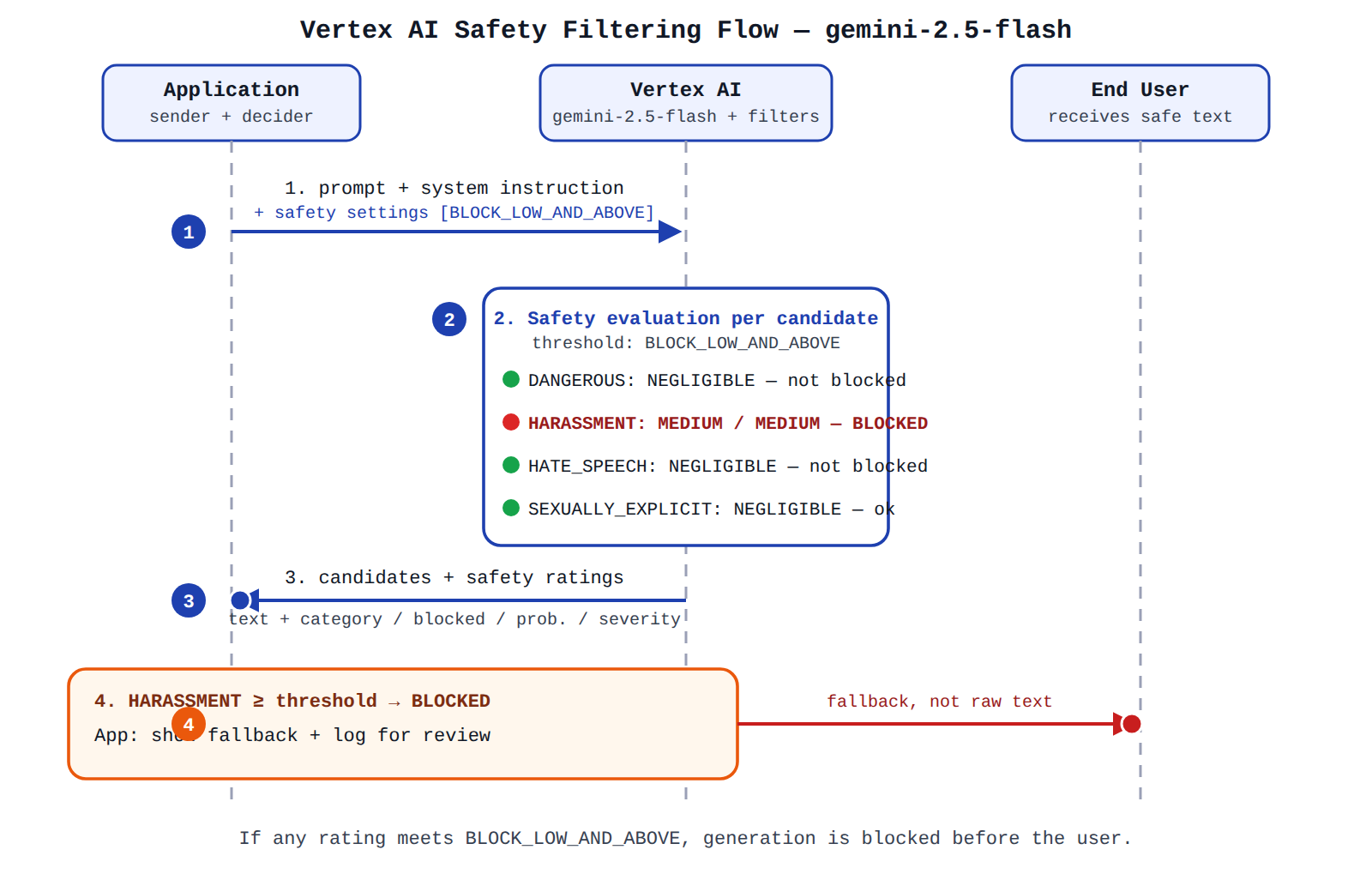
A sequence diagram showing an app sending prompt plus safety settings to gemini-2.5-flash, the model returning candidates with four safety ratings, and the app blocking on harassment and showing a fallback.
The example configuration applies the threshold BLOCK_LOW_AND_ABOVE to four peer harm categories:
HARM_CATEGORY_DANGEROUS_CONTENTfor instructions or content that enable harmHARM_CATEGORY_HARASSMENTfor demeaning or harassing languageHARM_CATEGORY_HATE_SPEECHfor attacks based on protected characteristicsHARM_CATEGORY_SEXUALLY_EXPLICITfor explicit sexual content
In the example result, harassment was blocked with MEDIUM probability and MEDIUM severity, while the other three categories were not blocked with NEGLIGIBLE probability and NEGLIGIBLE severity. The application depends on these ratings to decide whether to show the text, show a fallback message, or log the event for review.
Exam tip: BLOCK_LOW_AND_ABOVE is a sensitive threshold that blocks content even when the model estimates a low probability of harm.
Adaptive Controls for a Proactive Posture
Adaptive controls for a proactive posture are safety rules and monitoring that change as threats, data, and business use change. SAIF maintains a proactive posture by using automation to apply the same checks on every request, collecting probability and severity signals over time, and tightening thresholds or system instructions where abuse appears. The control plane for this loop sits between users and the model: prompts and system instructions flow inward from users to the model, ratings and blocked decisions flow outward from the model to the application, and policy owners adjust the settings based on what the ratings show. This cycle lets an organization keep AI features available for legitimate use while reducing the impact of prompt injection, poisoned data, and harmful generation.
Business benefits and organizational impact of the Secure AI Framework (SAIF) come from treating AI security as a business strategy, not only as a technical task. SAIF helps leaders protect generative AI systems from attacks and misuse while keeping AI projects aligned with business goals like growth, efficiency, and customer trust.
Aligning AI Security With Business Objectives
Aligning AI security with business objectives means security decisions support what the organization is trying to achieve. Secure AI Framework (SAIF) connects security protocols to business priorities, so teams can weigh speed, cost, and innovation against risk in a consistent way. For example, a product team launching a customer chatbot and a finance team using AI for forecasting both follow the same secure foundation, even though their goals differ. This shared approach avoids one-off security fixes and helps leaders decide which AI uses are safe to scale.
Contextualizing AI Risk Within Business Processes
Contextualizing AI risk within business processes means understanding AI threats in terms of daily workflows, not only in terms of models and data. Secure AI Framework (SAIF) helps organizations see where AI touches sensitive data, important decisions, and customer interactions across the workflow. When risk is placed in that business context, leaders can prioritize protections where harm would be greatest, such as fraud, data leakage, or incorrect outputs affecting customers. The result is clearer ownership, better planning, and security spending focused on real business impact:
- Stronger protection for high-value processes that use generative AI.
- Faster and safer rollout of new AI features and use cases.
- Fewer disruptions, rework, and compliance problems from insecure AI.
- Better coordination between security, product, and business teams.
Building Trust Through Secure-by-Design AI
Building trust through secure-by-design AI means security and responsibility are built into AI systems from the start, rather than added later. Secure AI Framework (SAIF) encourages transparent practices, such as clear controls, consistent review, and attention to safety throughout the AI lifecycle. When customers, partners, and regulators can see that AI was developed with protection in mind, trust in the system increases. That trust becomes an organizational asset because it supports adoption, protects brand reputation, and helps the business grow its use of generative AI responsibly.
Key Facts
- The Secure AI Framework (SAIF) uses six pillars that expand security foundations to AI, extend detection and response, automate defenses, harmonize controls, adapt controls, and contextualize AI risk in business processes.
- Prompt injection uses hidden instructions to make a model ignore its rules, data poisoning corrupts what a model learns through bad training or retrieval data, and harmful generation produces dangerous, harassing, hateful, or sexually explicit content.
- Vertex AI safety settings evaluate every Gemini generation and block output before it reaches the user when a safety rating meets or exceeds thresholds such as BLOCK_LOW_AND_ABOVE.
- Secure AI Framework (SAIF) creates business value by aligning AI security with business objectives, prioritizing protections where business harm would be greatest, and building customer trust through secure-by-design AI development.
Frequently Asked Questions
What are the six pillars of Google's Secure AI Framework (SAIF)?
The six pillars of the Secure AI Framework (SAIF) are expanding strong security foundations to the AI ecosystem, extending detection and response to bring AI into an organization's threat universe, automating defenses to keep pace with threats, harmonizing controls to maximize security and accelerate adoption, adapting controls to adjust mitigations and create faster feedback loops, and contextualizing AI system risks in surrounding business processes. Foundations support detection and automation, while harmonizing and adapting controls keeps adoption consistent over time and business context guides decisions. Together the pillars protect AI models, data, and workflows while supporting business objectives.
What is the difference between prompt injection, data poisoning, and harmful generation in generative AI systems?
Prompt injection uses hidden instructions in input to make a model ignore its rules, data poisoning corrupts what a model learns through bad training or retrieval data, and harmful generation produces dangerous, harassing, hateful, or sexually explicit content. The Secure AI Framework (SAIF) treats these as system-level risks, so mitigation must cover the prompt going in, the model doing the work, and the generated content going out.
How do safety settings in Vertex AI block unsafe Gemini output?
Automated defenses with safety settings in Vertex AI evaluate every generation from the Gemini model gemini-2.5-flash and block unsafe output before it reaches the user when a safety rating meets or exceeds its configured threshold. The example configuration applies the sensitive threshold BLOCK_LOW_AND_ABOVE to HARM_CATEGORY_DANGEROUS_CONTENT, HARM_CATEGORY_HARASSMENT, HARM_CATEGORY_HATE_SPEECH, and HARM_CATEGORY_SEXUALLY_EXPLICIT, where harassment was blocked with MEDIUM probability and MEDIUM severity while the other three categories were not blocked with NEGLIGIBLE probability and severity. The application uses these ratings with probability and severity scores to decide whether to show the text, show a fallback message, or log the event for review.
How does Google's Secure AI Framework (SAIF) help align AI security with business objectives?
The Secure AI Framework (SAIF) creates business value by aligning AI security with business objectives so teams can weigh speed, cost, and innovation against risk in a consistent way. It helps organizations contextualize AI risk within business processes to prioritize protections where harm would be greatest, such as fraud, data leakage, or incorrect outputs affecting customers, which supports faster and safer rollout with fewer disruptions. Building security in from the start through secure-by-design practices increases trust among customers, partners, and regulators, which supports adoption and protects brand reputation.
Sample Question
An enterprise is developing a generative AI solution and adopts Google's Secure AI Framework (SAIF) to protect its machine learning infrastructure, model weights, and pipeline data.
The security architecture team wants to ensure that standard, proven security protections—such as granular Identity and Access Management (IAM), data encryption at rest and in transit, and secure network perimeters—are systematically applied across the entire AI deployment lifecycle.
Which core pillar of Google's Secure AI Framework (SAIF) directly addresses this requirement?
How learners score on this domain
Last updated