Fundamental
Prepare and test your skills
Fundamental
Prepare and test your skills
Enterprise GenAI Applications and Business Value
Managed application services are generative AI (opens in a new tab) applications at the top of the enterprise technology stack that face end users directly. Employees and customers interact with these services in natural language instead of building models or writing code. Their business value comes from grounding answers in enterprise data, so stakeholders receive data-driven insights that improve support, search, and workflow automation. This grounding is what turns a general model into a trusted business tool.
Conversational Applications That Face End Users
Conversational applications are managed services that provide virtual assistants and search experiences through natural dialogue. A customer types a question in plain language, and the conversational application returns a helpful answer drawn from business knowledge. This approach changes workflows because support, sales, and self-service no longer depend on keyword search or manual lookup.
Common application-layer uses include:
- Building virtual assistants for customer support and online sales interactions
- Enabling conversational search through large knowledge bases with natural language queries
- Finding answers to complex questions that combine textual inquiries with related images
Because these conversational applications sit between users and enterprise knowledge, they improve response speed, expand access to information, and raise satisfaction without requiring users to understand the underlying models.
Grounded Document and Data Understanding
Grounded document and data understanding means the application analyzes enterprise documents and data before it answers, so insights reflect real business content. The application reads reports, transactions, feedback, and threat data, then summarizes findings, flags risks, or explains causes for stakeholders. Grounding keeps responses tied to source material, which supports more informed and data-driven decisions.
Typical grounded tasks include:
- Extracting data from reports, invoices, receipts, financial transactions, or contracts to highlight errors, compliance issues, risks, or anomalies that indicate fraud
- Analyzing sentiment in user-generated content such as social media posts and product reviews
- Analyzing transcribed call center conversations to extract insights such as the most common reasons customers give low ratings
- Analyzing cybersecurity data such as threat reports and repositories to extract threat indicators, translate complex attack graphs into plain-text explanations, simulate attack paths, and recommend mitigations
For business leaders, grounded understanding turns scattered documents into usable insight for efficiency, risk reduction, and customer experience improvement.
How Grounding Works in a Customer-Support Application
Retrieval-augmented generation (RAG) is the method managed support applications use to ground answers in a knowledge base. In the Google Cloud example, containerized services run in a Google Kubernetes Engine (GKE) (opens in a new tab) cluster, the support knowledge base lives in Cloud Storage, and the Gemini API performs retrieval and generation. Data flows from the customer to the retriever, then to the generator, and back to the customer, with Cloud Storage as the source of truth on every request. Generation happens only after retrieval, so the final answer depends on enterprise sources rather than on the model alone.
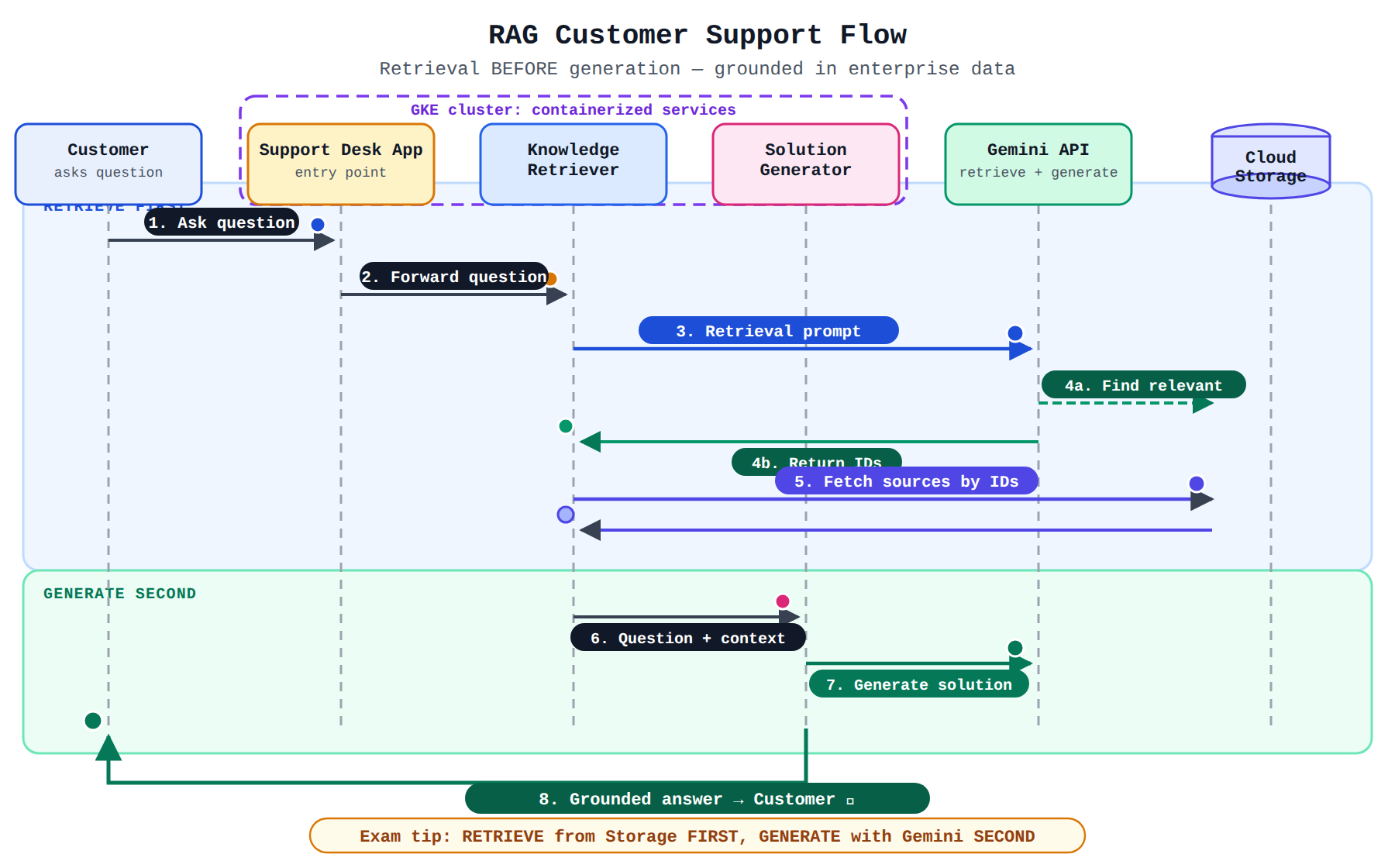
A sequence diagram with six lifelines — Customer, Support Desk App, Knowledge Retriever, Solution Generator, Gemini API, and Cloud Storage — showing ordered steps where retrieval from Cloud Storage happens before generation by Gemini to deliver a grounded answer.
The ordered flow is:
- Customer submits question: The customer submits a question to the support desk application.
- Application forwards question: The support desk application passes the question to the knowledge retriever service.
- Retriever requests relevant resources: The knowledge retriever service sends a prompt to the Gemini API, and Gemini identifies relevant resources from the support knowledge base stored in Cloud Storage and returns their IDs.
- Retriever fetches sources: The knowledge retriever service retrieves the relevant resources from Cloud Storage using those IDs.
- Retriever hands off context: The knowledge retriever service sends the customer question plus the retrieved resources to the solution generator service.
- Generator requests solution: The solution generator service sends the resources to the Gemini API with a prompt to generate a detailed solution.
- Customer receives grounded answer: Gemini generates a solution such as step-by-step instructions, and the solution generator service delivers it to the customer through the support desk application.
Exam tip: A grounded support answer is retrieved first from Cloud Storage and generated second by Gemini — retrieval before generation is what makes the insight data-driven.
Business Value and Stakeholder Roles
Business value from managed application services is measured by outcomes such as efficiency, cost, and experience, not by model details alone. Leaders define a measurable business use case (opens in a new tab) first, then work backward to the application that supports faster resolution, better self-service, or higher retention. Success is tracked through direct financial gains such as increased revenue or reduced costs, operational efficiency such as faster time-to-market or quicker issue resolution, and customer experience such as higher satisfaction scores or improved retention.
Different stakeholders shape that value in different ways:
- Business leaders and decision-makers approve the selection when it aligns with business priorities and constraints such as security and regulatory requirements
- Product owners influence or control model behavior to align it with product priorities
- Domain experts apply domain expertise to improve effectiveness of answers and insights
- End users use the output of the application to make more informed decisions in their daily work
When business goals, user expectations, and grounded application capabilities connect, adoption rises and the application delivers relevant, efficient, and innovative results.
Integration of generative AI into enterprise workflows means embedding AI capabilities directly into the tools employees and customers already use. Instead of standing alone, a generative AI application (opens in a new tab) sits in the enterprise technology stack between user interfaces, company data, and existing Software-as-a-Service (SaaS) platforms or custom internal tools. This placement modernizes the user experience by letting people create content, find answers, and automate repetitive steps with natural language inside familiar workflows.
What Generative AI Applications Do for End Users
Generative AI applications are end-user tools that create new content and uncover relationships in existing information to drive productivity. A generative AI model learns patterns from training data and then generates summaries, text, images, video, or code, while also using associative reasoning to find hidden insights across documents and data. Traditional AI (opens in a new tab) models focus instead on learning from historical data to classify information or predict future outcomes.
Generative AI solutions excel at workflow-level tasks that can be embedded into SaaS platforms and internal portals:
- Creating and recommending content, including marketing copy, translations, summaries, captions, images, video, and synthetic voice
- Powering conversational search and chatbots, including virtual assistants for support and sales and search over large knowledge bases
- Scaling and automating repetitive workflow tasks to reduce manual effort and operational complexity
- Using associative reasoning to find insights and relationships within documents, feedback, transactions, and threat data
- Generating code and assisting developers by writing code, functions, commands, Terraform scripts, tests, and documentation from natural language prompts
Choosing Generative AI, Traditional AI, or Both
The choice between generative AI and traditional AI depends on the output the business needs and the data available for the workflow. Traditional AI is particularly effective with structured data such as tabular data and images, while generative AI handles summarization, content generation, advanced transcription, and inputs that combine text, images, video, or audio. The two approaches are not mutually exclusive, because output from a traditional AI model can become prompt input for a generative AI model.
| Option | Primary strength | Use when the workflow needs |
|---|---|---|
| Traditional AI | Classify or predict from historical patterns | Spam filtering, defect detection, price or revenue prediction, sales forecasting, and customer segmentation |
| Generative AI | Create summaries and new content | Marketing content, chatbots, document understanding, sentiment analysis, and developer assistance |
For example, traditional predictive AI forecasts customer churn probability from historical data, then a large language model (LLM)-powered chatbot lets the sales team explore that prediction in natural language and generate business intelligence (BI) dashboards by conversation. In another flow, traditional AI identifies customer segments, then generative AI generates personalized marketing content tailored to each segment.
Exam tip: Use traditional AI to predict or classify from structured historical data, use generative AI to summarize or create new content, and combine them when a prediction needs to be explained or personalized in natural language.
Defining Business Value Before Changing Workflows
A business-value approach connects the AI technology choice to measurable goals, executive priorities, and user expectations before existing processes change. The team starts from desired outcomes such as increased employee efficiency or enhanced customer satisfaction, then works backward to ensure the business use case (opens in a new tab) directly supports those goals. Success is measured through return on investment (ROI) signals like direct financial gains, operational efficiency, and customer experience, while respecting constraints like security, privacy, and regulatory compliance.
Defining the use case follows an ordered decision process:
- Business goal and success criteria: Name the measurable goal, how ROI will be measured, and any compliance constraints.
- Type of AI: Decide whether the goal requires generative AI, traditional AI, both, or no AI.
- User experience expectation: Identify the end users and how they will interact with the AI-powered application or service.
- Business-driven and user-centric solution: Link the technology choice to efficiency, enhanced customer or product experience, and differentiated innovation.
- Business process change: Identify what must change in existing processes or workflows for people to adopt the new capability.
This process depends on input from both technical and business owners. Data scientists and machine learning (ML) engineers commonly lead model selection, while business leaders approve alignment to priorities, product owners shape model behavior, domain experts improve effectiveness, and end users clarify how outputs will support decisions.
Personalized Marketing Example From Data to Served Content
The personalized marketing application shows how generative AI embeds into an existing web portal workflow to serve user-specific content. User data flows from internal and external sources into BigQuery (opens in a new tab), an enterprise data warehouse for managing and analyzing data, where a Dataflow pipeline processes the data at scale to derive marketing insights such as demographic profiles, interests, and purchasing patterns. Eventarc then routes an event to trigger a Cloud Run service, and that service sends the insights with a prompt to Gemini Enterprise Agent Platform, a platform for building and governing enterprise-grade AI agents. The Gemini model generates per-user audio, video, and text assets, the Cloud Run service uploads the generated content to a content-server bucket in Cloud Storage, and the company web portal hosted on Cloud Run retrieves that user-specific content from Cloud Storage and displays it on visited pages. Quality improves when the business adds a feedback loop so the model learns from campaign impact and a human review step before upload to verify safety and brand standards.
Customer Support Example Using Retrieval-Augmented Generation
The customer-support application shows how retrieval-augmented generation (RAG) embeds generative AI into an existing support-desk workflow to answer questions with company knowledge. The containerized services run in a Google Kubernetes Engine (GKE) (opens in a new tab) cluster, which deploys and operates containerized applications at scale, and depend on a support knowledge base stored in Cloud Storage and the Gemini API for generation. Data flows from the customer through a knowledge retriever service to a solution generator service before returning as a detailed answer. Because retrieval happens first and generation happens only after relevant resources are supplied, the workflow reduces manual lookup work for agents and gives customers faster, context-aware solutions inside the same support portal.
The sequence is:
- Customer submits question: The customer submits a question to the support desk application.
- Question routed: The support desk application passes the question to the knowledge retriever service.
- Retrieval prompt sent: The knowledge retriever service constructs and sends a prompt to the Gemini API to find relevant resources.
- Resources identified: Gemini identifies relevant resources from the Cloud Storage knowledge base.
- IDs returned: Gemini returns the IDs of the relevant resources to the knowledge retriever service.
- Resources fetched: The knowledge retriever service retrieves the relevant resources from Cloud Storage.
- Context forwarded: The knowledge retriever service sends the question plus relevant resources to the solution generator service.
- Generation prompt sent: The solution generator service sends the resources to the Gemini API with a prompt to generate a detailed solution.
- Solution generated: Gemini generates a solution such as step-by-step instructions or a video walkthrough.
- Solution delivered: The solution generator service provides the solution to the customer through the support desk application.
Horizontal AI applications are generative AI solutions built for general business functions that many industries share, while vertical AI applications are tailored to a specific sector or domain. The main difference is scope: horizontal tools solve common problems such as content creation, customer support, document understanding, and code generation, while vertical tools solve problems that depend on industry-specific data, workflows, rules, and user expectations. Both types can use generative AI (opens in a new tab), traditional AI, or a combination, because horizontal versus vertical is about business scope, not the underlying AI technique.
Horizontal AI Applications
Horizontal AI applications are tools that target general business functions that appear across many industries. They include creating and recommending content, powering conversational search and chatbots, scaling repetitive workflows, finding insights across documents and data, and generating code or developer documentation. These capabilities can be customized to different industries, which makes these generative AI applications (opens in a new tab) reusable across teams and sectors. Their strategic advantage is broad efficiency: they can increase productivity, reduce operational complexity, and speed time-to-market. A customer-support application that uses retrieval-augmented generation (RAG) is a horizontal example: a customer question flows to a knowledge retriever, relevant resources are retrieved from Cloud Storage, and a solution generator uses Gemini API to produce a step-by-step answer or video walkthrough.
Vertical AI Applications
Vertical AI applications are solutions tailored to a specific sector, such as media and marketing, manufacturing, cybersecurity, or ecommerce. They depend on industry-specific data, workflows, compliance rules, and user expectations. For example, a personalized marketing application for the media and marketing industries ingests user data into BigQuery (opens in a new tab), processes it with Dataflow to derive demographic and purchasing insights, triggers a Cloud Run service through Eventarc, and sends those insights to Gemini Enterprise Agent Platform to generate audio, video, and text assets. The generated content is stored in a Cloud Storage content-server bucket and then served to users through a web portal on Cloud Run. Vertical applications can add human review before content is published to verify safety guidelines and brand standards. Their strategic advantage is deeper fit: they can align with domain expertise, industry compliance, and specialized workflows that general tools may not handle well.
Strategic Advantages and Tradeoffs
Strategic advantages and tradeoffs show when to favor broad reuse versus deep industry fit. Horizontal applications prioritize efficiency across teams, while vertical applications prioritize alignment with domain rules and user expectations. The comparison depends on scope, examples, advantage, and implementation needs.
| Dimension | Horizontal AI applications | Vertical AI applications |
|---|---|---|
| Scope | General business functions used across many industries | Specific sector or domain |
| Examples | Content creation, conversational search and chatbots, document and data understanding, code generation, customer support | Personalized marketing for media and marketing, manufacturing defect detection, cybersecurity threat analysis, ecommerce revenue prediction |
| Strategic advantage | Broad reuse, faster go-to-market, efficiency, reduced operational complexity, potential cost savings | Deeper domain fit, industry compliance, specialized workflows, alignment with domain experts and user expectations |
| Key considerations | May need prompt engineering or tuning for specialized tasks | Requires industry data, domain experts, process changes, and sometimes human review |
The two approaches are not mutually exclusive. A horizontal capability can be customized into a vertical application, and generative AI can be combined with traditional AI. For example, traditional predictive AI can forecast customer churn, and a generative AI chatbot can let a sales team explore those predictions in natural language.
Choosing Between Horizontal and Vertical AI
Choosing between horizontal and vertical AI means working backward from the desired business outcome to the right scope and technology. The team first names measurable goals and constraints, then selects the AI type, user experience, and workflow changes needed for adoption. Key stakeholders include business leaders, product owners, domain experts, and end users, and the decision must respect security, privacy, and regulatory requirements.
The decision process for the business use case (opens in a new tab) is:
- Business goal and success criteria: Identify measurable goals such as efficiency, cost reduction, customer experience, or competitive advantage, and define how return on investment (ROI) will be measured.
- Type of AI/ML: Decide whether the problem needs generative AI, traditional AI, or no AI.
- User experience expectation: Identify the end users and how they will interact with the application, such as through chatbots, search, or generated content.
- Business-driven and user-centric AI solution: Connect the technology to business requirements, executive priorities, and user expectations.
- Business process change: Identify the workflow changes needed to adopt the AI application, such as the retriever-generator flow running in a Google Kubernetes Engine (GKE) (opens in a new tab) cluster.
Exam tip: Horizontal AI applications solve general functions across industries, while vertical AI applications are tailored to a specific sector; the same generative AI capability can be customized from a horizontal building block into a vertical solution.
Key Facts
- Managed application services ground generative AI answers in enterprise data so stakeholders receive data-driven insights for support, search, and workflow automation.
- Retrieval-augmented generation (RAG) performs retrieval from Cloud Storage before generation by the Gemini API, so the final support answer depends on enterprise sources.
- Traditional AI classifies or predicts from structured historical data, while generative AI summarizes information and creates new content such as text, images, video, and code.
- Horizontal AI applications serve general business functions across industries, while vertical AI applications are tailored to a specific sector with its own data, workflows, and compliance rules.
Frequently Asked Questions
What is the difference between horizontal AI applications and vertical AI applications?
Horizontal AI applications serve general business functions shared across many industries such as content creation, conversational search, document understanding, code generation and customer support, while vertical AI applications are tailored to a specific sector such as media and marketing, manufacturing, cybersecurity or ecommerce with its own data, workflows and compliance rules. Horizontal applications prioritize broad reuse, efficiency and faster go-to-market, while vertical applications prioritize deeper domain fit and alignment with specialized workflows.
When should I use traditional AI instead of generative AI in an enterprise workflow?
Use traditional AI when the workflow needs to classify or predict from structured historical data such as spam filtering, defect detection, price or revenue prediction, sales forecasting and customer segmentation, and use generative AI when the workflow needs to create summaries and new content such as marketing content, chatbots, document understanding, sentiment analysis and developer assistance. The two can be combined when a prediction needs to be explained or personalized in natural language, such as forecasting churn with traditional AI and exploring it with a large language model (LLM)-powered chatbot.
How does retrieval-augmented generation (RAG) ground answers in a customer-support application?
Retrieval-augmented generation (RAG) performs retrieval from Cloud Storage before generation by the Gemini API, so the final answer depends on enterprise sources rather than on the model alone. In the Google Cloud example, the customer question flows to a knowledge retriever service that identifies and fetches relevant resources from Cloud Storage, then a solution generator service sends those resources to the Gemini API to generate a detailed solution delivered through the support desk application.
What are managed application services and how do they create business value?
Managed application services are generative AI applications at the top of the enterprise technology stack that face end users directly and create business value by grounding answers in enterprise data to provide data-driven insights for support, search and workflow automation. They let employees and customers interact in natural language instead of building models or writing code, and success is measured by outcomes such as increased revenue, reduced costs, faster resolution and higher satisfaction or retention.
Sample Question
An enterprise operations team is looking to modernize its accounts payable and vendor management workflow. Currently, employees spend considerable time manually reviewing complex invoices, terms-of-service contracts, and unstructured vendor submissions, before transcribing that data into their internal tools and SaaS systems.
To improve efficiency, the organization plans to embed generative AI foundation model capabilities (such as automated entity extraction and document parsing) directly into their everyday business applications and internal dashboards.
What is the primary business impact of embedding generative AI directly into these existing enterprise workflows?
How learners score on this domain
Last updated