Fundamental
Prepare and test your skills
Fundamental
Prepare and test your skills
How Structured Metadata Improves RAG Grounding
Free sample question, answered and explained below. The Generative AI Leader practice bank has 2,191 more like it. Try 10 free: instant score, no account.
An enterprise is designing a knowledge management solution powered by a large language model. The team utilizes vast collections of unstructured text—such as technical manuals, customer support logs, and policy documents—as the primary content corpus, while attaching structured metadata such as author names, creation dates, and category tags.
How does combining unstructured data with structured metadata enhance the generative AI system's performance and governance?
Explanations
The structured metadata replaces the unstructured text during foundation model pre-training, eliminating the need for natural language corpora.
The structured metadata replaces the unstructured text during foundation model pre-training, eliminating the need for natural language corpora.
What Structured Metadata Actually Does
Structured metadata serves as descriptive attributes associated with files or records (such as file sizes, timestamps, and taxonomy labels). It does not replace the rich narrative depth found in unstructured natural language text.
Why It Fails to Meet the Need
- Insufficient Semantic Richness: Pre-training foundation models requires hundreds of billions of words of diverse natural language to learn grammar, reasoning, context, and domain concepts. Metadata fields alone are far too sparse and standardized to train generative models.
- Misunderstands the Training Pipeline: Foundation models are trained primarily on vast corpora of unstructured data (books, web articles, documents, code), not isolated metadata tags.
- Incomplete Representation: Discarding unstructured text would remove the actual knowledge, explanations, and procedural details that the enterprise needs the AI to synthesize.
Key Characteristics and Limitations
- Structured metadata describes data properties rather than expressing complex semantic content.
- Foundation language models cannot acquire broad conversational and analytical capabilities solely from tabular attributes.
- Eliminating unstructured text strips away the contextual depth necessary for text generation.
This Answer Would Be Correct If:
- The organization were only training a simple classification model to sort records strictly by file type or numerical timestamp without any natural language understanding.
The unstructured text provides rich contextual knowledge for language comprehension and generation, while structured metadata enables precise filtering, access control, and verifiable grounding.
The unstructured text provides rich contextual knowledge for language comprehension and generation, while structured metadata enables precise filtering, access control, and verifiable grounding.
What Unstructured Data and Structured Metadata Provide
In generative AI architectures, unstructured data and structured metadata play complementary and essential roles. Unstructured data (such as articles, transcripts, documentation, and customer communications) represents the vast majority of enterprise knowledge and serves as the core semantic material that large language models process, summarize, and generate. Structured metadata provides organized, tabular attributes (like timestamps, document IDs, author tags, and security classifications) that describe and manage the underlying unstructured files.
How It Meets Enterprise Requirements
- Contextual Understanding: Unstructured data contains the nuanced language, rich narratives, and complex explanations required for generative models to understand domain-specific questions and formulate human-like responses.
- Precision Retrieval: Structured metadata allows retrieval systems to filter, sort, and constrain search results (for example, restricting answers to documents updated within the last six months or within a specific department).
- Verifiable Grounding: Metadata supplies direct references, URLs, and source identifiers that enable grounding, anchoring model outputs to verifiable enterprise records and reducing hallucinations.
- Access Control & Governance: Metadata tags ensure organizational compliance by enforcing permissions, confirming that users only receive generated answers derived from files they are authorized to view.
Key Advantages and Capabilities
- Hallucination Reduction: Grounding models in factual unstructured documents via metadata-driven retrieval anchors generation in verifiable truth.
- Auditability: Grounded responses can cite specific document names and section references provided by metadata.
- Scalable Discovery: Retrieval-Augmented Generation (RAG) pipelines use structured metadata to quickly narrow candidate documents before applying semantic search over unstructured text.
- Lifecycle Management: Teams can easily archive, refresh, or deprecate training and retrieval documents based on structured creation and expiration dates.
Metadata-Filtered RAG Grounding Pipeline
Process Flow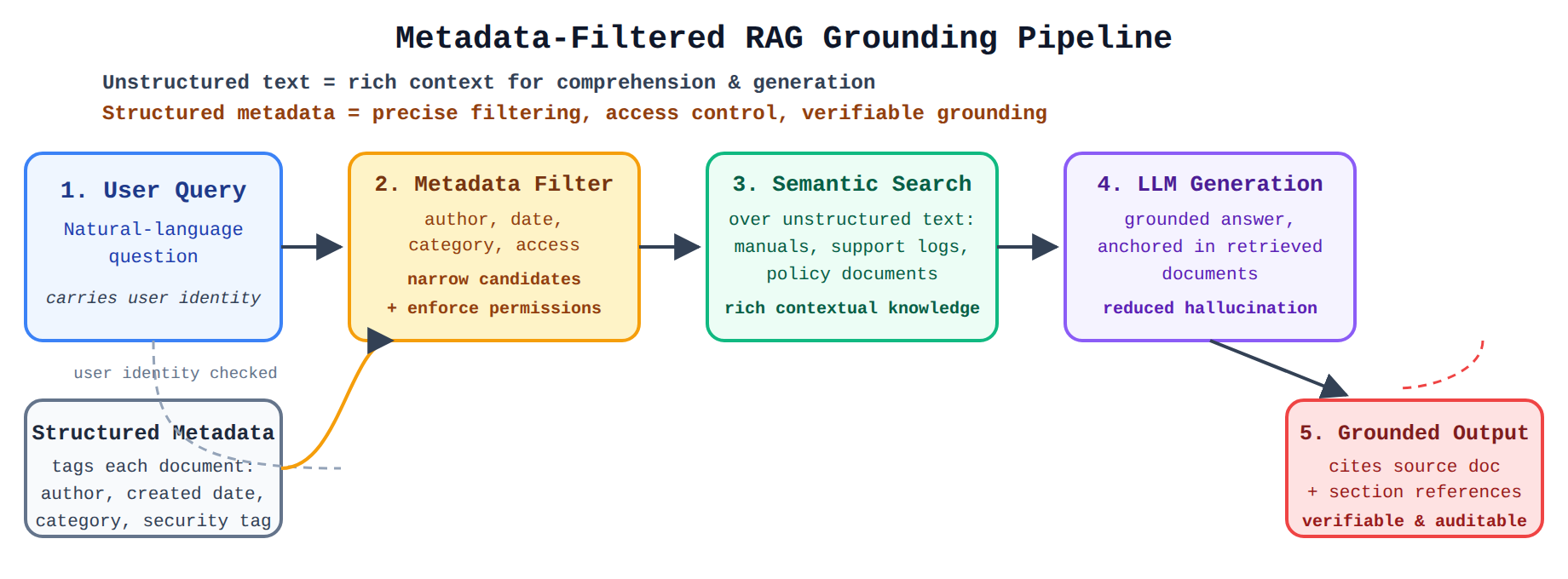
Why This Approach Is Optimal
Generative AI models excel at interpreting the flexible semantics of unstructured natural language, but they lack native awareness of organizational rules, document freshness, and permission boundaries. Augmenting unstructured textual corpora with structured metadata combines the creative reasoning of language models with the rigor, auditability, and governance of enterprise data management.
The unstructured content enforces strict relational schemas to eliminate hallucinations, while structured metadata generates natural language output.
The unstructured content enforces strict relational schemas to eliminate hallucinations, while structured metadata generates natural language output.
What Relational Schemas and Natural Language Generation Actually Entail
This option reverses the fundamental characteristics and functions of structured and unstructured data in AI systems.
Why It Fails to Meet the Need
- Inversion of Roles: Structured data (such as relational database tables) enforces strict schemas with defined columns, data types, and constraints, whereas unstructured data is flexible and lacks a predefined data model.
- Misattributed Text Generation: Generative models synthesize natural language by processing and generating unstructured sequences of text, not by relying on structured metadata to draft prose.
- Grounding Mechanisms: Hallucinations are mitigated by grounding models in verifiable data sources using retrieval techniques, not by forcing unstructured text into relational schemas.
Key Characteristics and Limitations
- Unstructured content includes free-form text, audio, images, and video that do not conform to rigid tabular schemas.
- Structured data adheres to fixed schemas and tables, making it straightforward to query with languages like SQL but unable to directly convey expressive long-form narratives.
- Generative models produce unstructured natural language output by predicting tokens based on prompt context and reference documents.
This Answer Would Be Correct If:
- The scenario described converting unstructured documents into rigid SQL databases to be queried exclusively through traditional relational database management systems.
The structured metadata converts all narrative text into relational tables to eliminate the requirement for vector embeddings and semantic search.
The structured metadata converts all narrative text into relational tables to eliminate the requirement for vector embeddings and semantic search.
What Metadata and Vector Embeddings Do
Structured metadata provides contextual labels and filtering criteria, but it does not convert full narrative documents into relational database tables, nor does it remove the need for semantic search.
Why It Fails to Meet the Need
- Vector Embeddings Remain Crucial: Unstructured text must still be transformed into numerical vector embeddings so that generative AI systems can perform semantic search (identifying relevant passages based on conceptual meaning rather than exact keyword matches).
- Loss of Nuance: Attempting to flatten complex, narrative documentation into fixed relational columns destroys context, nuance, and readability.
- Complementary Architecture: Modern generative AI pipelines use hybrid search, combining vector embeddings of unstructured text with structured metadata filtering rather than replacing one with the other.
Key Characteristics and Limitations
- Semantic search relies on embeddings generated from unstructured text chunks to identify conceptual similarity.
- Relational tables are optimal for exact-match numerical queries and transactions, but struggle to represent complex conversational text.
- Vector search and metadata filtering work together in managed services (such as RAG engines and search platforms) to deliver accurate grounding.
This Answer Would Be Correct If:
- The company was migrating away from generative AI entirely in favor of an exclusively SQL-based transactional reporting system.
Try 10 interactive questions like this one, free
Answer them yourself and get your score the moment you finish. No account needed.
Full access includes
- 2,191 practice questions across all 4 exam domains
- Every answer explained: why it is right, and why the others are not
- Scout, an AI tutor that answers your follow-up questions
- Readiness tracking by domain, so you know when to book the exam
Related questions
Keep the momentum going with these hand-picked practice scenarios
FundamentalGenerative AI Leader
Structured vs Unstructured Data Storage
Identifying the differences between structured and unstructured data, and identifying real-world examples of each type
FundamentalGenerative AI Leader
Structured vs Unstructured Data
Identifying the differences between structured and unstructured data, and identifying real-world examples of each type
FundamentalGenerative AI Leader
Generative AI Case Management
Identifying business use cases where gen AI can create, summarize, discover, and automate (e.g., text generation, image generation, code generation, video generation, data analysis, and personalized user experience)
FundamentalGenerative AI Leader
Vertex AI Studio Prototyping Workspace
Platforms
FundamentalGenerative AI Leader
Vertex AI AutoML
Describing how Google Cloud's AI platform democratizes AI development (e.g., low-code and no-code tools, pre-trained models, APIs)
AdvancedProfessional Cloud DevOps Engineer
Config Sync Nomos Vet PR Validation
Configuring deployment processes (e.g., approval flows)
Last updated