Fundamental
Prepare and test your skills
Fundamental
Prepare and test your skills
How RLHF Aligns Models With Human Values
Free sample question, answered and explained below. The Generative AI Leader practice bank has 2,191 more like it. Try 10 free: instant score, no account.
An AI engineering team has pre-trained a large language model on extensive text data. While the model is articulate, it occasionally generates biased responses, exhibits reasoning errors, and struggles to adhere to safety policies. The team wants to post-train the model so that it learns how to be safe, helpful, and aligned with human values through iterative exploration and feedback.
Which machine learning technique uses an agent-environment feedback loop and cumulative reward signals to achieve this alignment?
Explanations
Supervised Fine-Tuning (SFT)
Supervised Fine-Tuning (SFT)
What Supervised Fine-Tuning Is
Supervised Fine-Tuning (SFT) is a model adaptation technique where a pre-trained base model is trained on curated, high-quality pairs of prompt inputs and target demonstrations. The model adjusts its weights using cross-entropy loss to maximize the exact token probability of the provided reference answers, learning through imitation rather than trial and error.
Why It Doesn't Meet the Requirement
- Absence of Feedback Loops: SFT relies on static imitation of gold-standard responses rather than an iterative agent-environment feedback loop.
- No Reward Function: It does not compute cumulative rewards or evaluate dynamic candidate responses generated during training.
- Brittleness to Novel Scenarios: When faced with nuanced conversational edge cases not covered by the exact demonstration data, models tuned strictly through supervised methods struggle to balance competing safety and helpfulness trade-offs.
Key Characteristics and Limitations
- Teacher Forcing: Directly forces the model to predict the next token based on static human-written targets.
- High Data Curation Cost: Requires thousands of manually written, exhaustive demonstration dialogs.
- Lack of Exploration: Penalizes any output that deviates from the target sequence, even if the model's alternate answer is safe and valid.
This Answer Would Be Correct If
The team had a prepared dataset of curated question-and-answer pairs and wanted to train the model to mimic specific response formats without utilizing reward models or feedback optimization loops.
Reinforcement Learning from Human Feedback (RLHF)
Reinforcement Learning from Human Feedback (RLHF)
What Reinforcement Learning from Human Feedback (RLHF) Is
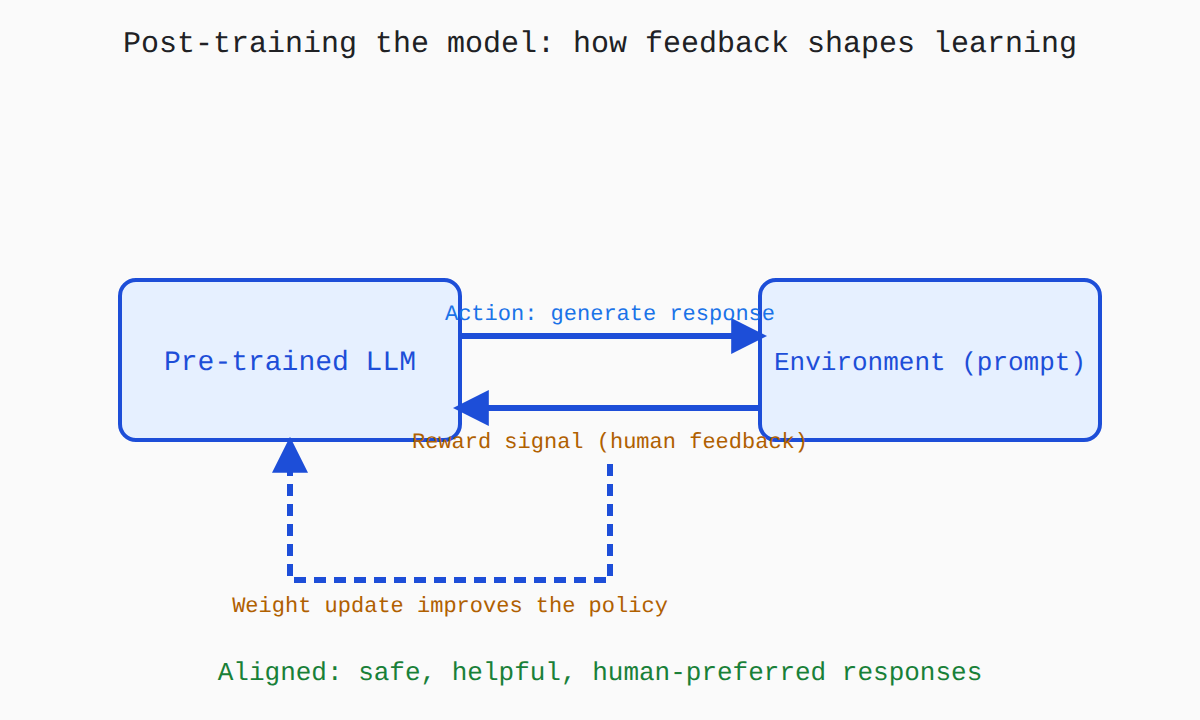
Reinforcement Learning from Human Feedback (RLHF) is an advanced machine learning method that optimizes foundation models by aligning their outputs with human preferences, safety standards, and intended goals. In this framework, the generative model operates as an agent taking actions (generating text or responses) within an environment (the user prompt and evaluation context). Instead of simply predicting subsequent words from a static dataset, the model explores diverse candidate answers and receives numeric scores via a feedback loop driven by a reward model calibrated on human judgements.
How It Meets the Alignment and Safety Requirements
- Shifting Output Probabilities: By assigning higher scalar rewards to safe, accurate, and constructive answers, RLHF systematically nudges the model's parameters so that desirable responses become more probable and undesirable responses become less probable.
- Bridging Knowledge and Behavior: Pre-training teaches a foundation model what to say by absorbing statistical language structure, but RLHF instructs the model how to behave, ensuring it remains helpful, safe, and logical.
- Handling Nuanced Objectives: Safety and tone are difficult to specify using exact mathematical loss functions. RLHF solves this by training a proxy reward model on comparative human rankings to score nuanced outputs reliably.
Key Advantages and Capabilities
- Dynamic Exploration: Enables the model to experiment with multiple reasoning paths and response variations rather than passively mimicking training prompts.
- Reduced Harmful Content: Effectively curbs hallucinations, toxic outputs, and evasive behaviors by penalizing unsafe choices.
- Cumulative Reward Maximization: Employs policy gradient algorithms (such as PPO or GRPO) to maximize long-term rewards across complex conversational turns.
- Customizable Alignment: Adapts smoothly to organizational guidelines through bespoke reward definitions and human preference datasets.
Why This Is Optimal
RLHF directly addresses the limitations of standard generative pre-training. Rather than treating all web data equally, it introduces human-guided feedback loops that turn a raw, unconstrained language generator into a safe, controllable enterprise assistant.
Unsupervised Pre-training
Unsupervised Pre-training
What Unsupervised Pre-training Is
Unsupervised Pre-training (often called self-supervised pre-training) is the foundational phase of training large language models. During this stage, the model processes immense volumes of unstructured text from the internet, books, and code repositories to predict masked or subsequent tokens across sequences without human labeling.
Why It Doesn't Meet the Requirement
- No Value Alignment: Pre-training absorbs patterns, styles, and information indiscriminately from source data, including undesirable biases, profanity, and factual errors.
- Lacks Goal-Driven Rewards: The model optimizes solely for raw token prediction likelihood rather than safety, compliance, or human satisfaction.
- Cannot Guarantee Behavioral Adherence: Pre-training teaches the system syntax, grammar, and world facts, but does not inherently teach the model to act as a helpful conversational assistant.
Key Characteristics and Limitations
- Massive Resource Consumption: Involves petabytes of raw text and thousands of GPU or TPU compute hours.
- Next-Token Objective: Evaluates success through cross-entropy loss against uncurated training text.
- Unguided Exploration: Operates without human preference signals or safety guardrails.
This Answer Would Be Correct If
The scenario described the initial stage of building a foundational model from scratch on large-scale text collections to acquire general linguistic knowledge and semantic understanding.
Reason and Act (ReAct) agent prompting
Reason and Act (ReAct) agent prompting
What the ReAct Pattern Is
Reason and Act (ReAct) is an agentic prompting design pattern used during inference. It prompts a language model to alternate between generating natural language thoughts (reasoning steps), executing external actions (such as invoking search engines, calculators, or database APIs), and observing the resulting feedback from the tools to reach an answer.
Why It Doesn't Meet the Requirement
- Inference Technique vs. Training Method: ReAct is an in-context prompting framework that guides how a deployed model interacts with tools at runtime. It does not update the underlying neural network parameters or weights.
- No Model Weight Alignment: The feedback loop in ReAct occurs within the context window of a single user session to retrieve facts; it does not train the model to inherently behave more safely across future sessions.
- No Cumulative Reward Signal: ReAct evaluates stopping conditions (such as task completion or maximum iterations) rather than computing scalar rewards to optimize a behavioral policy.
Key Characteristics and Limitations
- Thought-Action-Observation Loop: Structures runtime execution into reasoning thoughts, tool queries, and environmental observations.
- Runtime Latency: Multi-step prompting increases token usage and response latency for end users.
- Susceptible to Error Propagation: If an intermediate tool returns flawed data or the model makes a reasoning misstep, errors cascade into the final output without altering model weights.
This Answer Would Be Correct If
The team needed an application architecture where a deployed model queries external APIs and databases sequentially to solve multi-step problems in real time without retraining or fine-tuning the model.
Try the scenario
Choosing the post-training technique for a safe, aligned model
Change the inputs and watch how the outcome changes.
Change the technique and the objective to see how the training loop changes.
Try 10 interactive questions like this one, free
Answer them yourself and get your score the moment you finish. No account needed.
Full access includes
- 2,191 practice questions across all 4 exam domains
- Every answer explained: why it is right, and why the others are not
- Scout, an AI tutor that answers your follow-up questions
- Readiness tracking by domain, so you know when to book the exam
Related questions
Keep the momentum going with these hand-picked practice scenarios
FundamentalGenerative AI Leader
Supervised Learning Classification and Regression
Describing the machine learning approaches (e.g., supervised, unsupervised, reinforcement)
FundamentalGenerative AI Leader
Unsupervised Learning for Unlabeled Data
Describing the machine learning approaches (e.g., supervised, unsupervised, reinforcement)
FundamentalGenerative AI Leader
Cloud Storage BigQuery Dataflow Data Preparation
Identifying the stages of the machine learning lifecycle; data ingestion, data preparation, model training, model deployment, and model management; and the Google Cloud tools for each stage
FundamentalGenerative AI Leader
Prompt Chaining for Multi-Step Workflows
Identifying prompting techniques and use cases (e.g., zero-shot, one-shot, few-shot, role prompting, prompt chaining)
FundamentalGenerative AI Leader
Prompt Engineering vs Fine-Tuning
Describing the Google Cloud-recommended practices to address limitations (e.g., grounding, retrieval-augmented generation [RAG], prompt engineering, fine-tuning, human in the loop [HITL])
FundamentalAssociate Data Practitioner
Model Registry Aliases
Organize models in Model Registry
Last updated