Fundamental
Prepare and test your skills
Fundamental
Prepare and test your skills
Detecting Inference Drift in Production Models
Free sample question, answered and explained below. The Generative AI Leader practice bank has 2,191 more like it. Try 10 free: instant score, no account.
An enterprise deploys a predictive model to a live production endpoint on Google Cloud to forecast user engagement. Over several months, consumer engagement habits gradually evolve, and the operations team is concerned that shifting input data may degrade prediction quality. The team wants to configure automated monitoring that compares the statistical distribution of incoming production features against a baseline of historical production data collected in the past.
Which monitoring feature should the team implement to identify this statistical deviation over time?
Explanations
Infrastructure latency and error rate tracking
Infrastructure latency and error rate tracking
What Infrastructure Latency and Error Rate Tracking Is
Infrastructure tracking focuses on standard operational telemetry such as request latency (p95/p99), CPU/GPU resource utilization, request throughput (QPS), and HTTP error response codes (e.g., 4xx and 5xx errors) via Cloud Monitoring.
Why It Doesn't Meet the Requirement
- Focuses on operational health, not data integrity: Infrastructure metrics measure whether the serving endpoint is responsive and operational, but they provide zero visibility into the statistical distributions or semantic validity of the payload data.
- Silent data failures: A model can successfully return HTTP 200 responses with low latency even when processing drifted data that causes completely inaccurate or degraded predictions.
Key Characteristics and Limitations
- Operational scope: Essential for Site Reliability Engineering (SRE) and SLA compliance, but unable to evaluate data distributions.
- Lacks data awareness: Does not analyze payload contents, categorical distributions, or numerical intervals.
- No statistical distance metrics: Cannot calculate Jensen-Shannon divergence or L-infinity distances between historical and current feature distributions.
This Answer Would Be Correct If
The team needed to monitor endpoint availability, ensure prediction latency stayed within service level agreements (SLAs), or detect server-side container crashes.
Inference drift detection
Inference drift detection
What Inference Drift Detection Is
Inference drift detection is a continuous model monitoring capability in Google Cloud designed to track whether incoming production feature distributions change significantly over time. Unlike static checks, drift detection establishes a statistical baseline using past production data and continuously evaluates recently served live inference requests against that baseline.
How It Meets the Requirements
- Evaluates data deviation over time: It directly measures whether incoming real-time requests deviate from the distribution of feature values observed in production in the past.
- Uses past production data as a baseline: Model Monitoring calculates baseline distributions from historical serving data, making it ideal when monitoring how live traffic evolves after deployment.
- Automated threshold alerting: When calculated distance metrics—such as Jensen-Shannon divergence for numerical features or L-infinity distance for categorical features—exceed an alerting threshold (defaulting to 0.3), automated alerts are dispatched.
Inference Drift: Baseline vs Live Comparison
Comparison Matrix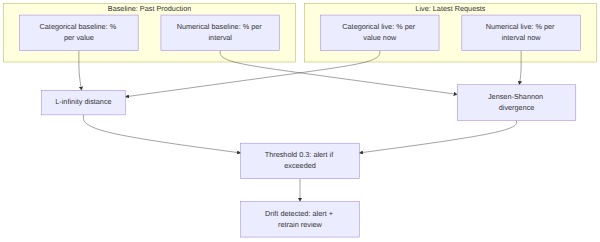
Key Advantages and Capabilities
- Proactive performance safeguards: Identifies shifts in consumer behavior before model output degradation causes adverse business outcomes.
- Cost-effective sampling: Allows teams to configure an inference request sampling rate to evaluate representative subsets of production traffic without excessive overhead.
- Configurable monitoring frequency: Enables scheduled evaluations to analyze specific time windows of logged production data.
- Actionable retraining signals: Provides visual distribution overlays to help data science teams decide when models need retraining or re-tuning.
Why This Is Optimal
Inference drift detection is specifically designed to identify gradual or sudden changes in production distributions where the reference baseline is prior operational data, fulfilling all scenario requirements precisely.
Feature attribution monitoring
Feature attribution monitoring
What Feature Attribution Monitoring Is
Feature attribution monitoring evaluates shifts in the relative importance or contribution of individual input features to the model's final predictions, commonly quantified using SHAP (SHapley Additive exPlanations) values.
Why It Doesn't Meet the Requirement
- Measures feature influence, not input distribution: The scenario asks to identify deviations in the statistical distribution of incoming feature values themselves. Feature attribution focuses on internal model decision weighting rather than raw data integrity or feature distributions.
- Does not detect data integrity issues directly: An incoming feature value could shift dramatically in distribution while temporarily retaining a similar attribution score, masking input data drift.
Key Characteristics and Limitations
- Explainability focus: Designed to provide explainable AI (XAI) insights into whether a previously critical feature has suddenly lost its predictive influence.
- Computational overhead: Calculating SHAP values for inference attributions requires additional computational overhead compared to statistical distance scoring.
- Requires explainability metadata: Requires configuring model explainability specifications alongside prediction endpoints.
This Answer Would Be Correct If
The team wanted to track whether a key predictive feature (such as customer account age) unexpectedly dropped in relative importance when generating inference outcomes.
Training-serving skew detection
Training-serving skew detection
What Training-Serving Skew Detection Is
Training-serving skew detection is a monitoring mechanism that detects discrepancies between the data distribution used during model training and the data distribution encountered when serving predictions in production.
Why It Doesn't Meet the Requirement
- Incorrect baseline comparison: The scenario specifically requires comparing live production features against a baseline of historical production data collected over past months. Training-serving skew instead compares production data against the training dataset distribution.
- Different root cause: Training-serving skew checks for mismatches originating at deployment time (e.g., inconsistencies in feature engineering pipelines, data preprocessing bugs, or training set unrepresentativeness) rather than natural data evolution over time across production epochs.
Key Characteristics and Limitations
- Requires training dataset availability: Skew detection requires access to the original training dataset to compute baseline statistical distributions.
- Static reference point: The baseline does not update based on past production serving logs; it remains anchored to the training split.
- Complementary role: While essential for validating initial pipeline consistency, it is distinct from monitoring time-series shifts within production data.
This Answer Would Be Correct If
The organization needed to verify whether production data immediately following deployment matched the original dataset used during the model training phase.
Try 10 interactive questions like this one, free
Answer them yourself and get your score the moment you finish. No account needed.
Full access includes
- 2,191 practice questions across all 4 exam domains
- Every answer explained: why it is right, and why the others are not
- Scout, an AI tutor that answers your follow-up questions
- Readiness tracking by domain, so you know when to book the exam
Related questions
Keep the momentum going with these hand-picked practice scenarios
FundamentalGenerative AI Leader
SLSA Software Supply Chain Security
Recognizing Google-recommended practices for continuous monitoring and evaluation of gen AI models (e.g., automatic model upgrades, key performance indicators, security patches and updates, versioning, performance tracking, drift monitoring)
FundamentalGenerative AI Leader
Pseudonymization via Consistent Tokenization
Describing privacy considerations (e.g., privacy risks, data anonymization and pseudonymization)
FundamentalGenerative AI Leader
Labeled vs Unlabeled Data Tradeoffs
Identifying the differences between labeled and unlabeled data
FundamentalGenerative AI Leader
Vertex AI Search and Conversation RAG
Recognizing the functionality, use cases, and business value of Vertex AI Platform (e.g., Model Garden, Vertex AI Search, AutoML)
FundamentalGenerative AI Leader
Google Cloud Enterprise Security and Data Privacy Architecture
Describing how Google Cloud has an enterprise-ready AI platform (e.g., responsible, secure, private, reliable, scalable)
AdvancedProfessional Cloud Security Engineer
BigQuery Policy Tag Enforcement
Restricting access to Google Cloud data services (e.g., BigQuery, Cloud Storage, and Cloud SQL datastores).
Last updated