Fundamental
Prepare and test your skills
Fundamental
Prepare and test your skills
Unsupervised Pre-training and Supervised Fine-tuning
Free sample question, answered and explained below. The Generative AI Leader practice bank has 2,191 more like it. Try 10 free: instant score, no account.
An enterprise is planning to deploy a domain-specific generative AI application on Google Cloud to handle specialized customer support workflows. The project team is assessing data acquisition costs and preparation efforts across different training strategies.
How do generative AI foundation models leverage unlabeled and labeled data across their lifecycle to optimize data collection resources?
Explanations
They completely eliminate the need for labeled data, relying solely on unlabeled datasets for both initial pre-training and downstream supervised tuning.
They completely eliminate the need for labeled data, relying solely on unlabeled datasets for both initial pre-training and downstream supervised tuning.
What This Option Describes
This option claims that generative AI models operate in an entirely unsupervised manner across all development phases, removing the need for labeled data entirely.
Why It Does Not Meet the Requirement
- Supervised Tuning Requires Labels: While pre-training relies on unlabeled data, adapting models to follow specific formatting, tone, or specialized classification standards (supervised tuning) requires curated labeled examples.
- Quality Alignment: Without labeled prompt-and-response examples, models cannot be tuned to align with domain-specific accuracy and business requirements.
Key Characteristics and Limitations
- Unsupervised Pre-training vs. Supervised Adaptation: Pre-training learns language distributions; supervised tuning aligns the model with specific human expectations.
- Prompt-Response Pairs: Supervised fine-tuning specifically utilizes labeled pairs to teach the model intended behaviors on specialized tasks.
This Answer Would Be Correct If
- The organization only intended to use an out-of-the-box base model via zero-shot prompting without any fine-tuning or specialized task alignment.
Additional Context
While prompt engineering can bypass fine-tuning, when fine-tuning is performed to specialize model behavior, labeled datasets are necessary.
They require millions of manually labeled examples for pre-training, but perform task-specific adaptation using raw, unlabeled data.
They require millions of manually labeled examples for pre-training, but perform task-specific adaptation using raw, unlabeled data.
What This Option Describes
This option suggests an inverted training pipeline where foundational pre-training relies entirely on human-labeled data and downstream adaptation requires only unlabeled data.
Why It Does Not Meet the Requirement
- Inverted Workflow: Pre-training foundation models on trillions of tokens using human annotations is economically and practically impossible due to the immense manual labor required.
- Task Adaptation Needs Ground Truth: Fine-tuning or supervised tuning specifically requires input-output pairs (labeled data examples) so the model learns how to generate desired target responses for specific tasks.
Key Characteristics and Limitations
- High Annotation Overhead: Requiring manual labels for pre-training datasets would make training foundation models prohibitively expensive.
- Lack of Supervision in Fine-Tuning: Unlabeled data alone cannot guide a model toward structured outputs, precise classifications, or custom business guidelines without ground-truth targets.
This Answer Would Be Correct If
- Foundation models were trained via pure supervised learning on annotated taxonomies from scratch, and fine-tuning was entirely unsupervised.
Additional Context
Pre-training leverages self-supervised learning on vast unlabeled data, which is what makes large-scale foundational AI scalable.
They require equal volumes of labeled and unlabeled data simultaneously during initial pre-training to establish baseline language understanding.
They require equal volumes of labeled and unlabeled data simultaneously during initial pre-training to establish baseline language understanding.
What This Option Describes
This option asserts that foundational pre-training depends on a 1:1 balance of labeled and unlabeled datasets simultaneously to establish core language understanding.
Why It Does Not Meet the Requirement
- Asymmetric Data Volumes: Initial pre-training utilizes vast amounts of unlabeled data (billions or trillions of tokens), whereas labeled datasets used in later stages represent a tiny fraction of that volume.
- Sequential, Not Simultaneous: The standard lifecycle separates broad self-supervised pre-training from task-specific supervised tuning into distinct sequential phases rather than requiring simultaneous 50/50 ingestion.
Key Characteristics and Limitations
- Resource Inefficiency: Mandating equal volumes of labeled data during pre-training would recreate the bottleneck of expensive manual annotation at scale.
- Self-Supervised Objective: Pre-training objectives (like predicting the next token) generate their own learning signals directly from raw text without requiring external labels.
This Answer Would Be Correct If
- Foundation model architectures were designed around semi-supervised co-training requiring equivalent proportions of annotated and unannotated data.
Additional Context
Understanding the sequential shift from massive unlabeled data in pre-training to compact, curated labeled data in fine-tuning is fundamental to evaluating AI resource implications.
They are pre-trained on massive corpora of unlabeled data to learn broad patterns, then adapted using smaller sets of high-quality labeled data for specialized tasks.
They are pre-trained on massive corpora of unlabeled data to learn broad patterns, then adapted using smaller sets of high-quality labeled data for specialized tasks.
What the Foundation Model Training Paradigm Is
Generative AI foundation models are built using a two-stage approach: extensive unsupervised pre-training on massive text or multimodal datasets, followed by supervised fine-tuning (or model tuning) on targeted, high-quality data examples.
How It Optimizes Resource Requirements
- Pre-training on raw, unlabeled data: Acquiring unlabeled data (such as web text, public books, and code) is relatively inexpensive and scalable because it does not require human annotation. During pre-training, the model learns general language structures, syntax, facts, and associative reasoning.
- Supervised tuning on smaller labeled datasets: When adapting a foundation model to specific downstream tasks (like classification, entity extraction, or domain-specific Q&A), organizations only need to provide a comparatively small set of labeled data examples rather than building a custom model from scratch.
Key Advantages and Capabilities
- Reduced Data Preparation Burden: Eliminates the need to hand-label millions of records to achieve high performance on specialized tasks.
- Faster Time-to-Market (GTM): Leverages existing pre-trained foundational knowledge, enabling organizations to deploy specialized solutions rapidly.
- Cost Efficiency: Human annotation is labor-intensive and costly; minimizing the volume of labeled data required directly cuts project development expenses.
- Flexibility: The same pre-trained model can be tuned for multiple distinct tasks using different small, labeled prompt-response datasets.
Foundation Model Data Cost Savings
Comparison Matrix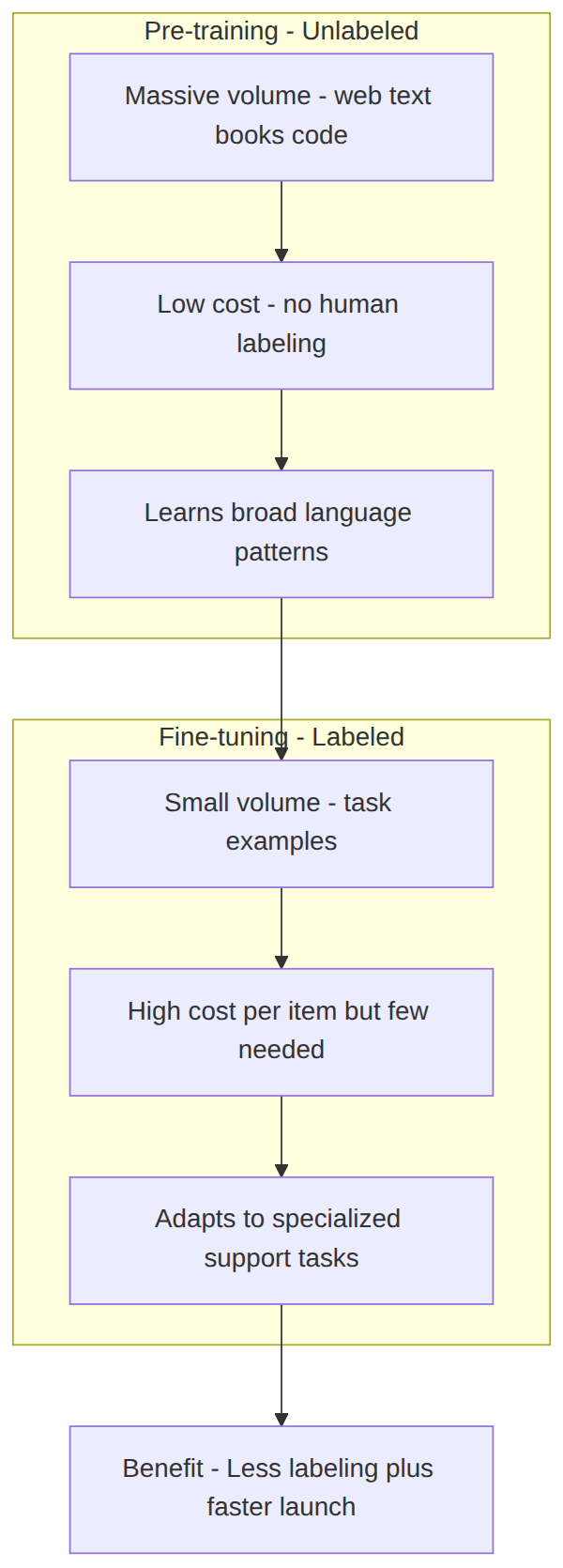
Try 10 interactive questions like this one, free
Answer them yourself and get your score the moment you finish. No account needed.
Full access includes
- 2,191 practice questions across all 4 exam domains
- Every answer explained: why it is right, and why the others are not
- Scout, an AI tutor that answers your follow-up questions
- Readiness tracking by domain, so you know when to book the exam
Related questions
Keep the momentum going with these hand-picked practice scenarios
FundamentalGenerative AI Leader
Labeled Data and Supervised Learning
Identifying the differences between labeled and unlabeled data
FundamentalGenerative AI Leader
Text Generation and Summarization
Recognizing the different types of gen AI solutions (e.g., text generation, image generation, code generation, personalized user needs)
FundamentalGenerative AI Leader
Human-in-the-Loop Evaluation and Surveys
Identifying techniques to measure the impact of gen AI initiatives
FundamentalGenerative AI Leader
Lightweight vs Flagship Model Tiers
Models
FundamentalGenerative AI Leader
Imagen Background Replacement Foreground Preservation
Imagen
AdvancedProfessional Cloud Security Engineer
Istio AuthorizationPolicy Dry-Run Mode
Configuring Binary Authorization to secure GKE clusters or Cloud Run.
Last updated