Fundamental
Prepare and test your skills
Fundamental
Prepare and test your skills
High Availability Storage for Real Time RAG
Free sample question, answered and explained below. The Generative AI Leader practice bank has 2,191 more like it. Try 10 free: instant score, no account.
An enterprise is building an architecture on Google Cloud to power real-time generative AI applications, including Retrieval-Augmented Generation (RAG) and foundational model integration. The data team needs to establish a storage and retrieval strategy that provides continuous uptime, rapid query latency, and seamless pipeline integration across Vertex AI workflows.
Which strategy best provides high data accessibility and efficient processing for generative AI workloads?
Explanations
Storing all grounding documents in single-region cold archive storage to minimize infrastructure costs
Storing all grounding documents in single-region cold archive storage to minimize infrastructure costs
What Cold Archive Storage Is
Cold archive storage (such as Archive class storage in Cloud Storage) is designed for infrequently accessed backup data and long-term regulatory compliance archives that are rarely read.
Why It Doesn't Meet the Requirement
- Unacceptable Retrieval Latency: Cold and archive tiers often have higher retrieval latencies and associated access costs per read, making them completely unsuitable for real-time AI grounding or interactive queries.
- Reduced Availability: Placing all data in a single region without multi-zone or multi-region redundancy increases vulnerability to single-zone outages.
- Incompatible with Real-Time RAG: Retrieval-Augmented Generation requires rapid, low-latency lookups to augment foundation model prompts in milliseconds.
Key Limitations
- High per-access retrieval fees make frequent real-time AI queries cost-prohibitive.
- Retrieval latency degrades generative conversational agent responsiveness.
- Single-region deployment lacks geographic redundancy and high availability.
This Answer Would Be Correct If
- The scenario focused purely on long-term historical audit log compliance where files are accessed less than once a year and cost minimization is the only constraint.
Additional Context
While cost optimization is an important architectural pillar, selecting cold archive storage for active data retrieval violates the fundamental AI requirement of data accessibility.
Storing data in highly available managed cloud storage services using standardized formats and optimized vector stores
Storing data in highly available managed cloud storage services using standardized formats and optimized vector stores
What Managed Highly Available Cloud Storage and Standardized Formats Are
In Google Cloud, leveraging managed services such as Cloud Storage, BigQuery, and managed database systems like Cloud SQL (or Vertex AI Vector Search) provides a resilient foundation for enterprise AI. These services offer built-in high availability (HA), automated multi-zone replication, and seamless integration with Vertex AI pipelines.
How It Meets Generative AI Requirements
- High Availability and Reliability: Managed cloud storage and database engines eliminate single points of failure across infrastructure outages, ensuring that generative AI pipelines and retrieval agents can access operational data continuously without downtime.
- Standardized Data Formats: Structuring and storing documents, embeddings, and tabular data in standard formats (such as JSON, Parquet, or Avro) reduces preprocessing overhead and ingestion latency when feeding context to foundation models.
- Efficient Processing and Search: Combining structured cloud storage with managed vector stores allows AI systems to perform low-latency semantic search and fast data retrieval for Retrieval-Augmented Generation (RAG).
High-Availability RAG on Google Cloud
System Architecture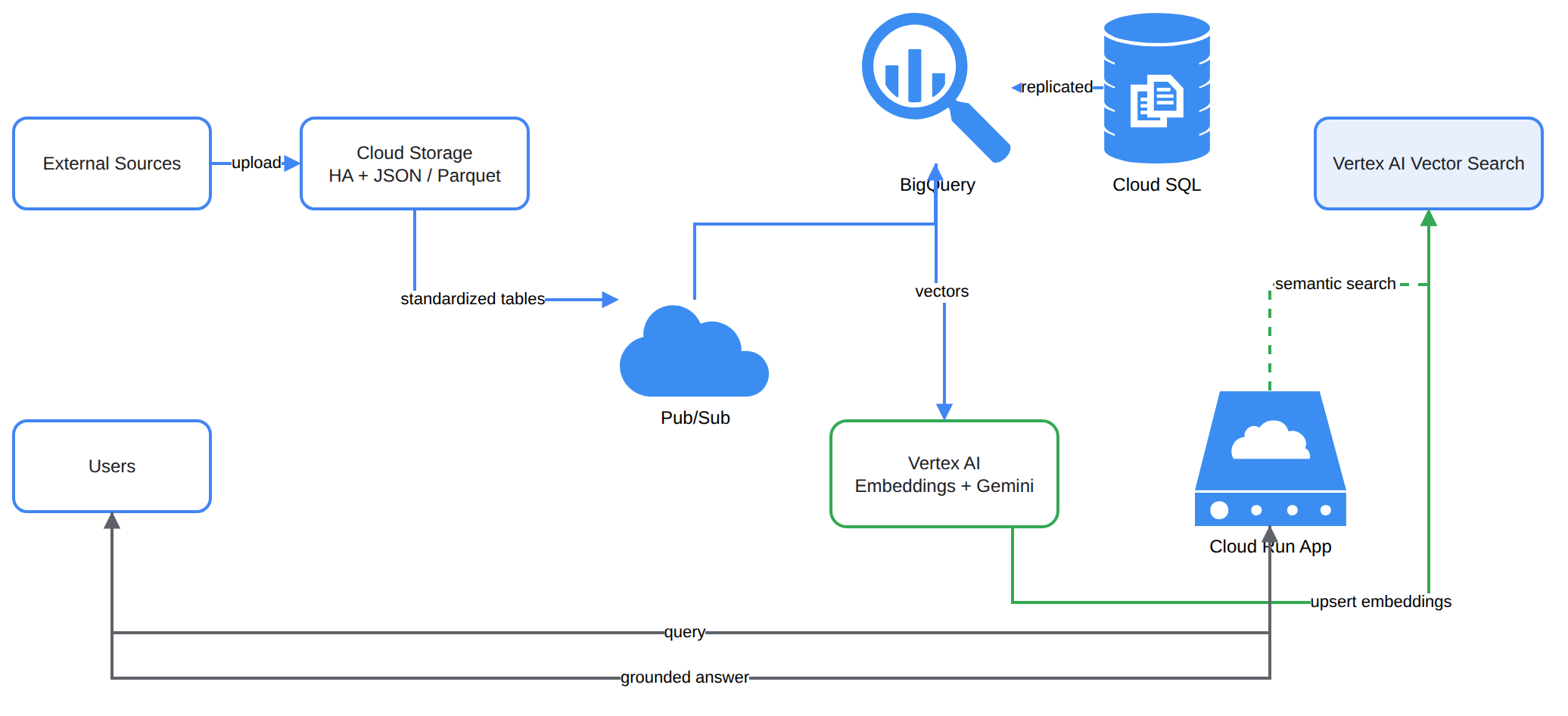
Key Advantages and Capabilities
- Seamless Vertex AI Integration: Natively connects with Google Cloud AI/ML training, fine-tuning, and prediction pipelines.
- Disaster Recovery and Resilience: Automated replication across availability zones protects workflows against regional or infrastructure-level disruptions.
- Low Retrieval Latency: Enables prompt grounding and real-time inference workflows without manual infrastructure scaling.
- Standardized Interoperability: Compatible with diverse open-source data orchestration tools (such as Ray, LangChain, and Dataflow).
Why This Is Optimal
This approach aligns with Google Cloud architecture best practices by decoupling compute from storage, eliminating single points of failure, and structuring data into consistent formats that downstream AI models and vector retrieval engines can query instantly.
Retaining unstructured documents in proprietary on-premises formats and converting them dynamically during live inference queries
Retaining unstructured documents in proprietary on-premises formats and converting them dynamically during live inference queries
What On-Demand Dynamic Conversion Does
This option relies on keeping operational data siloed in disparate, proprietary on-premises file formats and attempting to parse, transform, and convert data into readable text in real time whenever an end user submits an inference query.
Why It Doesn't Meet the Requirement
- High Latency Bottlenecks: Converting complex proprietary file formats on the fly introduces significant computational latency, directly degrading the real-time responsiveness required for generative AI interactions.
- Poor Accessibility and High Failure Rate: Relying on disparate legacy formats limits interoperability across cloud-based generative AI frameworks and increases the likelihood of data extraction errors.
- Lack of Cloud Scalability: On-premises infrastructure silos prevent AI pipelines from scaling horizontally to handle fluctuating user request volumes.
Key Limitations
- Increases inference pipeline latency by adding dynamic transformation steps.
- Requires complex custom parsers that are fragile and difficult to maintain.
- Creates severe scalability bottlenecks for high-throughput AI workloads.
This Answer Would Be Correct If
- The organization was running an air-gapped, offline legacy data migration test where real-time response latency and cloud integration were not required.
Additional Context
Generative AI architectures rely heavily on pre-processed, standardized data formats stored in cloud environments to ensure minimal retrieval time during Retrieval-Augmented Generation (RAG).
Hosting raw unstructured data inside an isolated standalone Compute Engine VM with non-replicated local storage
Hosting raw unstructured data inside an isolated standalone Compute Engine VM with non-replicated local storage
What Standalone Local VM Storage Is
This approach involves provisioning a single, unmanaged Compute Engine virtual machine and storing dataset files exclusively on its attached ephemeral or non-replicated local disk without external network backups or high-availability configurations.
Why It Doesn't Meet the Requirement
- Single Point of Failure: A standalone VM lacks automated disaster recovery or multi-zone failover, resulting in complete system downtime and data unavailability if the instance or host zone encounters an outage.
- No Scalable Data Accessibility: Storing raw data locally on a single machine prevents concurrent distributed processing by parallel AI training pipelines and vector search indexing jobs.
- Operational Overhead: Requires continuous manual maintenance, patching, and custom backup routines instead of leveraging managed Google Cloud storage resiliency.
Key Limitations
- Local VM storage cannot be concurrently mounted or accessed easily by distributed AI services.
- Zero fault tolerance against hardware failures or zone disruptions.
- Poor performance when handling concurrent RAG search queries.
This Answer Would Be Correct If
- A developer needed a quick, disposable single-node prototype environment where data persistence and system availability were completely irrelevant.
Additional Context
Enterprise generative AI workloads require decoupled, resilient storage layers (such as managed Cloud Storage buckets and Cloud SQL/BigQuery instances) rather than isolated VM disks to ensure seamless integration and high availability.
Try 10 interactive questions like this one, free
Answer them yourself and get your score the moment you finish. No account needed.
Full access includes
- 2,191 practice questions across all 4 exam domains
- Every answer explained: why it is right, and why the others are not
- Scout, an AI tutor that answers your follow-up questions
- Readiness tracking by domain, so you know when to book the exam
Related questions
Keep the momentum going with these hand-picked practice scenarios
FundamentalGenerative AI Leader
Data Quality Dimensions
Explaining the characteristics and importance of data quality and data accessibility in AI (e.g., completeness, consistency, relevance, availability, cost, format)
FundamentalGenerative AI Leader
Data Governance and Minimization
Explaining the characteristics and importance of data quality and data accessibility in AI (e.g., completeness, consistency, relevance, availability, cost, format)
FundamentalGenerative AI Leader
Transformer Self-Attention Mechanism
Describing how Google's AI-first approach and commitment to future innovation translate into cutting-edge gen AI solutions
FundamentalGenerative AI Leader
Unsupervised Learning for Unlabeled Data
Describing the machine learning approaches (e.g., supervised, unsupervised, reinforcement)
FundamentalGenerative AI Leader
Architecture Decision Records
Describing the importance of accountability and explainability in AI systems
IntermediateProfessional Cloud Architect
Binary Authorization Attestation Enforcement
Securing software supply chain
Last updated