Fundamental
Prepare and test your skills
Fundamental
Prepare and test your skills
Data Minimization and Governance for AI Retrieval
Free sample question, answered and explained below. The Generative AI Leader practice bank has 2,191 more like it. Try 10 free: instant score, no account.
An enterprise is developing a generative AI knowledge retrieval application. The AI leadership team needs to establish a data governance and storage strategy that manages data acquisition and storage costs while maximizing model utility and ensuring long-term dataset integrity.
Which strategy should the organization implement to achieve these goals?
Explanations
Retain all raw data across distributed in-memory dataframes without standardized preprocessing to avoid data transformation costs
Retain all raw data across distributed in-memory dataframes without standardized preprocessing to avoid data transformation costs
What Retaining In-Memory Data Without Preprocessing Is
This approach keeps raw, uncleaned datasets entirely within high-cost in-memory computing structures (like distributed DataFrames) while skipping standard transformation, schema validation, and cleaning steps.
Why It Doesn't Meet the Requirement
- Prohibitive operational costs: In-memory storage is significantly more expensive than standard cloud object storage and managed indexing services.
- Low data quality: Bypassing preprocessing causes unhandled null values, inconsistent categorical entries, and formatting errors that degrade AI performance.
- Short-term persistence: In-memory storage is volatile and poorly suited for long-term data governance, versioning, and lifecycle management.
Key Limitations
- Data inconsistency: Raw datasets without cleaning retain misspellings, formatting errors, and tokenization issues.
- Inefficient resource allocation: Consumes expensive memory resources for cold or infrequently queried records.
- Lack of lineage: Does not provide audit logs or transformation histories necessary for enterprise compliance.
This Answer Would Be Correct If
- A data scientist were running temporary, interactive exploratory data analysis on a small data sample during early prototyping.
Collect only business-necessary data, enforce least-privilege access control, and implement end-to-end data lineage and transformation tracking
Collect only business-necessary data, enforce least-privilege access control, and implement end-to-end data lineage and transformation tracking
What Data Governance and Minimization Is
Data governance encompasses the policies, processes, and controls used to manage an organization's data assets throughout their lifecycle. In generative AI workloads, sound governance combines data minimization (storing only what is necessary), access control, and data lineage tracking.
How It Meets the Requirements
- Managing acquisition and storage costs: By collecting and storing only data strictly necessary for business objectives, organizations eliminate the overhead of storing, indexing, and processing redundant or irrelevant records.
- Maximizing model utility: Curating and transforming relevant data into structured formats or searchable vector indexes directly enhances retrieval quality and reduces hallucinations.
- Ensuring long-term integrity: Tracking end-to-end lineage and maintaining audit logs ensure that datasets remain uncorrupted, traceable, and protected against unauthorized tampering or data poisoning.
End-to-End Data Lineage: Raw Data to Prediction
Process Flow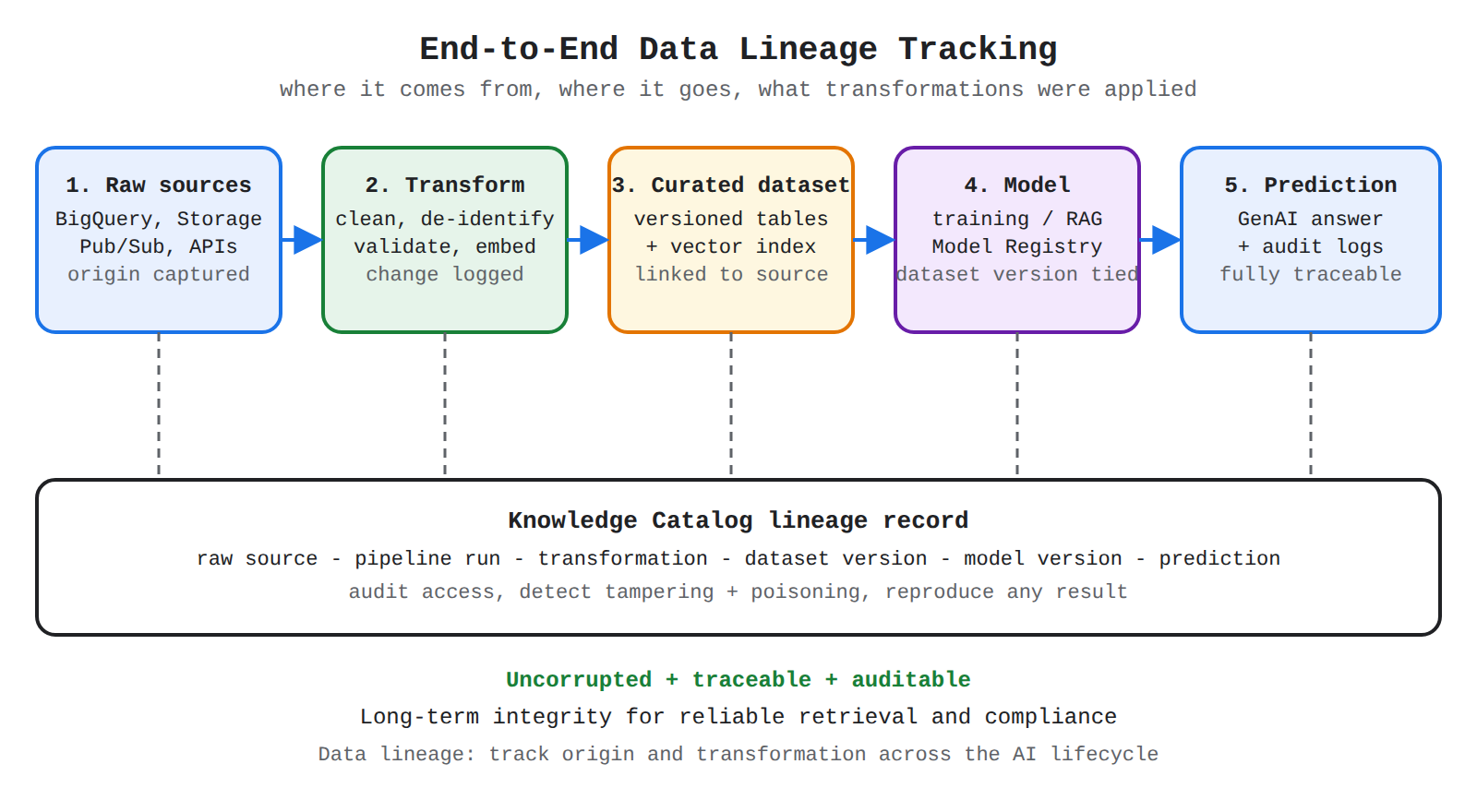
Key Advantages
- Cost efficiency: Reduces cloud storage consumption and expensive embedding/indexing compute costs.
- Security and compliance: Enforces the principle of least privilege and audit logging to protect sensitive corporate assets.
- Model reliability: Curated datasets prevent low-quality, out-of-date, or leaked data from degrading AI outputs.
- Operational traceability: Lineage tracking ensures reproducible data pipelines and simplified auditing.
Why This Is Optimal
Implementing structured data governance directly aligns economic trade-offs (avoiding unnecessary data bloat) with high operational utility and risk reduction. It balances cost containment with enterprise-grade security and model accuracy.
Store unindexed data in publicly accessible storage buckets to reduce vector database overhead and preprocessing costs
Store unindexed data in publicly accessible storage buckets to reduce vector database overhead and preprocessing costs
What Storing Unindexed Data Publicly Is
This option involves placing unstructured enterprise documentation into publicly readable cloud storage without performing chunking, text cleaning, indexing, or access restriction.
Why It Doesn't Meet the Requirement
- Severe security risk: Exposing proprietary enterprise data in public storage buckets violates basic cloud security principles and data privacy commitments.
- Fails retrieval utility: Without structured indexing, chunking, or metadata assignment, generative AI retrieval engines cannot efficiently search or retrieve relevant context at query time.
- Lacks data governance: Disregards identity management, least-privilege permissions, and regulatory compliance.
Key Limitations
- No access boundaries: Leaves sensitive corporate knowledge vulnerable to unauthorized external access and data exfiltration.
- Poor query performance: Raw, unindexed files cannot provide sub-second semantic retrieval for language models.
- Absence of data integrity controls: Fails to provide mechanisms to detect data tampering or unauthorized modifications.
This Answer Would Be Correct If
- The application exclusively served non-sensitive, static public assets (such as open-source website images) where semantic search and confidentiality are unnecessary.
Ingest all historical unstructured corporate data into an unrestricted central data lake to maximize raw training volume
Ingest all historical unstructured corporate data into an unrestricted central data lake to maximize raw training volume
What Ingesting All Unrestricted Data Is
This approach involves accumulating every available piece of historical corporate data into a centralized storage repository without applying filtering, curation, or role-based access restrictions.
Why It Doesn't Meet the Requirement
- Inflates storage and processing costs: Ingesting and maintaining massive amounts of legacy, redundant, or obsolete data substantially increases cloud storage and compute costs.
- Degrades model utility: Uncurated data introduces noise, inconsistent formats, and outdated information, leading to degraded model accuracy and potential hallucinations.
- Compromises security and compliance: Storing data without access controls or governance increases the attack surface and risks non-compliance with data privacy standards.
Key Limitations
- No data minimization: Collects unnecessary data that does not support specific AI business goals.
- High maintenance overhead: Expands the volume of unindexed and ungoverned files requiring security monitoring.
- Risk of training-serving skew: Increases inconsistencies between legacy training data and production inference queries.
This Answer Would Be Correct If
- The organization required an archival storage tier for long-term raw log retention where immediate query performance and model utility were not operational considerations.
Try 10 interactive questions like this one, free
Answer them yourself and get your score the moment you finish. No account needed.
Full access includes
- 2,191 practice questions across all 4 exam domains
- Every answer explained: why it is right, and why the others are not
- Scout, an AI tutor that answers your follow-up questions
- Readiness tracking by domain, so you know when to book the exam
Related questions
Keep the momentum going with these hand-picked practice scenarios
FundamentalGenerative AI Leader
High Availability Storage for RAG
Explaining the characteristics and importance of data quality and data accessibility in AI (e.g., completeness, consistency, relevance, availability, cost, format)
FundamentalGenerative AI Leader
Data Quality Dimensions
Explaining the characteristics and importance of data quality and data accessibility in AI (e.g., completeness, consistency, relevance, availability, cost, format)
FundamentalGenerative AI Leader
Vertex AI Agent Builder Grounding
Platforms
FundamentalGenerative AI Leader
Pseudonymization via Consistent Tokenization
Describing privacy considerations (e.g., privacy risks, data anonymization and pseudonymization)
FundamentalGenerative AI Leader
Google Cloud Enterprise Security and Data Privacy Architecture
Describing how Google Cloud has an enterprise-ready AI platform (e.g., responsible, secure, private, reliable, scalable)
AdvancedProfessional Data Engineer
Cloud Logging Sink Writer Identity Permissions
Observability of data processes (e.g., Cloud Monitoring, Cloud Logging, BigQuery admin panel)
Last updated