Fundamental
Prepare and test your skills
Fundamental
Prepare and test your skills
Data Stores for Grounding Agents in Enterprise Knowledge
Free sample question, answered and explained below. The Generative AI Leader practice bank has 2,191 more like it. Try 10 free: instant score, no account.
An enterprise is developing a generative AI agent to assist its customer support representatives. The architecture team needs to select the appropriate tooling mechanisms to enable three core capabilities:
- Connect the agent to unstructured internal PDF policy manuals and FAQs to ground responses in private company knowledge.
- Connect the agent to external REST APIs to retrieve real-time shipping updates.
- Generate structured parameter payloads so custom client-side code can execute database transactions.
Which agent tooling component should the enterprise configure specifically to ground the agent's responses in their private organizational documents?
Explanations
Extensions
Extensions
What Extensions Are
Extensions are agent tools that connect generative AI models directly to external REST APIs and cloud services. They bridge the gap between large language models and operational systems by translating model intents into live API requests using standardized API schemas (such as OpenAPI specifications).
Why Extensions Do Not Meet the Requirement
- Designed for live API interactions: Extensions focus on calling external endpoints to execute operations or retrieve live structured data (e.g., retrieving real-time package tracking from a shipping API), not indexing unstructured document repositories.
- Lacks native document retrieval: Extensions do not provide built-in vector search, document chunking, or semantic retrieval over collections of PDF files.
- Action-oriented rather than knowledge-oriented: Extensions are optimized for interacting with web services and third-party systems rather than serving as a RAG knowledge base.
Key Characteristics and Limitations
- API schema driven: Requires OpenAPI-compliant endpoint definitions to configure inputs, outputs, and authentication.
- Real-time execution: Executes synchronous or asynchronous HTTP/REST calls against external services.
- Transactional focus: Best suited for transactional operations like creating tickets, booking reservations, or checking real-time system status.
This Answer Would Be Correct If
- The question asked which tooling mechanism connects the agent directly to external partner REST APIs to fetch real-time carrier shipping updates.
- The requirement was to execute live actions against external enterprise applications like CRM or ERP systems without client-side intervention.
Additional Context
In modern agent architectures, extensions handle external system integration and action execution, whereas data stores handle knowledge retrieval and grounding.
Data stores
Data stores
What Data Stores Are
Data stores are specialized agent tooling components designed to index, search, and retrieve information from structured and unstructured internal data repositories. They allow generative AI agents to access enterprise content—such as PDF documents, HTML pages, databases, and internal knowledge bases—to ground responses in accurate, domain-specific information.
How Data Stores Meet the Grounding Requirement
- Grounding in private documents: Data stores ingest unstructured enterprise documents (like company policy PDFs and FAQs), process them into searchable chunks, and make them retrievable via semantic search.
- Factual grounding and hallucination reduction: When a user asks a policy question, the agent retrieves relevant excerpts directly from the data store and passes them to the underlying model as context, ensuring answers are grounded in verified enterprise facts.
- Out-of-the-box indexing: They eliminate the need to build custom retrieval-augmented generation (RAG) pipelines from scratch.
RAG Grounding via a Data Store
Process Flow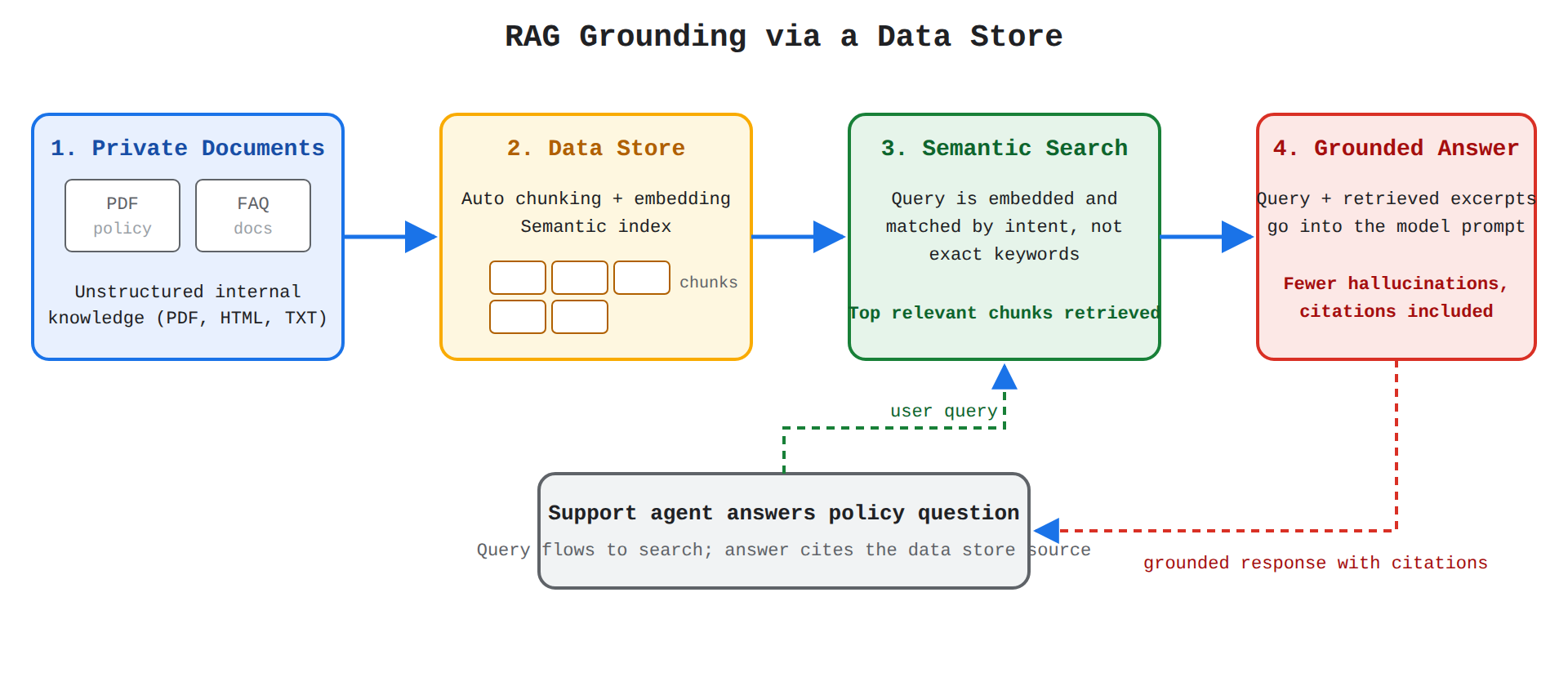
Key Advantages and Capabilities
- Multi-format document support: Natively handles unstructured data formats including PDF, HTML, TXT, and DOCX files.
- Built-in semantic search: Uses advanced embedding models to match user queries with relevant enterprise information based on intent rather than exact keyword matches.
- Automated chunking and indexing: Manages document ingestion, text splitting, embedding creation, and index updates automatically.
- Source citations: Automatically returns citations and references alongside generated responses to facilitate human verification.
Why This Is Optimal
Data stores provide a fully managed retrieval layer specifically engineered for knowledge discovery and grounding in enterprise documentation. While extensions and function calling enable agents to take actions and execute code, data stores are the dedicated mechanism for connecting agents to organizational document repositories.
Function calling
Function calling
What Function Calling Is
Function calling is a capability of large language models where the model detects when a custom function should be invoked and generates structured arguments (typically formatted as a JSON object) matching a predefined function signature.
Why Function Calling Does Not Meet the Requirement
- No document storage or retrieval: Function calling does not store, parse, or index private organizational PDFs or knowledge base articles.
- Requires client-side execution: The model itself does not execute code or fetch documents through function calling; it merely outputs structured parameters that the calling application must process.
- Misaligned with enterprise search: Using function calling to retrieve unstructured document content requires the developer to build, host, and maintain custom search infrastructure and retrieval logic.
Key Characteristics and Limitations
- Schema-guided output: Produces deterministic, validated JSON objects corresponding to custom developer functions.
- Application-managed execution: The developer's application code receives the generated parameters, runs the function locally or against internal databases, and passes the output back to the model.
- Control and security: Ideal when developers need complete programmatic control over how, where, and when custom business logic executes.
This Answer Would Be Correct If
- The question asked which mechanism generates structured arguments for the client application to execute custom database transactions or local software scripts.
- The scenario focused on bridging generative AI with custom backend code in a private execution environment.
Additional Context
Function calling is often combined with data stores in complex agents: the agent uses data stores to answer knowledge questions and function calling to interact with proprietary local software components.
Code Interpreter
Code Interpreter
What Code Interpreter Is
Code Interpreter is an execution tool within generative AI environments that enables the agent to dynamically generate and run programming code (such as Python) inside a sandboxed environment to perform mathematical calculations, data transformations, and visual chart generation.
Why Code Interpreter Does Not Meet the Requirement
- Not an enterprise document index: Code Interpreter does not serve as a managed knowledge base or vector search engine for unstructured PDF document libraries.
- Computational focus: It is built for algorithmic processing, advanced mathematical computation, statistical analysis, and data visualization rather than grounding responses in enterprise policy manuals.
- Runtime isolation: It executes scripts within a secure, isolated runtime environment for ephemeral computational tasks.
Key Characteristics and Limitations
- Dynamic script execution: Converts natural language queries into executable Python code to analyze structured data tables and generate outputs.
- Advanced analytics: Capable of performing complex data manipulations, regression models, and data charting that exceed standard SQL or text queries.
- Ephemeral environment: Code execution occurs in temporary containers without persistent knowledge storage across independent agent sessions.
This Answer Would Be Correct If
- The question required the agent to translate natural language questions into Python scripts to execute complex data analysis, statistical operations, or custom data visualizations.
- The support team needed the agent to calculate complex numerical adjustments or generate visual trend charts dynamically.
Additional Context
Code Interpreter provides computational power to agents, while data stores provide the factual knowledge foundation required for organizational grounding.
Try 10 interactive questions like this one, free
Answer them yourself and get your score the moment you finish. No account needed.
Full access includes
- 2,191 practice questions across all 4 exam domains
- Every answer explained: why it is right, and why the others are not
- Scout, an AI tutor that answers your follow-up questions
- Readiness tracking by domain, so you know when to book the exam
Related questions
Keep the momentum going with these hand-picked practice scenarios
FundamentalGenerative AI Leader
Vertex AI Model Garden
Platforms
FundamentalGenerative AI Leader
Horizontal vs Vertical AI Applications
Applications
FundamentalGenerative AI Leader
Assured Workloads vs Sensitive Data Protection vs Vertex Explainable AI
Describing how to choose the right gen AI solution for a specific business need
FundamentalGenerative AI Leader
Grounding Citations and Confidence Thresholds
RAG APIs
FundamentalGenerative AI Leader
Inference Drift Detection
Recognizing Google-recommended practices for continuous monitoring and evaluation of gen AI models (e.g., automatic model upgrades, key performance indicators, security patches and updates, versioning, performance tracking, drift monitoring)
AdvancedProfessional Cloud DevOps Engineer
Cloud Monitoring Dashboard Filters And Dashboard Viewer Role
Managing dashboards (e.g., creating, filtering, sharing, playbooks, PromQL)
Last updated