Fundamental
Prepare and test your skills

Fundamental
Prepare and test your skills
How APIs Deliver Reusable Business Value
The business value of application programming interfaces (APIs) is that they let organizations reuse capabilities, integrate systems quickly, and grow securely at scale. An API defines stable entry points, data formats, and response codes so one application can use logic built by another without knowing how the backend works. On Google Cloud, API Gateway (opens in a new tab) provides definition and deployment, Apigee provides full management and governance, and Google Enterprise APIs (opens in a new tab) provide long-term stability for enterprise dependencies.
What an API Contract Provides
An API contract is the agreement between an API provider and an API consumer about how the API will behave over time. The provider exposes a URL, request format, response format, and authentication method, and consumers build against that stable interface. For example, a book API can accept a GET request with an isbn query parameter and return a JSON object with title, author, and publish date plus a 200 code for success. The API can later add title or author parameters or new JSON fields without breaking the existing isbn behavior, which makes reuse safe across teams.
From API Definition to Deployment on API Gateway
A reusable service on API Gateway moves through an ordered lifecycle from definition to deployment to management. The definition is written as an OpenAPI 2.0 spec that lists the backend service URL, request data format, response data format, and authentication mechanism. The lifecycle follows a fixed order:
API Gateway Deployment Lifecycle
Process FlowA five-step process flow showing the API Gateway lifecycle: define an OpenAPI 2.0 spec, upload it with gcloud to create an API config, deploy the config on API Gateway, let client apps make REST calls through the gateway to the backend, and update by editing the spec, uploading, and redeploying, with a loop arrow back to step one.
- Define the API as an OpenAPI 2.0 spec.
- Upload the spec with the
gcloudcommand-line interface to create an API config. - Deploy the API config on API Gateway.
- Allow client applications to make REST calls through the gateway to the backend service.
- Update the service by updating the spec, uploading, and redeploying.
After deployment, traffic flows from client apps through API Gateway to the backend service, and responses flow back through the gateway. API Gateway handles concurrent calls, traffic management, authorization, and monitoring, and it logs request and response information while tracking latency, traffic, and errors.
Exam tip: Reusing an API does not require knowing how the backend service is built — integration only requires the defined URL, request and response formats, and authentication method.
Governance, Scale, and Long-Term Reuse
Governance for scalability and security adds policies, catalogs, roles, and lifecycle controls on top of the basic API contract. Apigee API hub provides centralized discovery and governance for APIs wherever they are deployed, and API Gateway can automatically push metadata about new deployments to the hub. Programmatic control uses OAuth 2.0 with short-lived service account credentials, which reduce risk compared with long-lived keys. Apigee organizations enforce structure where each organization belongs to exactly one Google Cloud project, contains isolated environments for deploying proxies, and separates API providers who build APIs from app developers who consume them.
Reuse over time depends on predictable change and support. Teams discover APIs in the API Library, enable them for a Google Cloud project, and build with client libraries that handle authentication, error handling, retry, and payload validation. Google Enterprise APIs are labeled in the Library and Marketplace and follow careful control of deprecation and breaking changes with notice, migration tools, and alternatives. Billing models for scale differ in how limits are handled:
| Pricing model | Payment style | API call behavior | Environment behavior |
|---|---|---|---|
| Subscription | Pre-pay for entitlements with discounts at higher volumes | Apigee continues serving calls over entitlement and bills the overage | Environment entitlement is enforced, with Environment Packs available to expand |
| Pay-as-you-go | Pay only for resources used | No API call limit, Apigee auto-scales as load rises | Up to 85 environments per organization, with multi-region environments billed per region |
An application programming interface (API) is a structured interface that lets one application request data or functionality from another service. In Google Cloud, APIs expose platform services so applications can add computing, networking, storage, and machine-learning-based data analysis without rebuilding those services. Each API defines how requests are made and how responses are returned, so separately built services, applications, and systems can communicate reliably and securely.
Core Purpose of an API in Google Cloud
The core purpose of an API in Google Cloud is to provide a reusable connection point grouped by capability. The call flows from the application to the service that owns the capability, and the service returns the result to the application. Common groups include Compute APIs such as Compute Engine API and Kubernetes Engine API, Storage and Database APIs such as Cloud Storage JSON API and Cloud Spanner API, Networking APIs such as Cloud DNS API, Big Data APIs such as BigQuery API and Cloud Pub/Sub API, Machine Learning APIs such as Cloud Vision API and Cloud Translation API, and Management Tool APIs such as Cloud Build (opens in a new tab) API and Deployment Manager API. Reliable use depends on documented methods, authentication to prove identity, client libraries to simplify calls, and access controls to limit sensitive surfaces.
REST, RPC, and MCP Interaction Styles
REST, RPC, and MCP are three API interaction styles that differ in how a client connects to the same kind of service. Service Health shows the overlap because it offers both REST and RPC interfaces for listing health events and getting event details, plus MCP tools in Preview. Client libraries and the gcloud command-line interface sit between the user and the service API to make calls easier.
| API style | Example services | How clients interact |
|---|---|---|
| REST | Service Health REST API, Cloud Build REST API, Cloud Storage JSON API | REST interfaces, client libraries, gcloud CLI |
| RPC | Service Health RPC API, App Design Center RPC APIs | RPC client stubs |
| MCP | Service Health MCP tools, App Design Center MCP server | MCP tools or MCP server connection, Preview status |
Exam tip: REST APIs are called through REST interfaces, RPC APIs through RPC client stubs, and MCP through MCP tools or an MCP server.
Service APIs Versus System APIs in Distributed Cloud
Access boundaries in Google Distributed Cloud separate Service APIs (opens in a new tab) meant for applications from System APIs reserved for the platform itself. GDC Service APIs are programmatic interfaces that applications call to add computing, networking, storage, and machine-learning-based data analysis. System APIs are used by the underlying GDC system itself, are discoverable in Kubernetes with kubectl and other open source tools, and are restricted to the relevant Infrastructure Operators. Kubernetes APIs form the third group in this model, providing the surface where System APIs are discovered.
Combining Service APIs Into Workflows
Combining Service APIs into one workflow creates interoperability because data flows from one service to the next through API requests. A single workflow can call a compute API to run code, a storage API to save results, and a data API to analyze them, with each service handling only its bounded job. Modular design appears in management chains where the App Hub API organizes resources, the Application Design Center (opens in a new tab) API designs and deploys applications, the Infrastructure Manager API automates infrastructure, and the Cloud Build API runs builds. Dependencies connect these modules because Pub/Sub supports Cloud Build and Secret Manager supports Developer Connect, so enabling one capability can require its supporting API. Application Integration (opens in a new tab) requires authentication for REST calls, and schemas such as the Service Health event log schema define data formats for viewing, exporting, or storing events.
Continue with this study guide: Define application programming interface (API).
Explain how organizations can create new business opportunities by exposing and monetizing public-facing APIs.
Public-facing APIs create new business opportunities by turning internal services and data into digital products that outside developers can use. Instead of keeping pricing, ordering, tracking, or legacy database functions locked inside the company, an organization exposes them as secure HTTP endpoints that return XML or JSON. External developers then build mobile apps, web apps, point-of-sale apps, and partner integrations on top of those assets, which speeds delivery and opens new revenue paths.
Direct Monetization With Rate Plans and Billing
Direct monetization with Apigee (opens in a new tab) charges developers or partners for API access and use through rate plans. A rate plan defines billing currency and frequency, setup fees, recurring fees, and consumption-based fees. Apigee collects usage data based on the rate plan and the developer's unique API key, then generates monetization reports that the provider uses for billing. Billing timing depends on the account type:
| Billing account | When developers pay | How charges work |
|---|---|---|
| Postpaid | After using API products | Developers are billed after usage with no upfront payment, and the provider handles settlement because Apigee does not generate invoices |
| Prepaid | Before using API products | Upfront payment goes into the developer wallet, and setup, per-transaction, and recurring fees are deducted; purchase fails with insufficient funds if the wallet is below the setup fee |
Indirect Monetization Through Ecosystems
Indirect monetization through ecosystems creates value through brand expansion, lead generation, and partner growth rather than per-call fees. The Apigee developer ecosystem lets providers manage internal and external developers, formalize relationships, onboard developers, and create a developer portal with documentation, samples, tutorials, API reference, blogs, forums, and support. SmartDocs makes documentation interactive so portal users can read about an API, send a live request, and view a live response. Picsart used Apigee-powered design APIs to shift from B2C to B2B with printers and merchandise makers, while Walgreens supports an app ecosystem around photo printing and prescriptions, so partner activity drives business without billing each call.
Exam tip: Direct monetization charges for API consumption through rate plans and billing; indirect monetization earns value by growing a developer and partner ecosystem rather than billing each API call.
Publishing Workflow From Product to App Key
The publishing workflow in Apigee publishing (opens in a new tab) moves in order from packaging to developer registration to documented use. An API product is a bundle of API proxies combined with a service plan that sets access limits, security, monitoring, and analytics, and it is the central mechanism for authorization and access control. The ordered steps are:
- Create API products that bundle APIs with service plans and limits.
- Register app developers who are allowed to use the products.
- Register developer apps by selecting one or more API products for each app and issuing a unique API key.
- Provide documentation and community support through the portal.
A developer registers before registering an app, the app must pass its API key with every request, and the request is granted only if the key is valid. The provider can revoke a key at any time, and deleting a developer invalidates all API keys associated with that developer.
Protecting and Scaling Public APIs
Protecting and scaling public APIs uses a proxy layer that hides backend details while enforcing traffic controls. An API proxy maps one public HTTP endpoint to a backend service running on Cloud Run functions, Cloud Run, App Engine standard environment, app servers, databases, or legacy enterprise service bus systems. Traffic flows from the client app to the managed endpoint and then to the backend, with responses returning along the same path. A developer needs only the proxy URL, query parameters or headers, authentication credentials, and response format. Rate limiting caps how quickly calls arrive, quotas cap totals such as 1000 requests per day, and caching with proxy policies or Cloud CDN serves repeated responses without hitting the backend. Apigee API Analytics collects URL, IP address, user ID, latency, and error data asynchronously, so measurement has no effect on API performance.
The business value of using Apigee API Management is centralized control for protecting APIs, managing access, and understanding use across environments. Apigee API Management is Google Cloud's native platform for building, managing, and securing APIs, and it places an API proxy layer between backend services and client apps. Traffic from internal or external clients passes through Apigee runtime services, which are containerized services in a Google-maintained Kubernetes cluster, while Google Cloud supplies identity, logging, analytics, and project management. This structure supports REST, gRPC, SOAP, and GraphQL APIs from one place.
Security and Control at the Apigee Proxy Layer
Security and control at the Apigee proxy layer means clients call a public proxy instead of calling the backend directly. The API proxy maps a public HTTP endpoint to a backend service, and policies on the proxy add security, rate limiting, quotas, mediation, caching, conditional logic, fault handling, and custom code without changing the backend. Keystore management configures TLS handshakes between Apigee and backends. Deployment choice changes where trust boundaries sit, with Apigee hybrid keeping traffic and data within enterprise-approved boundaries by running the runtime plane on-premises or in a chosen cloud while the management plane runs in Apigee's cloud.
Modernizing Legacy Systems Without Rewriting
Modernizing legacy systems without rewriting works because the proxy creates an abstraction that decouples backends from frontend apps. Traffic flows from the client app to the API proxy, then to the backend service, and the response flows back through the proxy. A request moves in order from client call to policy execution for security and traffic management to forwarding to the backend with an XML, JSON, or other response. Frontend developers need only the proxy URL, parameters, credentials, and response format, so teams can change a database, move hosts, or shift between data center and cloud while the public API stays consistent. New capability such as transformation, filtering, and quotas can be added at the proxy without touching legacy code.
Exam tip: API products are the central mechanism for authorization and access control in Apigee; individual API proxies are typically grouped into products rather than exposed directly.
Layered Protection With Load Balancing and Bot Defense
Layered protection with load balancing and bot defense adds network controls in front of API-level checks. Cloud Armor attaches to the external Application Load Balancer to provide web application firewall (WAF) capabilities and distributed denial of service (DDoS) protection, while reCAPTCHA adds risk scoring for website traffic. The request flow runs in a fixed order from client to load balancer to Cloud Armor evaluation to reCAPTCHA check to Apigee policy execution to backend forwarding. Apigee forwards valid requests to Google Kubernetes Engine backends over internal IP addresses, to private data centers through Cloud Interconnect, or to third parties through provisioned NAT addresses. If keys or tokens are invalid, Apigee returns a 403 response; Cloud Armor rejects requests that violate its rules before they reach Apigee.
Try the scenario
Layered API security: from Cloud Armor to the backend
Change the inputs and watch how the outcome changes.
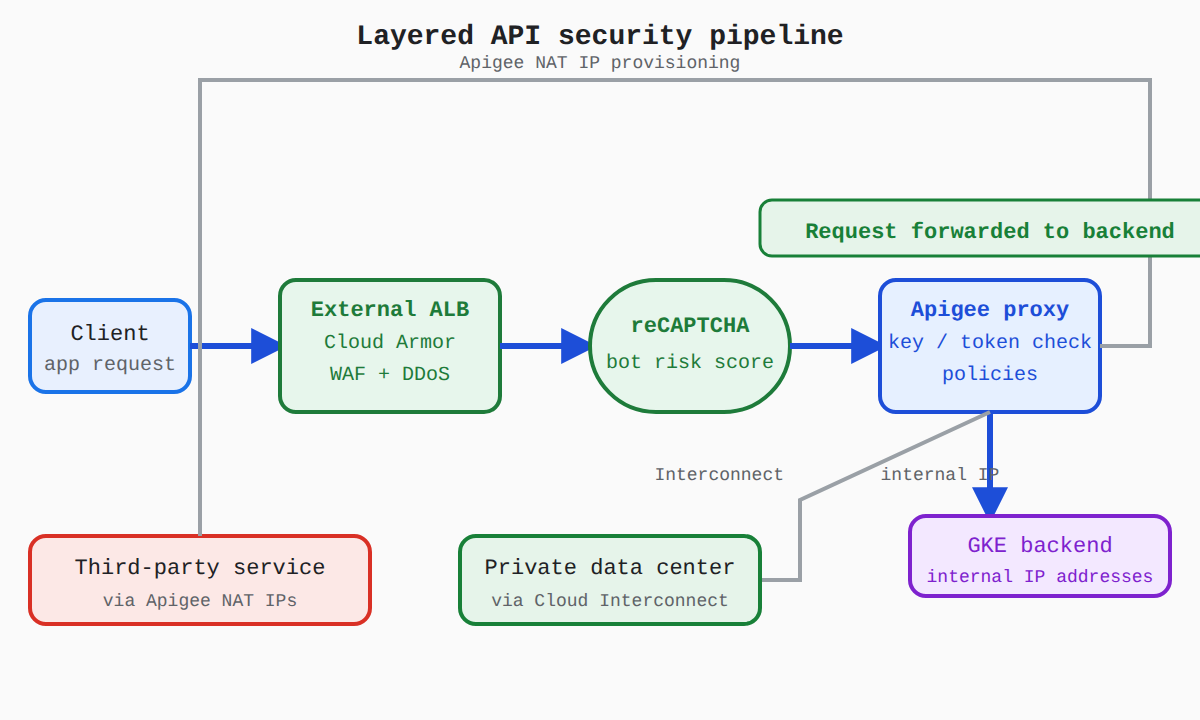
Change the traffic conditions to see which security layer stops the request, or which backend it reaches.
Visibility and Data Residency for Operations
Visibility and data residency for operations explain how Apigee observability (opens in a new tab) turns traffic into decisions while controlling where data lives. Apigee API Analytics collects default data such as URL, IP, user ID, latency, and errors asynchronously from the request flow, so collection has no effect on performance. Policies can add headers, query parameters, and portions of XML or JSON requests or responses. Dashboards cover proxy performance, error codes, latency, cache, and target performance, and data can be exported to Google Cloud Storage or BigQuery for analysis. Analytics visibility can be shared through the Drupal portal App Performance page, which shows errors, performance, availability, and quota status. Storage location follows the analytics region, with United States and European Union regions using multi-region storage for availability, and one-click installs defaulting to us-west1 without change. Apigee monetization (opens in a new tab) and API hub (opens in a new tab) extend this control by packaging proxies into products with service plans and centralizing discovery across gateways.
Continue with this study guide: Discuss the business value of using Apigee API Management.
Key Facts
- An application programming interface (API) lets one application consume data or logic from another application through defined URLs, request and response formats, and authentication without knowing the backend implementation.
- A reusable service on API Gateway follows an ordered lifecycle: define the OpenAPI 2.0 spec, upload it with gcloud to create an API config, deploy the config, allow client REST calls, and redeploy to update.
- In Apigee, an API proxy maps one public HTTP endpoint to a backend service, while an API product bundles proxies with a service plan and is the central mechanism for authorization and access control.
- Direct API monetization charges developers through rate plans with postpaid billing after usage or prepaid billing deducted from a wallet, while indirect monetization creates value through brand expansion and ecosystem growth.
- Apigee API Analytics collects URL, IP address, user ID, latency, and error data asynchronously so measurement has no effect on API performance.
Frequently Asked Questions
What is an application programming interface (API) in Google Cloud?
An application programming interface (API) in Google Cloud is a structured interface that lets one application request data or functionality from another service without knowing how the backend is built. Each API defines URLs, request and response formats, and authentication so separately built services can communicate reliably and securely to add capabilities such as computing, networking, storage, and machine-learning-based data analysis.
How do organizations define and deploy a reusable service on API Gateway?
A reusable service on API Gateway follows a fixed order where the API is defined as an OpenAPI 2.0 spec that lists the backend service URL, request and response formats, and authentication mechanism, then the spec is uploaded with gcloud to create an API config and the config is deployed on the gateway. After deployment client applications make REST calls through the gateway to the backend service, and the service is updated by updating the spec, uploading, and redeploying.
What is the difference between direct monetization and indirect monetization of public-facing APIs with Apigee?
Direct monetization charges developers or partners for API access through rate plans that define billing currency and frequency, setup fees, recurring fees, and consumption-based fees, with postpaid accounts billed after usage and prepaid accounts deducted from a developer wallet. Indirect monetization creates value through brand expansion, lead generation, and partner growth by building a developer ecosystem with a portal, documentation, samples, and community support rather than billing each API call.
Subdomains
Common API types and interaction models in Google Cloud are different styles for calling the same kinds of platform services. Google Distributed Cloud (GDC) services expose REST, RPC, and Model Contex…
API monetization strategies are ways to turn public-facing APIs into business value, either by charging for use or by growing business indirectly. Apigee is Google Cloud's API management platform …
Security, Governance, and Operational Visibility describes how Apigee gives a business one control point for protecting APIs, controlling access, and understanding API use. Apigee API Management i…
Reusable services and streamlined integration describe how application programming interfaces (APIs) let applications share data and logic through standard, reusable entry points. A team builds a capa…
How learners score on this domain
Last updated