Simulation
Layered API security: from Cloud Armor to the backend
Change the traffic conditions to see which security layer stops the request, or which backend it reaches.
Try the scenario
Layered API security: from Cloud Armor to the backend
Change the inputs and watch how the outcome changes.
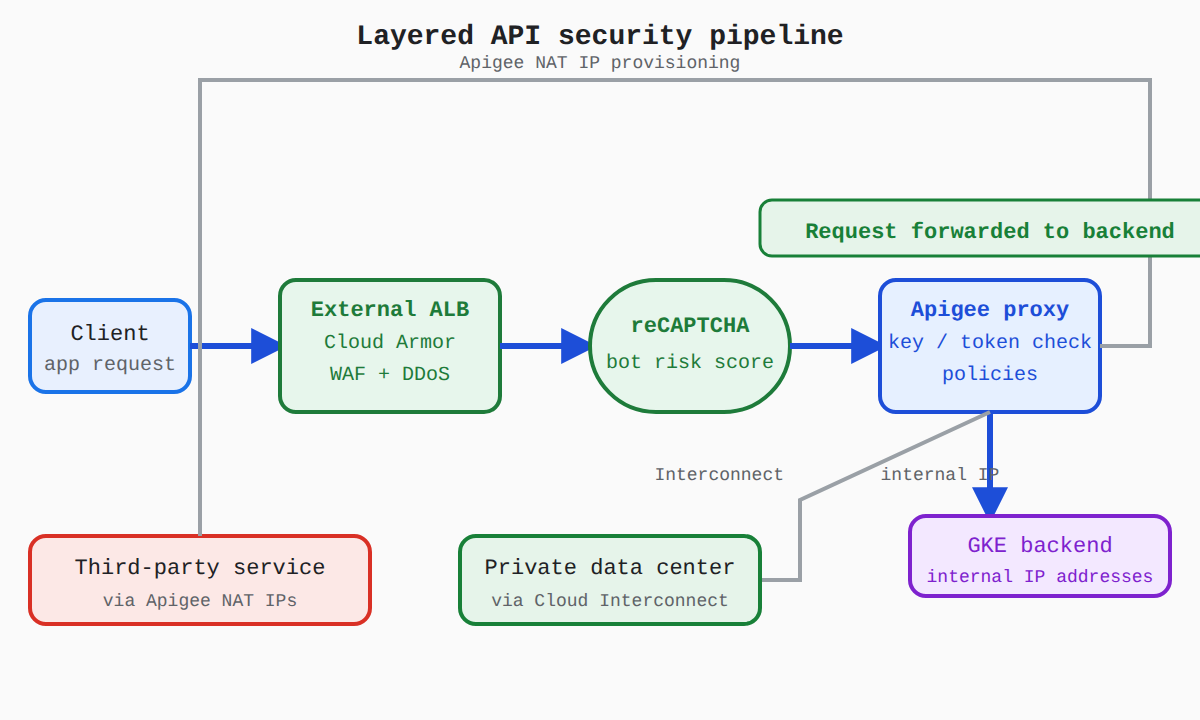
Change the traffic conditions to see which security layer stops the request, or which backend it reaches.
Every outcome
Succeeds
3 outcomesValid request forwarded to the GKE backend
With clean traffic, low bot risk, and a valid API key, Apigee forwards the request to the Google Kubernetes Engine backend directly over internal IP addresses, because Apigee and the GKE service sit in the same peered network.
Starting scenarioEvery input at its default
Valid request routed to the data center via Cloud Interconnect
The backend target changed to a private data center: Apigee sends the request over a dedicated Cloud Interconnect connection instead of the public internet, keeping traffic to on-premises systems private.
What changed
- Target backendGoogle Kubernetes EnginetoPrivate data center
Valid request egresses to a third party via NAT addresses
The backend target changed to an external partner service: Apigee sends the request to third parties through provisioned Apigee NAT IP addresses, so the external service sees a predictable source address.
What changed
- Target backendGoogle Kubernetes EnginetoThird-party service
Fails
1 outcomeCloud Armor blocks the request at the edge
Because the traffic violates a WAF rule or is part of a DDoS pattern, Cloud Armor rejects it at the external Application Load Balancer with an error status before it ever reaches Apigee. Edge blocks like this keep malicious volume away from the API management layer entirely.
What changed
- Network traffic condition (Cloud Armor)Clean traffictoDDoS / WAF violation
Mixed
2 outcomesreCAPTCHA flags the request as a bot
The traffic is clean for Cloud Armor rules, but reCAPTCHA scores it as high bot risk, so Cloud Armor can deny the request before the external Application Load Balancer routes it to Apigee. This condition changed: the bot risk is high instead of low.
What changed
- Bot risk assessment (reCAPTCHA)Low risk / legitimatetoHigh risk / bot
Apigee returns 403 for invalid credentials
Edge checks pass, but the API key is invalid or revoked, so Apigee executes its security policies and responds with 403 Forbidden instead of forwarding the request to any backend. This condition changed: the credentials are invalid instead of valid.
What changed
- API credentials (Apigee)Valid API keytoInvalid / revoked key
In the Domain
Layered Protection With Load Balancing and Bot Defense
Layered protection with load balancing and bot defense adds network controls in front of API-level checks. Cloud Armor attaches to the external Application Load Balancer to provide web application firewall (WAF) capabilities and distributed denial of service (DDoS) protection, while reCAPTCHA adds risk scoring for website traffic. The request flow runs in a fixed order from client to load balancer to Cloud Armor evaluation to reCAPTCHA check to Apigee policy execution to backend forwarding. Apigee forwards valid requests to Google Kubernetes Engine backends over internal IP addresses, to private data centers through Cloud Interconnect, or to third parties through provisioned NAT addresses. If keys or tokens are invalid, Apigee returns a 403 response; Cloud Armor rejects requests that violate its rules before they reach Apigee.
Domain 5 of 6
The value of APIs
Read the Domain summaryPractice this Domain
112 practice questions
Practice this DomainMore from this Domain
Last updated