Diagram
DNS Query to IP Connection in Order
Sequence
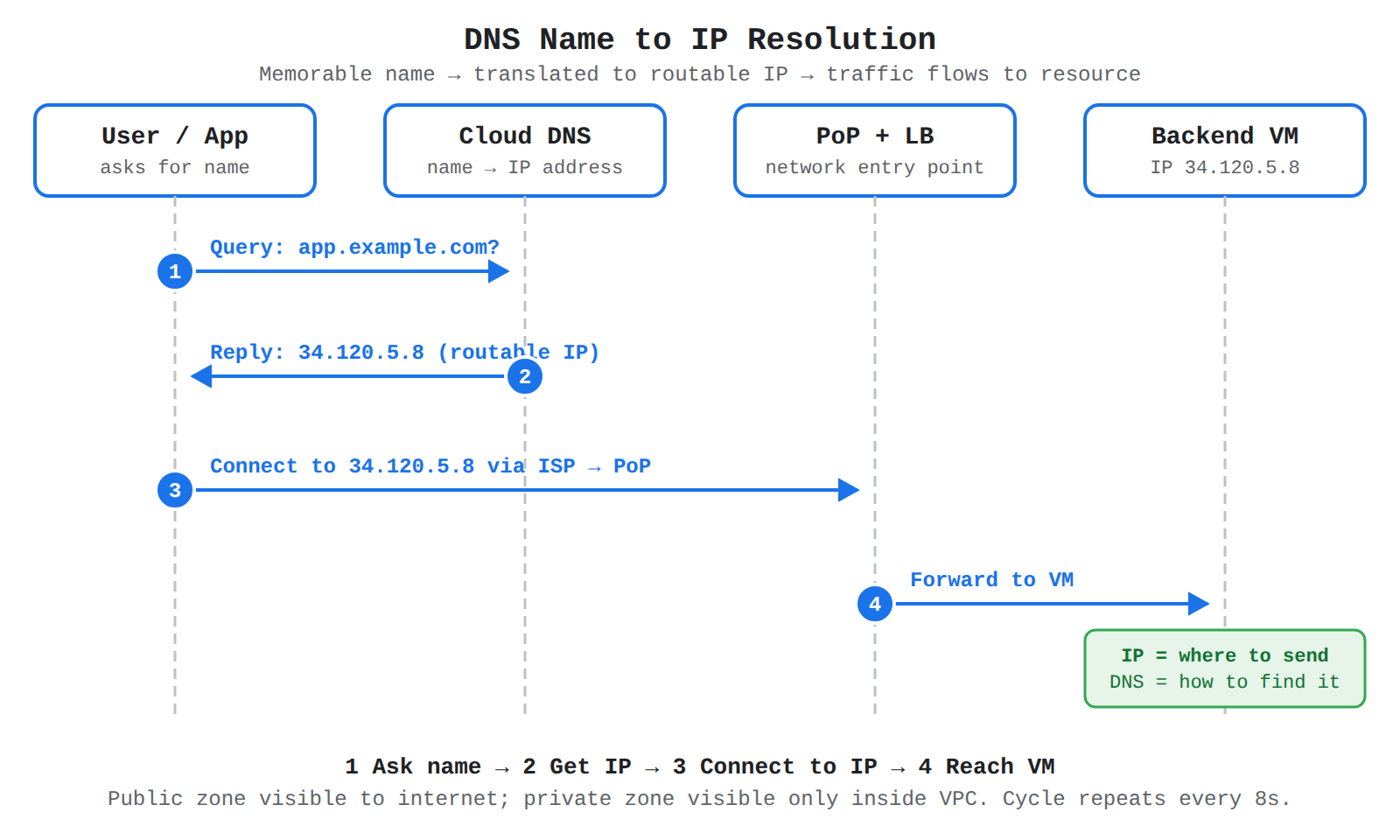
A sequence diagram with four lifelines — User App, Cloud DNS, PoP plus Load Balancer, and Backend VM — showing query for app.example.com, reply with IP 34.120.5.8, then connection to that IP in order.
In the Domain
How Domain Name Servers Translate Names to Addresses
The Domain Name System (DNS) is the system that translates domain names into routable IP addresses for people and applications. When a user or application requests a name, DNS resolution returns the matching IP address so traffic can flow from the requester to the correct resource. Access to Google Cloud APIs depends on DNS together with globally distributed load balancers and points of presence. Global load balancing, DNS, and failover between regions all depend on the underlying physical network.
Internal DNS automatically creates DNS names for Compute Engine virtual machines and internal load balancers. Cloud DNS provides low-latency and high-availability DNS zone serving and can act as the authoritative server for public zones visible to the internet or private zones visible only inside your network. In a hybrid environment with on-premises and cloud networks, private DNS requests can be forwarded between environments so services can be addressed from both sides.
Domain 5 of 6
Define basic network infrastructure terminology, including: IP address; internet service provider (ISP); domain name server (DNS), regions, and zones; fiber optics; subsea cables; network edge data centers, latency; and bandwidth.
Read the Domain summaryPractice this Domain
27 practice questions
Practice this DomainLast updated