Fundamental
Prepare and test your skills

Fundamental
Prepare and test your skills
Network Terminology Regions Latency and Bandwidth
Global connectivity in Google Cloud is the worldwide physical and logical network that moves traffic across zones, regions, and continents. The long-distance transport layer is built on backbone technologies such as fiber-optic cables and subsea cables, which carry high volumes of data between locations with high throughput. This backbone gives Google Cloud global reach, supports global load balancing, and keeps traffic on Google's network until it is close to its destination.
Global Backbone and Points of Presence
The global backbone (opens in a new tab) is Google Cloud's worldwide network that carries traffic between regions and enables global load balancing. The global backbone reduces end-user latency by placing interconnects close to users and gives Google flexibility to shift traffic across locations. Points of presence (PoPs) are network edge locations where customer traffic enters or leaves the Google network, so traffic can stay inside Google's network until it is near its destination. Access to Google Cloud APIs depends on Domain Name System (DNS), globally distributed load balancers, and PoPs working together over this physical infrastructure.
Location Scopes and Data Transport Boundaries
The location scope of a Google Cloud resource determines how far a failure can affect it and how data can move across boundaries. Resources can be zonal, regional, multi-region, or global, and each scope has a different level of isolation. Zonal resources operate in one zone, regional resources are redundantly deployed across zones in one region, multi-region resources are spread across specific regions, and global resources are available across all locations.
| Resource scope | Where it operates | Resilience to outages |
|---|---|---|
| Zonal | Single zone in a region | Low; a zone outage can affect it |
| Regional | Redundantly across multiple zones in one region | Medium; survives zone outages but not region outages |
| Multi-region | Distributed across specific regions | High; survives loss of a specific zone or region |
| Global | Available across all Google Cloud locations | High; survives zonal and regional incidents |
Zonal resources can be protected by deploying redundantly across zones or regions. Regional resources can be protected by deploying across multiple regions. Multi-region and global resources still need careful change management and defense-in-depth fallbacks because an outage that spans many regions or a bad global configuration can still affect them.
Global and Multi-Region Resources
Global resources are resources that are available across all Google Cloud locations and do not depend on infrastructure in any single region. Examples include projects, Virtual Private Cloud networks with routes and firewall rules, Cloud DNS zones, global external Application Load Balancers, global key rings in Cloud Key Management Service, Pub/Sub topics, and secrets in Secret Manager. Setting up one global resource can be simpler than operating many regional resources. The tradeoff is that a critical configuration error in a global resource can make it a single point of failure across all geographies.
Multi-region resources are resources distributed across specific regions to survive incidents in particular zones or regions. Examples include dual-region and multi-region Cloud Storage buckets, multi-region Spanner instances, multi-cluster Bigtable instances, and multi-region key rings in Cloud Key Management Service. Multi-regional services are designed to keep working after the loss of a single region. An outage that affects multiple regions at once can still affect some or all multi-region resources in those regions.
Internal Services and Dependencies
Internal services are the Google-built systems that underpin customer-facing Google Cloud services. Key examples include Spanner (opens in a new tab), Colossus, Borg, and Chubby, which are either load-balanced across multiple regions or dedicated to each region where they run. Where they are load-balanced across regions, Google rolls out updates region by region so problems can be detected without disrupting customer use. None of these internal services are limited to a single logical data center or a single region.
Networking services such as global load balancing, DNS, and failover between regions depend on physical networking infrastructure. Storage services such as Spanner, Bigtable, and Cloud Storage depend on encryption and key management, logging and auditing, internal replication for multi-region availability, and cross-region networking for backups and replication to other regions. Messaging services such as Pub/Sub depend on the global network to reach customer-controlled endpoints.
Latency, Throughput, and Region Selection
Data transport choices affect latency, bandwidth, cost, and resilience for applications on Google Cloud. To reduce latency for users in one area, deploy the application in the region closest to those users. For batch computing that needs low-latency and high-bandwidth links between compute nodes, a single-region architecture keeps traffic inside the region, which lowers delay between resources and avoids cross-region transfer costs. A single-region architecture can also help meet data residency rules, such as keeping user data stored and accessed only in data centers within Europe.
When choosing regions, consider service availability in each region, Compute Engine (opens in a new tab) machine-type availability, end-user latency needs, resource cost, cross-regional transfer cost, regulatory needs, and sustainability needs. Some factors conflict, so the cheapest region may not have the lowest carbon footprint or the lowest latency. The best choice balances speed, cost, compliance, and availability rather than optimizing only one factor.
Reliability and Example Architecture
Reliability in Google Cloud comes from combining global, regional, and zonal resources so a single zone or region failure has limited impact. A single region failure generally affects only customers operating solely in that region, while customers with multi-region products are not affected. Google Cloud is designed to prevent correlated failures across regions, and cross-region networking is required for explicitly configured backups and replication.
A multi-tier example shows how the layers work together. A global external Application Load Balancer receives client requests and sends them to a regional managed instance group with two Cloud SQL (opens in a new tab) connected Compute Engine virtual machines. The application reads and writes a Cloud SQL database configured for high availability, with primary and standby instances in separate zones and synchronous replication between them. The database is backed up automatically to a multi-region Cloud Storage bucket, so the global load balancer survives zone and region outages, the regional group survives zone outages, and the application continues even if a single zonal virtual machine fails.
Exam tip: A global resource is resilient to zone and region outages, but a configuration error in a global resource can become a single point of failure; use careful change management and regional fallbacks.
Core internet and network addressing connects human-friendly names to routable numeric locations so users and applications can reach cloud resources. An IP address is the numeric address that traffic is actually routed to, while the Domain Name System (DNS) translates a memorable domain name into that address. In Google Cloud, this translation works together with load balancers and points of presence over physical networking infrastructure.
What IP Addresses Do in Cloud Networks
IP addresses (opens in a new tab) are the routable identifiers that let network traffic find a specific virtual machine, load balancer, or service endpoint. Names are easier to remember and more flexible to change, but the network still needs the IP address to deliver packets to the right destination. Google Cloud uses internal private addresses inside a network and external addresses for traffic that must be reachable from outside.
Internal IP addresses are allocated from subnets, which segment the network address space by region and control which address range an instance receives. Static external IP addresses (opens in a new tab) are regional resources that can only be assigned within the same region, and they are also used by regional forwarding rules for regional load balancers and protocol forwarding. Resources with only a private internal address can still reach certain Google APIs and services through Private Service Connect (opens in a new tab) or Private Google Access, so a virtual machine does not always need an external IP address.
How Domain Name Servers Translate Names to Addresses
The Domain Name System (DNS) is the system that translates domain names into routable IP addresses for people and applications. When a user or application requests a name, DNS resolution returns the matching IP address so traffic can flow from the requester to the correct resource. Access to Google Cloud APIs depends on DNS together with globally distributed load balancers and points of presence. Global load balancing, DNS, and failover between regions all depend on the underlying physical network.
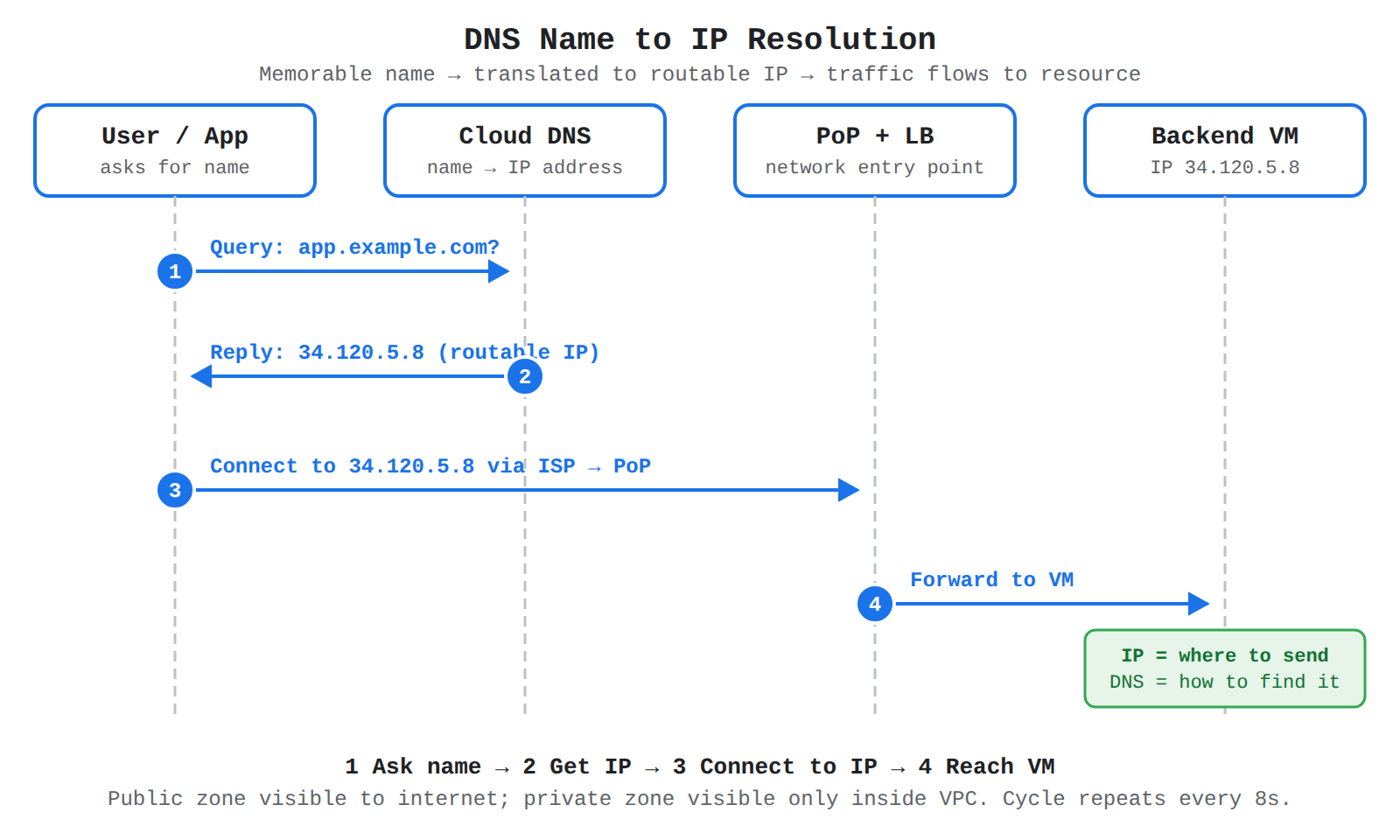
A sequence diagram with four lifelines — User App, Cloud DNS, PoP plus Load Balancer, and Backend VM — showing query for app.example.com, reply with IP 34.120.5.8, then connection to that IP in order.
Internal DNS automatically creates DNS names for Compute Engine virtual machines and internal load balancers. Cloud DNS (opens in a new tab) provides low-latency and high-availability DNS zone serving and can act as the authoritative server for public zones visible to the internet or private zones visible only inside your network. In a hybrid environment with on-premises and cloud networks, private DNS requests can be forwarded between environments so services can be addressed from both sides.
Exam tip: A Cloud DNS public zone is visible to the internet, while a Cloud DNS private zone is visible only within your network.
How Connectivity Reaches Cloud Services
Google Cloud connectivity moves customer traffic over a global backbone and a global network of peering points of presence. An internet service provider (ISP) gives users and businesses their initial access to the internet and carries their traffic toward Google's network. Traffic then enters Google's network at a nearby point of presence and stays inside Google's network until it is close to its destination, which improves performance and security.
For reliability, customer traffic enters through points of presence and is distributed by globally distributed load balancers that rely on DNS to direct requests to healthy resources. If a zone or region has a problem, DNS and global load balancing help support failover to another region over the same physical infrastructure. Together, IP addressing for location, DNS for name-to-address translation, and the backbone with points of presence for transport keep cloud applications reachable and responsive.
Cloud infrastructure structure and performance describe where an application runs and how quickly users can reach it. On Google Cloud, regions (opens in a new tab) hold compute and storage resources, zones isolate those resources inside a region, and network edge locations bring user traffic onto Google's network close to the user. Latency is the delay before data arrives, and bandwidth is the amount of data that can move at once and what it costs to move.
Regions and Zones
A region is a specific geographic location where Google Cloud resources such as virtual machines and storage can be deployed. A zone is an isolated deployment area inside a region, and each region contains multiple zones so a failure in one zone does not stop the others. This design is visible in storage: regional buckets replicate data synchronously across zones, regional Persistent Disk volumes replicate across two zones, and regional Filestore instances replicate across three zones.
Regions and zones also control cost, capacity, and deployment options. Not all CPU platforms and machine types are available in every region or zone, and Compute Engine deployments are limited by regional resource quotas. Resource prices differ by region, and moving an application and its data between regions later is cumbersome and sometimes costly. Choosing a region therefore balances latency to users, price, colocation with other services, machine availability, quotas, and carbon-free energy percentage.
| Location type | What it holds | How it protects performance and availability |
|---|---|---|
| Region | Compute Engine virtual machines, Persistent Disk, Cloud Storage buckets, and other regional resources | Places workloads close to users to lower latency and enables synchronous replication across zones |
| Zone | Individual virtual machines, zonal Persistent Disk volumes, and zone-level capacity | Isolates failures inside a region; intra-zone round-trip latency is typically less than 55 microseconds at the 50th percentile |
| Network edge location | Points of presence, Cloud CDN cache nodes, and peering or interconnect connections in over 200 metropolitan areas | Brings user traffic onto Google's network early and serves cached content close to users |
Network Edge Data Centers
Network edge locations (opens in a new tab) are the more than 200 metropolitan locations where user traffic enters Google's network. These points of presence span North America, South America, Europe, the Middle East, Asia Pacific, Oceania, and Africa, with connectivity through Cloud Interconnect, Verified Peering Provider, and Direct Peering. Access to Google Cloud APIs depends on DNS, globally distributed load balancers, and these edge locations.
Edge locations sit between users and regions in the traffic flow. Traffic flows from the user to the closest point of presence, then across Google's global network to the region where the resources live. Cached responses flow back from Cloud CDN nodes at the edge without traveling all the way to the region. For most mobile and other non-latency-critical apps, a single-region deployment with Cloud CDN delivery of cacheable content and Secure Sockets Layer termination at the edge is the optimal choice.
Latency and How It Shapes Region Choice
Latency is the round-trip delay a user experiences, and region selection affects only the latency to the Compute Engine region. An architect can optimize region choice and application behavior but cannot control the user's last mile or the latency to the closest Google edge point of presence. In some cases the region-to-user portion is only a small part of total delay, for example when users are mainly on cellular networks.
Latency can be estimated and measured before choosing regions. A rough rule is 1 millisecond of round-trip latency for every 100 kilometers traveled, assuming the real network path is about 1.5 to 2 times the map distance. The United States is connected to most other regions, so an app with a global user base in a single region is usually best hosted in a United States region, while traffic between Europe and Asia without direct connectivity flows through the United States. For multi-region apps that must synchronize data, inter-region latency is usually stable but should be measured, and cross-region packet loss is tracked against a global target average lower than 0.01 percent.
A practical methodology for choosing regions follows an ordered sequence:
- Remove blocked regions: First, remove regions blocked by non-latency factors such as price or colocation with required services.
- Choose a deployment model: Then, choose single-region or multi-region based on latency requirements and app architecture.
- Match regions to users: Then, for a single region deploy closest to corporate premises or representative users, or in the United States for a global user base; for multi-region choose regions close to users and optimize for median latency or for serving 95 to 99 percent of users within a target.
- Use price as a tiebreaker: Only after latency is similar in multiple regions, use pricing as the deciding factor.
Exam tip: Region selection changes only the latency to the Compute Engine region, not the user's last-mile latency or the latency to the closest edge POP.
Bandwidth, Data Transfer, and Performance Tradeoffs
Bandwidth in Google Cloud affects both performance and cost when traffic moves into, out of, or between locations. Three traffic directions define the charges that influence design for high availability and disaster recovery:
- Ingress traffic: Traffic that enters Google Cloud from the public internet, on-premises locations, or other clouds, which is free for most services except internet-facing traffic managers such as Cloud Load Balancing, Cloud CDN, and Google Cloud Armor that charge on ingress handled.
- Egress traffic: Traffic that leaves Google Cloud in any way, where egress charges apply to many services including Compute Engine, Cloud Storage, Cloud SQL, and Cloud Interconnect.
- Regional and zonal traffic: Traffic that crosses regional or zonal boundaries inside Google Cloud, where sending traffic to a replica in another zone or syncing data between regions can create cross-zonal or cross-regional charges.
These bandwidth costs create tradeoffs with latency and resilience. Replicating storage across zones or regions improves availability against outages, but the workflow depends on cross-zone or cross-region networking and pays the related transfer cost. A compact placement policy lowers network latency by keeping virtual machines physically close together, typically less than 45 microseconds at the 50th percentile between c2-standard-4 virtual machines, but that tight grouping is the opposite of spreading across zones for resilience. The best design places capacity where low latency is needed, uses the edge for caching and entry, and accepts replication cost only where availability requires it.
Key Facts
- The global backbone carries traffic between Google Cloud regions, while points of presence are edge locations where customer traffic enters Google's network and stays inside it until close to the destination.
- An IP address is the routable numeric destination for network traffic, while the Domain Name System (DNS) translates human-friendly domain names into those IP addresses.
- A region is a geographic location for deploying resources and contains multiple isolated zones so a single zone failure does not stop the whole region.
- Network edge data centers in over 200 metropolitan areas bring traffic onto Google's network early and serve cached content close to users through Cloud CDN.
- Latency is round-trip delay and bandwidth affects how much data can move and what it costs, with charges differing for ingress traffic, egress traffic, and traffic that crosses zonal or regional boundaries.
Frequently Asked Questions
What is the difference between an IP address and the Domain Name System (DNS)?
An IP address is the routable numeric destination that network traffic is actually delivered to, while the Domain Name System (DNS) translates human-friendly domain names into those IP addresses. In Google Cloud, internal private addresses are used inside a network and external addresses are used for traffic reachable from outside, and DNS resolution returns the matching IP address so traffic can flow to the correct resource.
What are regions, zones, and network edge data centers in Google Cloud?
A region is a specific geographic location where resources such as virtual machines and storage can be deployed, and each region contains multiple isolated zones so a failure in one zone does not stop the others. Network edge locations are more than 200 metropolitan locations where user traffic enters Google's network at points of presence, then travels across the global backbone to the region, while cached responses can be served from the edge without traveling to the region.
What is the difference between latency and bandwidth in Google Cloud?
Latency is the round-trip delay a user experiences, while bandwidth affects how much data can move at once and what it costs to move. Region selection affects only the latency to the Compute Engine region, and charges differ for ingress traffic that enters Google Cloud, egress traffic that leaves Google Cloud, and traffic that crosses zonal or regional boundaries inside Google Cloud.
Sample Question
A retail company is deploying a new e-commerce application on Google Cloud for customers located within a single geographic area. The architecture team has established the following availability and performance requirements:
- Fault tolerance: The application must remain available if a single failure domain experiences an unexpected outage, while avoiding the cost and complexity of replicating data across separate geographic areas.
- Low latency: Static content and initial client connection requests must be handled at the locations where user traffic first enters Google's global network to minimize round-trip time (RTT).
Which infrastructure strategy should the company implement to meet these requirements?
Distribute both the frontend and backend across multiple geographic regions, and route all static content requests directly to the regional backend servers.
Deploy the Compute Engine virtual machines directly inside network edge Points of Presence (POPs), and store application backups in a single zone.
Deploy the application across multiple zones within a single region, and use network edge Points of Presence (POPs) with Cloud Load Balancing and Cloud CDN.
Deploy all application components within a single zone to optimize intra-zone bandwidth, and deliver user traffic over Standard Tier transit ISP networks.
How learners score on this domain
Last updated