Fundamental
Prepare and test your skills

Fundamental
Prepare and test your skills
DNS Resolution of Domain Names to IP Addresses
Free sample question with answers and detailed explanation below. The Cloud Digital Leader practice bank has an additional 3,070 practice questions.Try 10 free realistic questions: instant score, no credit card, and no account required.
A retail company is deploying a customer-facing web application on Google Cloud and has assigned a public IP address to its external load balancer. Customers connect to the internet through their local internet service provider (ISP) and enter the application's domain name (such as shop.example.com) into their web browsers rather than typing the numerical IP address directly.
How is the human-readable domain name translated so that customer traffic can be routed to the application on Google Cloud?
Explanations
The WHOIS database translates the domain name into a numerical IP address and forwards the packets across the internet
The WHOIS database translates the domain name into a numerical IP address and forwards the packets across the internet
What the WHOIS Database Is
The WHOIS database is a publicly accessible directory service and query/response protocol (RFC 3912) used to look up administrative and ownership metadata about registered domain names and IP address blocks. It serves as a record-keeping directory for domain accountability rather than a live network routing or address translation mechanism.
Why It Doesn't Meet the Requirement
- Stores contact metadata, not routing records: The WHOIS database stores human-readable ownership and registration details rather than the active DNS resource records (such as
AorAAAArecords) that map subdomains to load balancer IP addresses. - Not involved in browser traffic forwarding: Web browsers and internet service providers (ISPs) do not query the WHOIS protocol to load a webpage, nor does the WHOIS database forward network packets across the internet.
Key Characteristics of the WHOIS Database
- Contact details: Stores contact information for the domain's registrant, administrator, and technical contacts.
- Lifecycle timestamps: Tracks important administrative dates, including when a domain was initially created, last updated, and when its registration expires.
- Registrar identification: Identifies the specific registrar of record managing the domain name.
This Answer Would Be Correct If
This option would be the right choice if the scenario involved an IT administrator or security analyst needing to identify the registered owner, technical contact, registrar of record, or expiration date of an existing domain name.
Additional Context
Students often confuse WHOIS with DNS because both are queryable databases associated with domain names. However, WHOIS answers the question "Who owns and manages this domain?" whereas DNS answers the question "What numerical IP address should network traffic be sent to for this domain?"
Domain name servers (DNS) query a hierarchical distributed database to resolve the domain name into the load balancer's routable IP address
Domain name servers (DNS) query a hierarchical distributed database to resolve the domain name into the load balancer's routable IP address
What the Domain Name System (DNS) and Name Servers Are
The Domain Name System (DNS) is a hierarchical distributed database that stores IP addresses and other resource records, allowing networks and clients to look up routable numerical addresses by human-readable domain names. DNS name servers store the specific DNS records for a domain and respond with answers to queries against their database. In Google Cloud, Cloud DNS acts as a resilient, global managed DNS hosting service that publishes domain names and zones to the global DNS namespace.
How It Meets the Requirements
- Facilitating initial connectivity via the ISP: A customer's internet service provider (ISP) provides the foundational network connectivity to the internet and typically initiates the recursive DNS query on behalf of the user's browser.
- Translating the domain name: When the user enters
shop.example.com, the request is directed to DNS name servers, which look up the domain's resource records in the distributed database. - Routing to the IP address: Every networked resource exposed to the internet—such as a Google Cloud external load balancer—requires a distinct, routable public IP address. Once the name server resolves
shop.example.cominto its corresponding numerical IP address, the user's traffic can be routed across the internet to the application.
DNS Name to IP Resolution Sequence
Sequence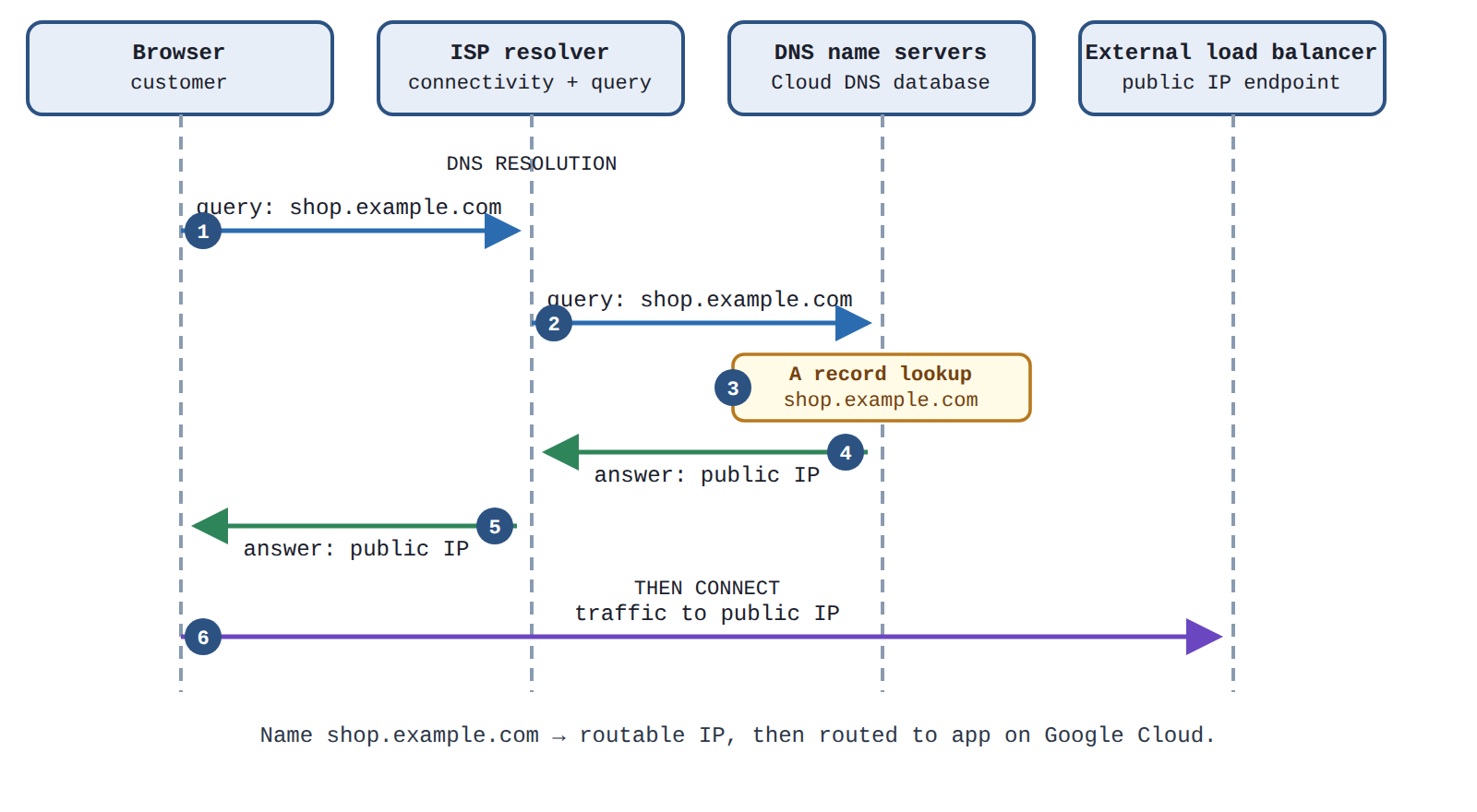
Key Capabilities and Advantages
- Human-friendly access: Eliminates the need for end users or application developers to memorize complex numerical IPv4 or IPv6 addresses.
- Decoupled infrastructure: Allows cloud administrators to change the underlying IP address of a server or load balancer by simply updating a DNS record, without requiring customers to use a different website address.
- Global scalability: Distributes lookup traffic across a worldwide hierarchy of name servers to ensure low-latency resolution.
- Public and private resolution: Services like Cloud DNS support both public zones (visible to the public internet) and private zones (visible only within authorized Virtual Private Cloud [VPC] networks).
Why This Is Optimal
Unlike administrative entities such as registrars, registries, or contact lookup tools like WHOIS, DNS name servers are the active network infrastructure components engineered specifically to perform real-time name-to-IP resolution for internet and cloud traffic.
A domain registry dynamically assigns a temporary IP address to the user's browser to establish a direct connection with the cloud server
A domain registry dynamically assigns a temporary IP address to the user's browser to establish a direct connection with the cloud server
What a Domain Registry Is
A domain registry (operated by a registry operator under the authority of ICANN) is a master database that maintains administrative data for second-level domains (such as google.com or example.com) beneath a specific top-level domain (TLD) or domain ending (such as .com, .net, or .co.uk).
Why It Doesn't Meet the Requirement
- Does not assign IP addresses to end-user browsers: End-user devices and networks receive their dynamically assigned IP addresses from their internet service provider (ISP) or local network router, not from a domain registry.
- Manages TLD hierarchy, not application endpoints: While TLD registries point DNS queries toward a domain's authoritative name servers, they do not dynamically issue temporary IP addresses to browsers or establish direct connections to Google Cloud servers.
Key Characteristics of a Domain Registry
- TLD management: Controls all domain registrations under a specific domain ending (for example, VeriSign operates the
.comand.netregistries). - ICANN delegation: Receives authority from the Internet Corporation for Assigned Names and Numbers (ICANN) to maintain core domain hierarchy infrastructure.
- Wholesale relationship: Works with accredited registrars who sell individual domain registrations to the public.
This Answer Would Be Correct If
This concept would apply if the question asked which organization maintains the authoritative master database for a top-level domain (TLD) like .com or if the question asked how an ISP assigns client IP addresses to customer modems and routers.
Additional Context
In internet networking, IP addresses serve two sides of a connection: the ISP assigns an IP address to the customer's connection so response packets can return to the user, while Google Cloud assigns a public IP address to the external load balancer so requests can reach the hosted application. DNS name servers bridge the gap by translating the domain name into the load balancer's IP address.
A domain registrar intercepts the user's browser traffic and routes the request directly to the destination server's IP address
A domain registrar intercepts the user's browser traffic and routes the request directly to the destination server's IP address
What a Domain Registrar Is
A domain registrar is a commercial organization accredited to manage the registration of domain names on behalf of individuals and businesses. It acts as an administrative and transactional interface between a registrant (the person or organization purchasing the rights to use the domain) and a domain registry (the organization that maintains the master database for a top-level domain).
Why It Doesn't Meet the Requirement
- Administrative role vs. active packet routing: A registrar handles the business transaction of reserving a domain name for a set period (typically one to ten years), not the live routing of customer HTTP/HTTPS network packets.
- No real-time traffic interception: When a user connects through their ISP and browses to a website, their data packets do not pass through the registrar's billing or registration platform to reach the Google Cloud load balancer.
Key Characteristics of a Domain Registrar
- Sales and renewals: Sells available domain names, processes annual renewals, and manages domain transfers between accounts.
- Record delegation: Allows the registrant to specify which DNS name servers (such as Cloud DNS name servers) are authoritative for the domain.
- WHOIS data collection: Collects administrative and technical contact information from the domain owner for inclusion in the WHOIS database.
This Answer Would Be Correct If
This option would be appropriate if the scenario asked which organization a company interacts with to purchase, register, or renew ownership rights for a domain name like example.com and designate its authoritative name servers.
Additional Context
While some domain registrars also offer optional DNS hosting provider services as a value-added feature, the registrar function itself is strictly administrative. In cloud architectures, organizations frequently register a domain through a registrar and delegate actual DNS resolution to Cloud DNS.
Try 10 interactive questions like this one, free
Answer them yourself and get your score the moment you finish. No account needed.
Full access includes
- 3,070 practice questions across all 6 exam domains
- Every answer explained: why it is right, and why the others are not
- Scout, an AI tutor that answers your follow-up questions
- Readiness tracking by domain, so you know when to book the exam
Related free sample questions
Keep the momentum going with these hand-picked practice scenarios
FundamentalCloud Digital Leader
Regional Multi-Zone Deployment with Edge POPs
Define basic network infrastructure terminology, including: IP address; internet service provider (ISP); domain name server (DNS), regions, and zones; fiber optics; subsea cables; network edge data centers, latency; and bandwidth.
FundamentalCloud Digital Leader
IaaS vs PaaS TCO Tradeoffs
Compare and contrast the benefits and tradeoffs of IaaS, PaaS, and SaaS including total cost of ownership (TCO), flexibility, shared responsibilities, management level, and necessary staffing and technical expertise.
FundamentalCloud Digital Leader
Google SecOps Unified SIEM and SOAR
Define Security Operations (SecOps) in the cloud and describe its business benefits.
FundamentalCloud Digital Leader
Real-Time Clickstream Analytics Personalization
Explain how data generates business insights, drives decision-making, and creates new value.
FundamentalCloud Digital Leader
SRE with Google Cloud Observability
Discuss the fundamental concepts of modern operations, reliability, and resilience in the cloud.
AdvancedProfessional Cloud DevOps Engineer
Artifact Registry Virtual Repository Priority
Artifact Registry configuration
Last updated