Fundamental
Prepare and test your skills
Fundamental
Prepare and test your skills
Managed MySQL Migration Without Rewriting Queries
Free sample question with answers and detailed explanation below. The Cloud Digital Leader practice bank has an additional 3,070 practice questions.Try 10 free realistic questions: instant score, no credit card, and no account required.
A retail organization runs a self-hosted MySQL database on on-premises virtual machines and plans to migrate it to Google Cloud. Leadership has established the following goals and constraints for the migration:
- Eliminate the operational overhead of manual database patching, backups, and high-availability configuration
- Retain the current MySQL database engine and schema to avoid rewriting application queries
- Transition to a fully managed relational database service
Which migration strategy and Google Cloud service should the organization choose?
Explanations
Rehost (lift and shift) the self-hosted MySQL database on Compute Engine virtual machines
Rehost (lift and shift) the self-hosted MySQL database on Compute Engine virtual machines
What Rehosting (Lift and Shift) on Compute Engine Is
Rehosting, commonly known as a lift-and-shift migration, involves moving an existing workload from an on-premises environment to cloud infrastructure—such as Compute Engine virtual machines (VMs)—with minimal or no modifications to the underlying architecture. In this Infrastructure as a Service (IaaS) model, Google Cloud manages the physical data center, networking, and virtualization layers, while the customer remains responsible for the guest operating system and database software.
Why It Doesn't Meet the Requirements
While rehosting preserves the existing MySQL engine and avoids rewriting application queries, it fails to satisfy the core requirement of transitioning to a fully managed relational database service. Because the database remains self-hosted on Compute Engine VMs, the organization's IT team must still manually configure and maintain database patching, backups, replication, and high-availability failover.
Key Characteristics and Limitations
- Infrastructure-level optimization only: Lifting and shifting optimizes workloads from a hardware and data center perspective but does not natively leverage managed platform services.
- High operational burden: Database administrators remain responsible for operating system updates, MySQL engine upgrades, disk provisioning, and custom backup scripts.
- Complex high availability: Achieving regional failover on self-hosted VMs requires manual clustering, custom heartbeat monitoring, and manual replica promotion.
- Fast initial migration: Requires minimal upfront planning or architectural adjustments since the environment closely mirrors the on-premises setup.
This Answer Would Be Correct If
This approach would be the right choice if the organization needed to evacuate an on-premises data center as quickly as possible without changing any operational processes, or if the database relied on custom operating system configurations, specialized third-party software dependencies, or legacy configurations where refactoring or replatforming before migration was not feasible.
Additional Context
Organizations sometimes use rehosting as the first step in a phased migration strategy to exit physical data centers rapidly, and then subsequently replatform the self-hosted database to Cloud SQL in a second phase to reduce long-term operational overhead.
Refactor the database into containerized microservices running on Google Kubernetes Engine (GKE) Autopilot
Refactor the database into containerized microservices running on Google Kubernetes Engine (GKE) Autopilot
What Refactoring to Google Kubernetes Engine (GKE) Autopilot Is
Refactoring (often called move and improve) involves modifying and optimizing applications to take advantage of cloud-native capabilities without completely rewriting their core functionality. Google Kubernetes Engine (GKE) Autopilot is a managed container orchestration service where Google Cloud provisions and manages the underlying cluster infrastructure, including compute nodes, scaling, and baseline security configurations for containerized workloads.
Why It Doesn't Meet the Requirements
Although GKE Autopilot is a managed compute environment for containers, it is not a managed relational database service. Running a MySQL database inside containers on GKE still leaves the organization responsible for managing the database engine itself, including MySQL patching, schema backups, point-in-time recovery, and database replication. Furthermore, refactoring a database into microservices violates the constraint to avoid rewriting application queries or untangling dependencies prior to migration.
Key Characteristics and Limitations
- Designed for application tiers: GKE Autopilot is ideal for modernizing stateless application frontends and breaking monolithic VM applications into independent microservices.
- Requires untangling dependencies: Refactoring is suited for workloads with tightly coupled dependencies or inefficient resource utilization that must be restructured for cloud deployment.
- No native database engine management: Kubernetes manages container lifecycles and pod scheduling, not relational database internals like transaction logs or automated SQL failovers.
- Higher migration effort: Containerizing workloads and redesigning deployment pipelines requires significant DevOps and Site Reliability Engineering (SRE) effort.
This Answer Would Be Correct If
This option would be the right choice if the organization wanted to modernize its application frontend virtual machines or monolithic business logic into scalable, containerized microservices with automated cluster management, rather than migrating a backend relational database.
Additional Context
In a multi-tier cloud migration, organizations frequently mix and match migration approaches across a single application stack—for example, refactoring the frontend virtual machines to run on GKE Autopilot while simultaneously replatforming the backend MySQL database to Cloud SQL.
Replatform the database to Cloud SQL for MySQL
Replatform the database to Cloud SQL for MySQL
What Replatforming to Cloud SQL for MySQL Is
Replatforming (often referred to as move and tinker) involves migrating a workload to the cloud while introducing targeted platform optimizations—such as moving from a self-managed database to a fully managed database service—without changing the core application architecture. Cloud SQL for MySQL is Google Cloud's fully managed relational database service that automates routine database administration tasks while maintaining full compatibility with standard MySQL engines.
How It Meets the Requirements
- Eliminates operational overhead: Cloud SQL automatically manages software patching, automated and on-demand backups, point-in-time recovery (PITR), and regional high-availability (HA) failover configurations.
- Retains the current engine and schema: Because migrating from self-hosted MySQL to Cloud SQL for MySQL is a homogeneous database migration, the source and destination use the same database technology, preserving existing schemas and queries without requiring application rewrites.
- Provides a fully managed relational service: Cloud SQL offloads infrastructure and database engine maintenance to Google Cloud while delivering enterprise-grade reliability and scalability.
Cloud SQL for MySQL Managed Capabilities
Annotated Structure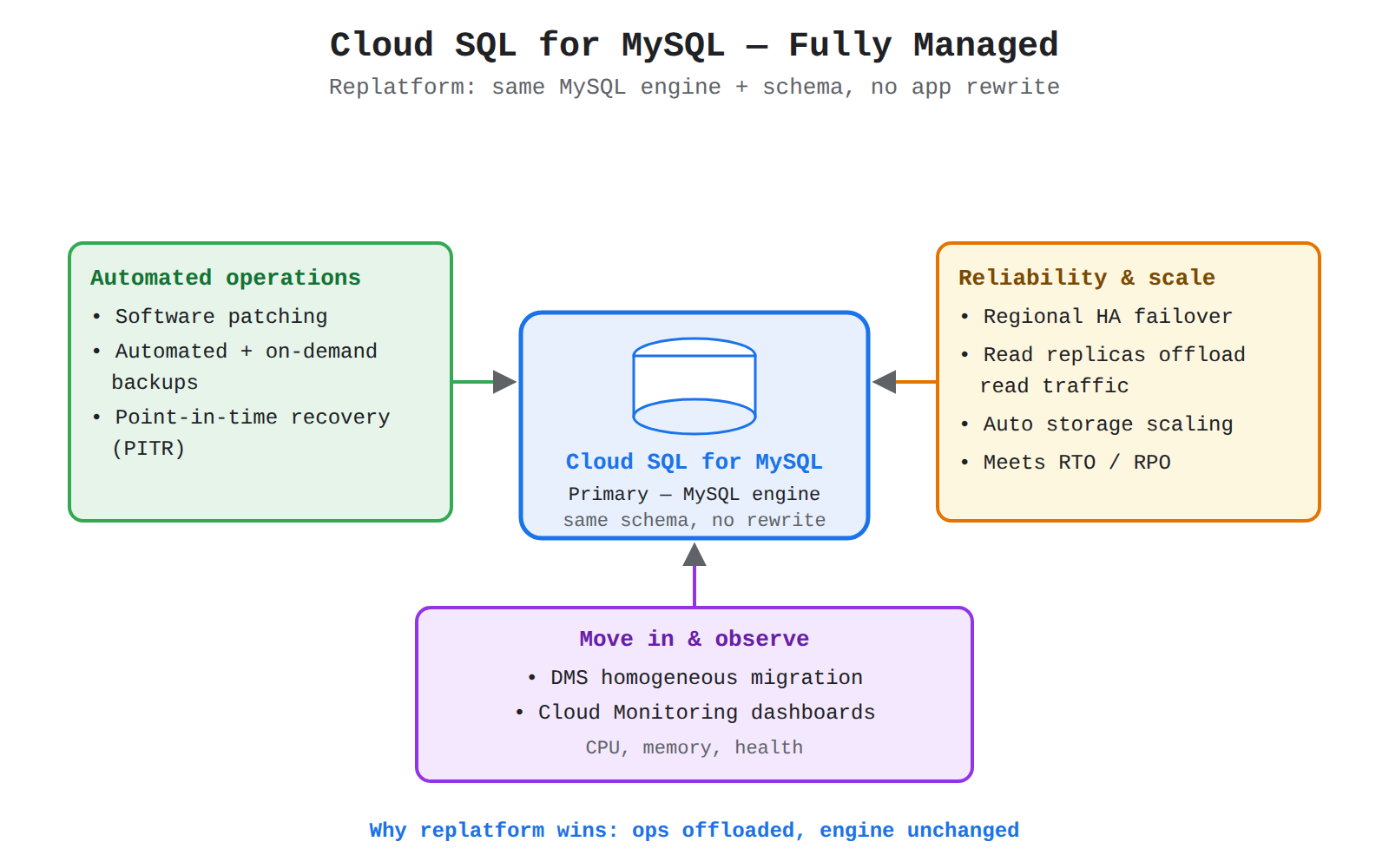
Key Advantages and Capabilities
- High availability and disaster recovery: Supports regional failover replicas to align with strict recovery time objectives (RTO) and recovery point objectives (RPO) for mission-critical workloads.
- Read scalability: Allows teams to add read replicas to offload read-heavy traffic from the primary database instance.
- Automated storage scaling: Dynamically increases storage capacity as data grows to prevent outages caused by disk exhaustion.
- Seamless migration tooling: Integrates natively with Google Cloud Database Migration Service (DMS) for either scheduled maintenance (one-time) or continuous replication (online) migrations.
- Built-in observability: Integrates with Cloud Monitoring predefined dashboards to track database health, CPU utilization, and memory capacity.
Why This Is Optimal
Compared to lifting and shifting onto virtual machines—which leaves the burden of database administration on internal IT teams—or refactoring and rebuilding—which demand costly and time-consuming application code changes—replatforming to Cloud SQL for MySQL delivers immediate operational relief and cloud-native reliability with minimal migration risk and zero application refactoring.
Rebuild (remove and replace) the database by rewriting the application to use Cloud Bigtable
Rebuild (remove and replace) the database by rewriting the application to use Cloud Bigtable
What Rebuilding (Remove and Replace) with Cloud Bigtable Is
Rebuilding (sometimes called remove and replace or rip and replace) is an intensive modernization strategy that involves discarding an existing software component or database and rewriting the workload from scratch to use a completely different cloud-native architecture. Cloud Bigtable is Google Cloud's fully managed, wide-column NoSQL database service designed for massive analytical and operational workloads requiring high throughput and low latency.
Why It Doesn't Meet the Requirements
This option directly conflicts with two stated requirements: retaining the current MySQL database engine and schema, and migrating to a relational database service. Moving from MySQL to Cloud Bigtable is a heterogeneous migration from a relational (SQL) database to a non-relational (NoSQL) key-value and wide-column store, which would force developers to completely redesign the data schema and rewrite all application queries.
Key Characteristics and Limitations
- High cost and complexity: Rebuilding an application and its database layer from the ground up requires substantial engineering time, testing, and financial investment.
- Non-relational data model: Cloud Bigtable does not support SQL joins, multi-row relational transactions, or standard MySQL schemas.
- Addresses legacy obsolescence: Rebuilding is specifically designed to eliminate technical debt when existing systems can no longer meet business objectives.
- Massive horizontal scalability: Cloud Bigtable excels at ingesting petabytes of time-series, IoT, or financial data at millions of operations per second.
This Answer Would Be Correct If
This strategy would be appropriate if the legacy database technology had reached its end of life, required uneconomical third-party licensing fees, or no longer satisfied business requirements because the workload had evolved into a massive-scale, high-throughput NoSQL time-series or analytical workload that required Cloud Bigtable.
Additional Context
When an existing relational database still meets functional business needs and uses a modern, supported engine like MySQL, rebuilding introduces unnecessary project risk and delay compared to replatforming directly to Cloud SQL.
Try 10 interactive questions like this one, free
Answer them yourself and get your score the moment you finish. No account needed.
Full access includes
- 3,070 practice questions across all 6 exam domains
- Every answer explained: why it is right, and why the others are not
- Scout, an AI tutor that answers your follow-up questions
- Readiness tracking by domain, so you know when to book the exam
Related free sample questions
Keep the momentum going with these hand-picked practice scenarios
FundamentalCloud Digital Leader
OLTP vs OLAP Workload Separation
Describe the ways that an organization can migrate or modernize their current database in the cloud.
FundamentalCloud Digital Leader
Database Migration Service Continuous CDC
Describe the ways that an organization can migrate or modernize their current database in the cloud.
FundamentalCloud Digital Leader
Toil Reduction and Blameless Postmortems
Define important cloud operations terms.
FundamentalCloud Digital Leader
Data Lakehouse Medallion Architecture
Discuss the main data value chain concepts and terms.
FundamentalCloud Digital Leader
Low CO2 Regions and Active Assist Recommender
Discuss how Google Cloud helps organizations meet sustainability goals and reduce environmental impact.
AdvancedProfessional Cloud DevOps Engineer
Log-Based Metrics Before Exclusion Filters
Optimizing logs (e.g., filtering, sampling, exclusions, cost management, source considerations)
Last updated