Fundamental
Prepare and test your skills

Fundamental
Prepare and test your skills
Cut Emissions with Low CO2 Regions and Rightsizing
Free sample question with answers and detailed explanation below. The Cloud Digital Leader practice bank has an additional 3,070 practice questions.Try 10 free realistic questions: instant score, no credit card, and no account required.
An organization is defining sustainability and operational efficiency guidelines for its cloud infrastructure. The IT operations team wants to actively minimize carbon emissions and reduce wasted energy across its compute and database workloads.
Which strategy aligns with Google Cloud recommendations for active carbon reduction and resource optimization?
Explanations
Deploy workloads in regions flagged with the Low CO2 indicator and apply Active Assist recommender insights to remove idle and downsize over-provisioned resources.
Deploy workloads in regions flagged with the Low CO2 indicator and apply Active Assist recommender insights to remove idle and downsize over-provisioned resources.
What Active Carbon Reduction and Resource Optimization Entail
Active carbon reduction in Google Cloud involves purposefully architecting and managing cloud infrastructure to minimize environmental impact. This approach combines two foundational strategies: selecting cloud data center regions powered by a high percentage of carbon-free energy (CFE) and using intelligent automation tools like Active Assist Recommender to continuously eliminate resource waste.
How It Meets Sustainability and Optimization Goals
- Selecting Low CO2 regions: Google Cloud identifies regions running on higher shares of clean energy with a green leaf icon and Low CO2 designation in the Google Cloud console. Deploying workloads in these regions immediately lowers gross carbon emissions.
- Eliminating idle resources: Active Assist analyzes historical usage data (such as CPU, memory, and network throughput) through Cloud Monitoring to flag idle virtual machine (VM) instances, unattached disks, and idle database instances, allowing administrators to stop or delete them.
- Downsizing over-provisioned infrastructure: Machine type sizing and database recommenders evaluate actual utilization trends, guiding teams to rightsize CPU, RAM, and disk allocations rather than drawing power for unused headroom.
Key Advantages
- Direct carbon footprint reduction: Workloads consume electricity from cleaner, renewable-heavy regional grids.
- Reduced power consumption: Decommissioning unused compute capacity directly decreases the energy load on physical data centers.
- Lower total cost of ownership (TCO): Eliminating zombie infrastructure and rightsizing over-allocated virtual machines significantly lowers monthly compute and database spending.
- Actionable operational insights: Automated recommenders provide structured, metric-driven recommendations via the console, API, and
gcloudCLI.
Why This Is Optimal
Combining strategic geographical placement in Low CO2 regions with automated, data-driven rightsizing addresses sustainability across the entire resource lifecycle—from initial deployment to ongoing day-to-day operations.
Active Carbon Reduction Lifecycle
Process Flow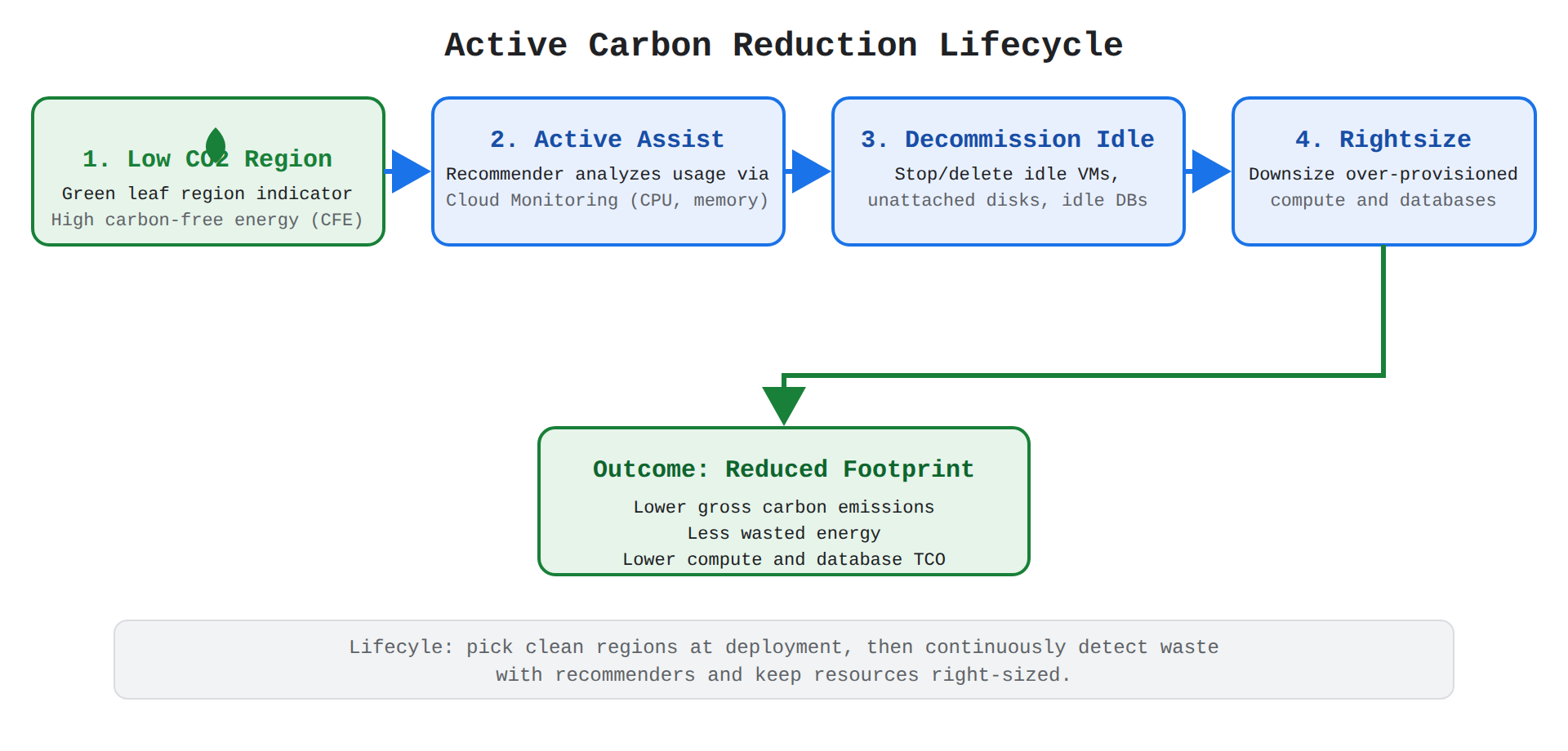
Maintain static on-demand compute reservations continuously without monitoring usage, while disabling automatic storage expansion on databases.
Maintain static on-demand compute reservations continuously without monitoring usage, while disabling automatic storage expansion on databases.
What Static Unmonitored Reservations and Fixed Storage Represent
This practice involves purchasing on-demand compute reservations and maintaining them indefinitely without reviewing utilization metrics, alongside capping database disk capacity without automated scaling mechanisms.
Why It Doesn't Meet the Requirement
- Fosters idle resource waste: Unused on-demand reservations reserve dedicated physical hardware capacity. If left unconsumed, they waste energy and generate unnecessary billing charges.
- Lacks proactive optimization: Failing to monitor reservations prevents teams from receiving and acting on reservation recommendations, which identify idle or underutilized capacity based on 7-to-30-day historical lookback periods.
- Increases downtime risk: Disabling auto grow on database storage does not reduce environmental impact; instead, it creates out-of-disk risks and potential service outages when capacity limits are reached.
Key Characteristics and Limitations
- Accumulates financial and energetic costs for compute capacity that runs empty.
- Requires manual administrative intervention to prevent out-of-disk failures.
- Bypasses Active Assist Recommender insights that help teams release unneeded reservations.
This Answer Would Be Correct If
An organization were preparing for an imminent disaster recovery failover drill where dedicated capacity must remain locked in reserve for a strict compliance test.
Additional Context
Compute Engine generates idle and underutilized reservation recommendations precisely to highlight reserved capacity that has not been consumed, allowing administrators to modify or delete reservations to optimize efficiency.
Deploy workloads in any available region and increase baseline virtual machine sizes so that CPU and memory utilization remain below 10% at all times.
Deploy workloads in any available region and increase baseline virtual machine sizes so that CPU and memory utilization remain below 10% at all times.
What Over-Provisioning for Low Utilization Is
This approach intentionally provisions significantly larger virtual machine (VM) instance types than required by application demand, ensuring that hardware utilization stays artificially low under the assumption that excess headroom guarantees reliability.
Why It Doesn't Meet the Requirement
- Increases carbon footprint: Running heavily oversized VMs forces physical data center servers to consume excess power and cooling to maintain idle capacity, directly increasing environmental impact.
- Ignores regional carbon intensity: Deploying indiscriminately across any region disregards the grid carbon intensity of different geographic locations, missing the opportunity to leverage cleaner regional energy grids.
- Generates operational waste: Maintaining low resource utilization (such as sub-10% CPU usage) causes Active Assist recommenders to flag these instances as over-provisioned and wasteful.
Key Characteristics and Limitations
- Substantially inflates cloud infrastructure costs with no proportional performance benefit.
- Causes massive inefficiencies in shared physical data center capacity.
- Contradicts standard cloud elasticity principles such as horizontal autoscaling.
This Answer Would Be Correct If
An organization had unpredictable, massive traffic spikes with zero tolerance for autoscaling latency and no concern for cloud costs or carbon footprint.
Additional Context
Cloud sustainability best practices recommend rightsizing instances to match real-world workloads and relying on Managed Instance Group (MIG) autoscaling to handle dynamic load rather than keeping oversized static instances running continuously.
Provision maximum CPU and storage capacity upfront across multi-regional deployments to eliminate the need for dynamic scaling recommendations.
Provision maximum CPU and storage capacity upfront across multi-regional deployments to eliminate the need for dynamic scaling recommendations.
What Upfront Maximum Provisioning Is
Upfront maximum provisioning is a legacy on-premises architecture pattern where infrastructure is sized to handle theoretical maximum peak loads years in advance, avoiding automated scaling and ongoing rightsizing.
Why It Doesn't Meet the Requirement
- Maximizes energy and carbon waste: Allocating peak compute and storage capacity across multiple regions continuously consumes power and cooling for unused infrastructure around the clock.
- Bypasses cloud elasticity: Modern cloud operations rely on dynamic scaling and recommendations to match infrastructure footprint directly to real-time application demand.
- Multiplies multi-regional overhead: Spreading oversized static resources across multiple regions compounds environmental waste across several electricity grids unnecessarily.
Key Characteristics and Limitations
- Results in extremely high, unnecessary operational expenditures (OpEx).
- Leads to vast amounts of stranded, unutilized computing capacity.
- Ignores automated cloud insights designed to rightsize workloads and eliminate idle assets.
This Answer Would Be Correct If
A system had static, predictable workloads that max out high-performance hardware 24/7 with zero variability in user demand.
Additional Context
Sustainable cloud architecture emphasizes deploying into Low CO2 regions, using automatic storage expansion (ENABLE_AUTO_STORAGE_INCREASE), and applying automated rightsizing recommendations to ensure energy is consumed only when computing work is actively performed.
Try 10 interactive questions like this one, free
Answer them yourself and get your score the moment you finish. No account needed.
Full access includes
- 3,070 practice questions across all 6 exam domains
- Every answer explained: why it is right, and why the others are not
- Scout, an AI tutor that answers your follow-up questions
- Readiness tracking by domain, so you know when to book the exam
Related free sample questions
Keep the momentum going with these hand-picked practice scenarios
FundamentalCloud Digital Leader
24/7 Carbon-Free Energy and CFE%
Discuss how Google Cloud helps organizations meet sustainability goals and reduce environmental impact.
FundamentalCloud Digital Leader
Google Cloud Carbon Footprint
Discuss how Google Cloud helps organizations meet sustainability goals and reduce environmental impact.
FundamentalCloud Digital Leader
Google Cloud Data Ownership and Privacy Principles
Describe how Google Cloud earns and maintains customer trust in the cloud.
FundamentalCloud Digital Leader
Cloud Run Serverless Containers
Describe the benefits and business value of running compute workloads in the cloud.
FundamentalCloud Digital Leader
Streaming ETL vs ELT
Discuss the main data value chain concepts and terms.
AdvancedProfessional Cloud Security Engineer
Workforce Identity Federation with PAM
Granting permissions to different types of identities using IAM conditions and IAM deny policies.
Last updated Validated