Fundamental
Prepare and test your skills

Fundamental
Prepare and test your skills
Layered Encryption for Data at Rest and in Transit
Free sample question with answers and detailed explanation below. The Cloud Digital Leader practice bank has an additional 3,070 practice questions.Try 10 free realistic questions: instant score, no credit card, and no account required.
A healthcare organization is designing a cloud security strategy based on the principle of defense-in-depth. The Chief Information Security Officer (CISO) wants to ensure that sensitive patient data remains protected against unauthorized access across multiple threat vectors, including compromised storage media and intercepted network communications.
To meet these requirements, the architecture must protect data throughout its lifecycle:
- Storage protection: Safeguard data stored on physical disks and virtual storage systems.
- Network protection: Secure data moving across both external host connections and internal worker node communications.
How should the organization apply data encryption to achieve a defense-in-depth posture?
Explanations
Rely exclusively on single-layer storage encryption at rest, because securing the underlying disks automatically encrypts data traveling across network tunnels
Rely exclusively on single-layer storage encryption at rest, because securing the underlying disks automatically encrypts data traveling across network tunnels
What Encryption at Rest Does
Encryption at rest uses cryptographic algorithms (such as AES-256) to protect static data stored on physical media—including solid-state drives (SSDs), hard disks, and backup tapes—or within logical storage volumes and databases.
Why It Doesn't Meet the Requirement
- Does not protect network traffic: Encryption at rest only secures data while it is written to storage media. When an application or storage system reads that data to transmit it across a network, the storage layer decrypts it; without encryption in transit, the data travels across network links in plaintext.
- Single-layer limitation: Relying on a single layer of encryption contradicts the defense-in-depth principle, which requires multiple layers of storage encryption (such as disk-level, volume-level, and application-level encryption) combined with network encryption.
Key Characteristics and Limitations
- Protects static media: Prevents unauthorized data exposure if physical drives are decommissioned improperly, lost, or stolen.
- Decrypts upon read: Storage controllers decrypt data blocks before passing them to compute hosts or network interfaces.
- No protection against network interception: Cannot defend against packet capture or eavesdropping on external or internal network links.
- Requires complementary controls: Must be paired with encryption in transit (such as
TLSorIPsec) and encryption in use for full lifecycle protection.
This Answer Would Be Correct If
This option would only be sufficient if the scenario asked exclusively how to protect offline, archival physical disks from physical theft in an environment where data is never transmitted over a network.
Additional Context
A common misconception is that encrypting a file on a storage array keeps it encrypted automatically when queried over a network. In reality, virtual network overlays and external connections require dedicated encryption in transit mechanisms to protect active data flows.
Encrypt data in transit only for external traffic crossing the network perimeter, while leaving internal traffic between worker nodes unencrypted
Encrypt data in transit only for external traffic crossing the network perimeter, while leaving internal traffic between worker nodes unencrypted
What Perimeter-Only Encryption in Transit Is
Perimeter-only encryption is a traditional networking approach where cryptographic protection is applied exclusively to external traffic entering or leaving a trusted network boundary, while internal traffic moving between backend servers, virtual machines, or worker nodes travels in plaintext.
Why It Doesn't Meet the Requirement
- Fails the defense-in-depth requirement: Relying solely on a network perimeter violates the core principle of defense-in-depth, which assumes that any single boundary—including the outer firewall—can eventually be breached.
- Leaves internal communications vulnerable: Leaving internal traffic between worker nodes unencrypted exposes sensitive patient data to packet sniffing, spoofing, and unauthorized interception if an attacker gains a foothold inside the internal network.
- Omits storage protection: Focusing exclusively on external network links does not address the requirement to protect data stored on physical disks and virtual storage systems via encryption at rest.
Key Characteristics and Limitations
- Castle-and-moat assumption: Assumes that all systems and users inside the internal network can be implicitly trusted.
- Vulnerability to lateral threats: Once an attacker bypasses the external perimeter, unencrypted internal tunnels (such as unencrypted
VXLANoverlays) allow unrestricted access to data flows. - Incomplete lifecycle coverage: Ignores the cryptographic requirements for stored data on disk drives and storage volumes.
This Answer Would Be Correct If
This approach would only be seen in legacy, isolated on-premises architectures where hardware constraints prevented encryption overhead and internal networks were assumed to be completely immune to insider threats or lateral breaches.
Additional Context
Modern cloud security architectures encrypt both external host traffic and internal node-to-node traffic (for example, using IPsec underneath virtual network tunnels) alongside encryption at rest to ensure comprehensive protection.
Apply encryption in use to active system memory only, replacing the need for encryption at rest and encryption in transit across storage and network layers
Apply encryption in use to active system memory only, replacing the need for encryption at rest and encryption in transit across storage and network layers
What Encryption in Use Is
Encryption in use (often enabled through Confidential Computing) is a security technology that encrypts data while it is actively being processed in system memory (RAM). It utilizes hardware-based trusted execution environments (TEEs) to prevent unauthorized access from the host operating system, hypervisor, or privileged administrators during computation.
Why It Doesn't Meet the Requirement
- Leaves stored data exposed: Protecting data only while it resides in active
RAMleaves persistent patient records completely unprotected when written to physical disks or virtual storage systems (data at rest). - Leaves network communications exposed: Memory encryption does not secure packets moving between bare metal hosts, storage virtual machines, and worker nodes (data in transit).
- Violates defense-in-depth principles: Defense-in-depth is an additive, multi-layered strategy. Encryption in use is designed to complement—never replace—encryption at rest and encryption in transit.
Key Characteristics and Limitations
- Protects active computation: Isolates sensitive workloads in encrypted memory enclaves during processing.
- Transient scope: Only applies while data resides inside the CPU and memory subsystem.
- No storage persistence: Once processing finishes and data is written to disk or transmitted over a network, memory encryption no longer applies.
This Answer Would Be Correct If
This option would be appropriate if the question specifically asked which additional security control protects sensitive workloads in active RAM after encryption at rest and encryption in transit have already been implemented.
Additional Context
True end-to-end data protection addresses all three states of data: at rest (layered storage encryption), in transit (external and internal network encryption), and in use (confidential memory encryption). Removing storage and network encryption creates critical vulnerabilities across the infrastructure.
Implement multiple layers of encryption at rest for storage systems alongside encryption in transit for both external and internal network traffic
Implement multiple layers of encryption at rest for storage systems alongside encryption in transit for both external and internal network traffic
What Defense-in-Depth with Multi-Layered Encryption Is
Defense-in-depth is a foundational cybersecurity strategy that employs multiple, overlapping layers of security controls throughout an IT environment. Rather than relying on a single security perimeter, this approach combines encryption at rest, encryption in transit, and encryption in use so that if one defensive layer is bypassed or compromised, subsequent layers continue to protect sensitive data from unauthorized access.
Multi-Layered Encryption Defense
Layered Stack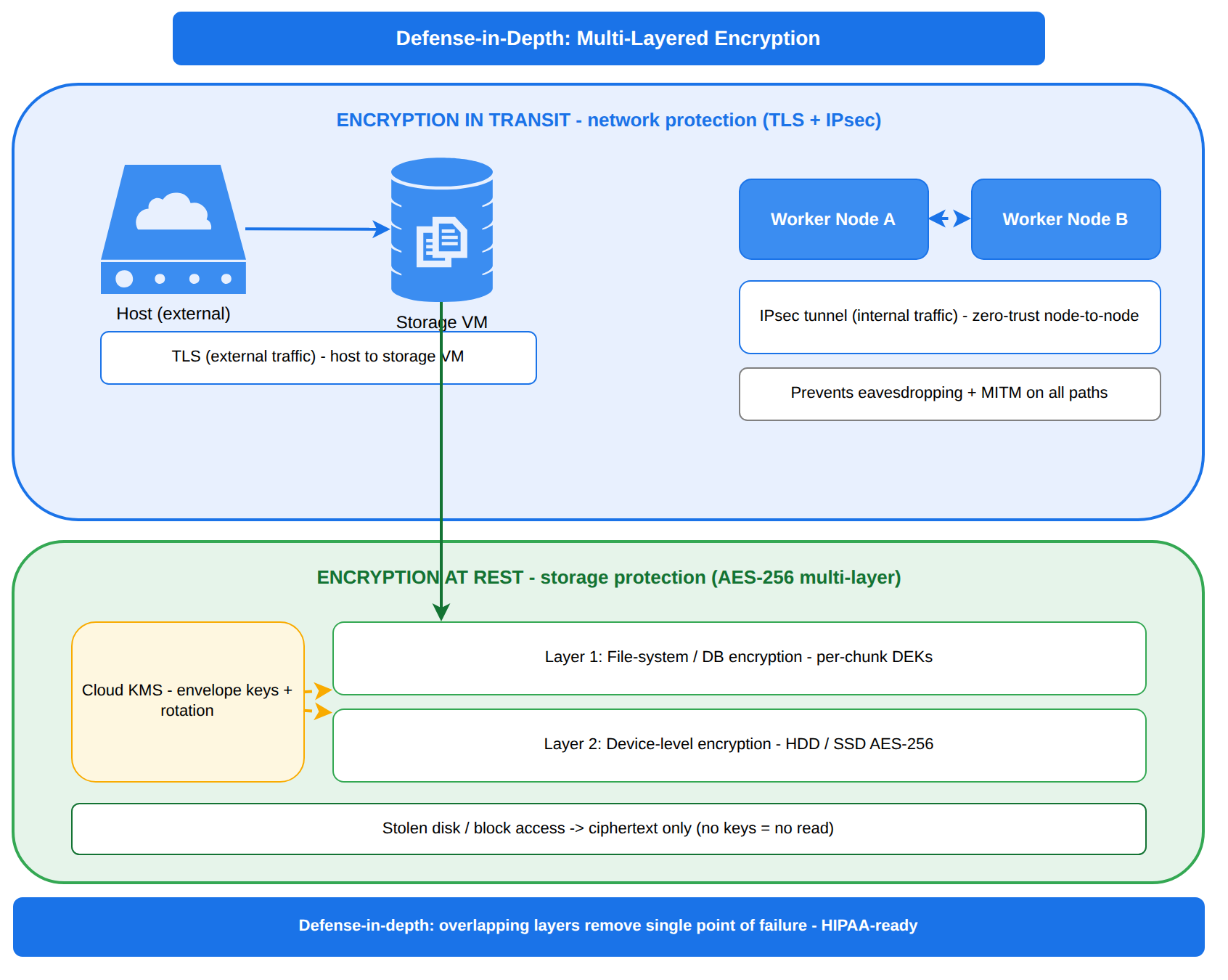
How It Meets the Requirements
- Storage protection via layered encryption at rest: Applying multiple layers of encryption at rest across physical storage media, volumes, and virtual storage systems ensures that raw data cannot be read even if physical drives are stolen or unauthorized users gain access to underlying storage blocks.
- Network protection via comprehensive encryption in transit: Encrypting external traffic (such as connections between hosts and storage virtual machines) and internal traffic (such as communications between worker nodes across virtual network tunnels) using protocols like
IPsecorTLSprevents eavesdropping and man-in-the-middle attacks.
Key Advantages and Capabilities
- Redundant protection: Overlapping security controls eliminate single points of failure across storage and network layers.
- Zero-trust alignment: Encrypting internal node-to-node traffic ensures that lateral movement by an attacker inside the network does not expose plaintext payloads.
- Lifecycle data security: Protects sensitive information continuously, whether it is sitting on disk (at rest), moving across network links (in transit), or being processed in confidential memory (in use).
- Regulatory compliance: Satisfies strict healthcare and financial data privacy mandates that require multi-layered cryptographic safeguards.
Why This Is Optimal
Unlike perimeter-only or single-layer approaches, combining multi-layered encryption at rest with end-to-end encryption in transit across both external and internal pathways addresses the full spectrum of threat vectors. In Google Cloud environments, encryption at rest and in transit are foundational pillars that work together seamlessly to maintain data confidentiality and integrity.
Try 10 interactive questions like this one, free
Answer them yourself and get your score the moment you finish. No account needed.
Full access includes
- 3,070 practice questions across all 6 exam domains
- Every answer explained: why it is right, and why the others are not
- Scout, an AI tutor that answers your follow-up questions
- Readiness tracking by domain, so you know when to book the exam
Related free sample questions
Keep the momentum going with these hand-picked practice scenarios
FundamentalCloud Digital Leader
IAM Predefined Roles at Resource Level
Define key security terms and concepts.
FundamentalCloud Digital Leader
Standardized APIs for Reusable Integration
Explain the business value of application programming interfaces (APIs).
FundamentalCloud Digital Leader
IAM Policy Inheritance in Resource Hierarchy
Discuss the benefits of using the resource hierarchy to control access.
FundamentalCloud Digital Leader
Data Lakehouse Medallion Architecture
Discuss the main data value chain concepts and terms.
FundamentalCloud Digital Leader
Vertex AI Custom Model Training
Discuss how building custom models by using Google Cloud’s Vertex AI can create opportunities for business differentiation.
FundamentalAssociate Cloud Engineer
Cloud Monitoring Metrics Explorer PromQL
Deploying Google Cloud Managed Service for Prometheus
Last updated