Fundamental
Prepare and test your skills

Fundamental
Prepare and test your skills
Cloud Armor Edge Filtering Before the VPC
Free sample question with answers and detailed explanation below. The Cloud Digital Leader practice bank has an additional 3,070 practice questions.Try 10 free realistic questions: instant score, no credit card, and no account required.
An e-commerce company is preparing for a major seasonal promotion. Leadership is concerned that malicious actors might use thousands of compromised external devices to flood their website with overwhelming traffic, rendering the application unavailable to legitimate shoppers.
The company wants to use Google Cloud Armor to defend against this type of threat without exhausting compute resources inside their Virtual Private Cloud (VPC).
How does Google Cloud Armor leverage Google's infrastructure to protect the application?
Explanations
It detects, absorbs, and filters malicious traffic at the edge of Google's global network before the traffic can enter the VPC or reach backend workloads
It detects, absorbs, and filters malicious traffic at the edge of Google's global network before the traffic can enter the VPC or reach backend workloads
What Google Cloud Armor Edge Defense is
Google Cloud Armor is a network security and distributed denial-of-service (DDoS) mitigation service built on top of Google's global infrastructure and frontend load balancing systems. In a DDoS attack, malicious actors utilize numerous compromised hosts (often referred to as a botnet) to flood a target with overwhelming volumes of traffic, attempting to exhaust resources and render the application unavailable to legitimate users. Cloud Armor defends against these threats by operating at the network edge, positioning security controls as close to the source of the incoming traffic as possible.
How it meets the requirements
- Mitigating large-scale volumetric threats: By leveraging Google's distributed global network and Anycast-based load balancing, Cloud Armor increases the surface area available to absorb massive traffic spikes across global points of presence.
- Protecting the VPC and backend resources: Because traffic is terminated, inspected, and filtered at the Google Cloud edge far upstream of the customer environment, malicious requests are dropped before they ever enter the Virtual Private Cloud (VPC) or consume compute capacity on backend servers.
Key advantages and capabilities
- Always-on Layer 3 and Layer 4 protection: Automatically detects and mitigates volumetric and protocol-based attacks (such as
SYNfloods) inline and in real time without adding latency. - Upstream traffic filtering: Evaluates user-configurable security policies at the edge so only well-formed, permitted requests pass through the load balancing proxies.
- Cost and resource preservation: Prevents unwanted traffic from triggering unnecessary auto-scaling events or exhausting backend Compute Engine instances and serverless workloads.
- Hybrid and multi-cloud support: Protects backend services regardless of whether they are hosted on Google Cloud, on-premises, or in another cloud environment.
Inline L3/L4 Mitigation at Google Edge
Process Flow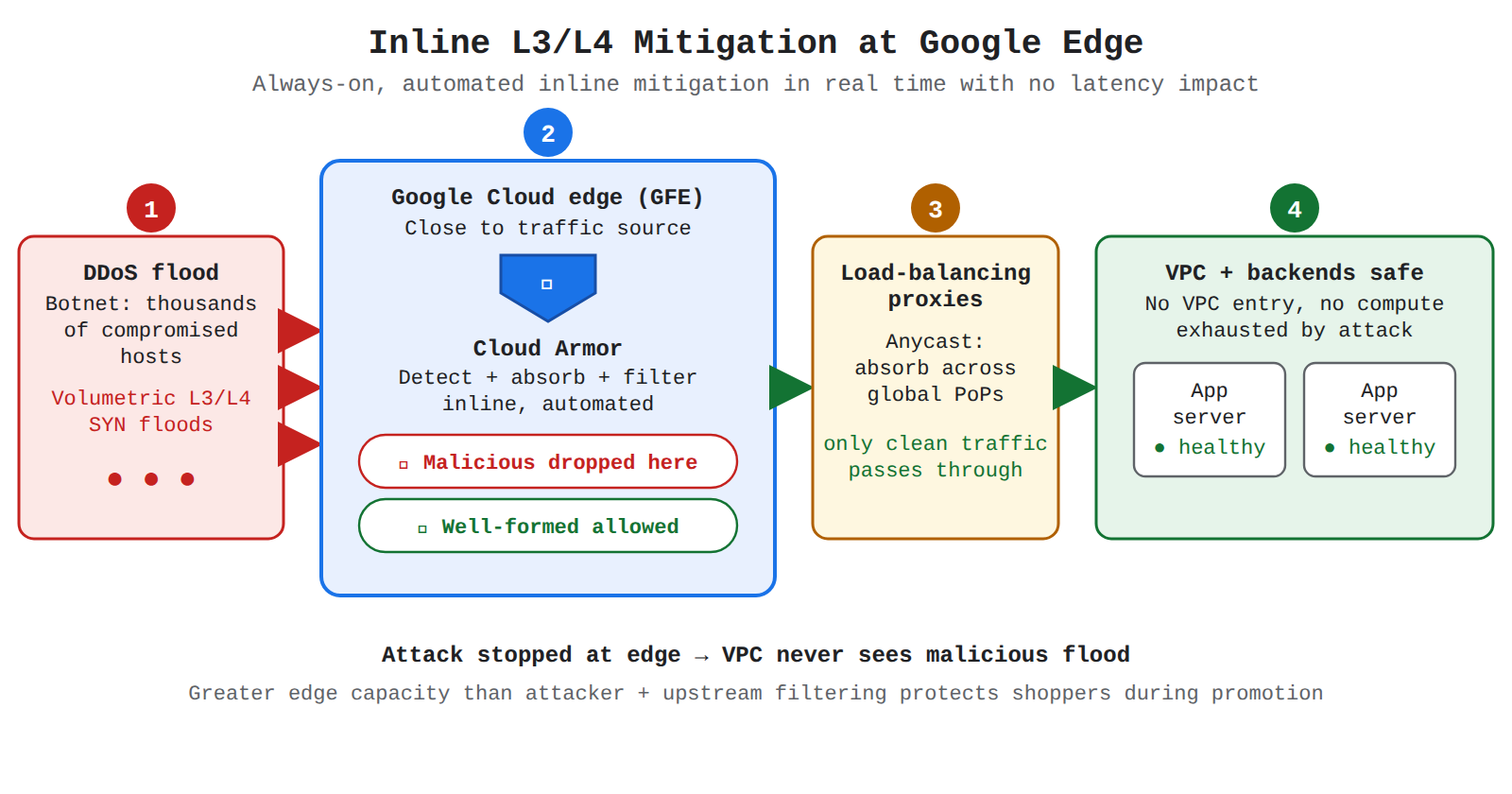
Why this is optimal
Stopping a volumetric DDoS attack requires having greater network capacity than the attacker and dropping bad traffic before it hits narrow network bottlenecks. Intercepting threats at Google's global network edge neutralizes attacks at the perimeter rather than straining internal virtual networks or application servers.
It routes all incoming attack traffic directly into the VPC network so that backend virtual machines can inspect and drop the malicious packets
It routes all incoming attack traffic directly into the VPC network so that backend virtual machines can inspect and drop the malicious packets
What internal host-based packet inspection does
Routing traffic directly to backend Virtual Machine (VM) instances relies on the compute and network capacity of individual servers inside a Virtual Private Cloud (VPC) to process, inspect, and drop unwanted network packets using local host firewalls or operating system resources.
Why it doesn't meet the requirement
The fundamental goal of a Distributed Denial of Service (DDoS) attack is to exhaust the target's bandwidth, CPU, and memory so legitimate users cannot connect. If Google Cloud Armor allowed massive volumes of attack traffic to enter the VPC network and reach backend VMs, the attack would succeed. The sheer volume of malicious packets would saturate internal network links and overwhelm the backend servers just trying to inspect and drop the traffic, leading to complete service unavailability.
Key characteristics and limitations
- Resource exhaustion: Processing millions of malicious packets per second directly on backend instances consumes critical CPU and memory needed for legitimate application logic.
- Lack of upstream absorption: Individual internal VMs cannot match the massive bandwidth capacity of Google's global frontend infrastructure.
- Increased operational costs: Allowing DDoS traffic to hit backend workloads can trigger rapid, expensive auto-scaling and inflate resource consumption inside the environment.
This answer would be correct if
This approach would only apply if an organization were inspecting trusted, low-volume internal east-west traffic between virtual machines inside a VPC using host-based intrusion detection agents, rather than defending public-facing endpoints against external volumetric DDoS attacks at the network perimeter.
It establishes a VPC peering connection with the external hosts generating the traffic to isolate and store the malicious requests inside a Cloud CDN cache
It establishes a VPC peering connection with the external hosts generating the traffic to isolate and store the malicious requests inside a Cloud CDN cache
What VPC Network Peering and Cloud CDN do
VPC Network Peering is a networking feature that allows private connectivity between two separate Virtual Private Cloud networks (such as connecting a customer VPC to a Google-managed tenant project). Cloud CDN (Content Delivery Network) uses Google's globally distributed edge points of presence to cache static web and video content closer to end users to reduce latency and offload origin servers.
Why it doesn't meet the requirement
In a Distributed Denial of Service (DDoS) attack, traffic is generated by thousands of untrusted, compromised external devices across the public internet. A cloud provider never establishes a private VPC peering connection with malicious external attackers. Furthermore, Cloud CDN is designed to serve valid cached content to legitimate users, not to act as a storage vault for malicious DDoS payloads. In fact, attackers often attempt cache-busting attacks to bypass the CDN cache and overload the backend origin server.
Key characteristics and limitations
- VPC Peering scope: Used strictly for private network routing between trusted VPCs, never for connecting to untrusted public internet botnets.
- Cloud CDN purpose: Accelerates content delivery by serving cached responses at the edge, working alongside Cloud Armor edge security policies to block malicious requests before they cause cache misses.
- Threat drop mechanism: When Cloud Armor detects an attack, it drops or denies the malicious packets at the network edge rather than storing them.
This answer would be correct if
These technologies would be relevant in two separate, legitimate architectural scenarios: using VPC Network Peering to privately connect a customer VPC with a Google-managed Apigee tenant project, or using Cloud CDN alongside Cloud Armor to serve static website assets from edge caches while filtering out cache-busting requests.
It relies exclusively on manual rule configurations created by administrators during an active attack to block Layer 3 and Layer 4 volumetric floods
It relies exclusively on manual rule configurations created by administrators during an active attack to block Layer 3 and Layer 4 volumetric floods
What manual security policy configuration is
In Google Cloud Armor, administrators can manually configure custom security policies using match conditions, IP address lists, geographic controls, and Web Application Firewall (WAF) rules to filter specific types of incoming application requests.
Why it doesn't meet the requirement
While manual rules are used to customize Layer 7 (application layer) filtering, Cloud Armor does not rely on manual human intervention to stop Layer 3 and Layer 4 volumetric DDoS attacks. Network and protocol-based volumetric floods happen rapidly and at a massive scale that humans cannot manually react to in real time. Instead, Cloud Armor provides always-on, automated inline mitigation for L3 and L4 attacks out of the box for applications behind external load balancers.
Key characteristics and limitations
- Automated L3/L4 defense: Protection against network-level volumetric attacks (like
UDPorSYNfloods) is built-in, continuous, and requires zero manual configuration. - Proactive L7 policies: Protecting against application-layer attacks (such as HTTP floods, SQL injection, or cross-site scripting) utilizes user-configured security policies and preconfigured OWASP Top 10 WAF rules.
- Adaptive Protection: For complex L7 DDoS spikes, Cloud Armor Adaptive Protection uses machine learning to analyze traffic patterns, alert teams, and automatically suggest or apply mitigation rules rather than relying solely on manual guesswork.
This answer would be correct if
This concept would apply if the scenario asked how an administrator enforces custom Layer 7 access controls—such as blocking requests to a specific /admin URL path or restricting access based on specific IP ranges—which requires defining explicit rules in a Cloud Armor security policy.
Try 10 interactive questions like this one, free
Answer them yourself and get your score the moment you finish. No account needed.
Full access includes
- 3,070 practice questions across all 6 exam domains
- Every answer explained: why it is right, and why the others are not
- Scout, an AI tutor that answers your follow-up questions
- Readiness tracking by domain, so you know when to book the exam
Related free sample questions
Keep the momentum going with these hand-picked practice scenarios
FundamentalCloud Digital Leader
Google Cloud Armor Security Policies
Describe how an organization can protect against network attacks using Google products, including distributed denial-of-service (DDoS) using Google Cloud Armor.
FundamentalCloud Digital Leader
Cloud Armor Preconfigured WAF Rules
Describe how an organization can protect against network attacks using Google products, including distributed denial-of-service (DDoS) using Google Cloud Armor.
FundamentalCloud Digital Leader
Shared Responsibility Model Customer IAM
Discuss fundamental cloud security concepts.
FundamentalCloud Digital Leader
AutoML Training Data Quality and Bias
Explain how an organization can create business value by using their own data to train custom ML models with AutoML.
FundamentalCloud Digital Leader
Google Cloud Defense-in-Depth Security Model
Explain the business value of Google’s defense-in-depth multilayered approach to infrastructure security.
IntermediateProfessional Cloud Database Engineer
Cloud Scheduler Pub/Sub Cloud Run IAM
Schedule database exports
Last updated