Fundamental
Prepare and test your skills

Fundamental
Prepare and test your skills
Blocking SQLi and XSS with Cloud Armor
Free sample question with answers and detailed explanation below. The Cloud Digital Leader practice bank has an additional 3,070 practice questions.Try 10 free realistic questions: instant score, no credit card, and no account required.
An e-commerce company runs a public web application behind a global external Application Load Balancer on Google Cloud. The security team needs to configure a Google Cloud Armor security policy to meet the following requirements:
- Inspect incoming Layer 7 requests and drop malicious traffic at the edge of Google's network
- Mitigate common OWASP Top 10 web application vulnerabilities, including SQL injection (SQLi) and cross-site scripting (XSS)
- Avoid the operational overhead of manually authoring dozens of individual attack pattern signatures
Which Google Cloud Armor capability should the company use?
Explanations
Google Threat Intelligence feeds
Google Threat Intelligence feeds
What Google Threat Intelligence feeds are
Google Threat Intelligence in Google Cloud Armor is an enterprise capability that allows or blocks incoming traffic based on continuously updated threat intelligence data feeds—such as Tor exit nodes, VPN providers, known malicious IP addresses, or public cloud IP ranges—using the evaluateThreatIntelligence() match expression.
Why it doesn't meet the requirements
- Matches IP reputation and network categories rather than exploit payloads: Google Threat Intelligence evaluates the classification or reputation of the source IP address rather than inspecting the Layer 7 HTTP payload for SQL injection (SQLi) or cross-site scripting (XSS) attack patterns.
- Cannot stop OWASP Top 10 attacks from standard networks: If an attacker sends a malicious SQLi or XSS request from a standard residential or commercial ISP address that does not appear on a threat intelligence feed, Threat Intelligence rules will permit the request to pass through.
Key characteristics and limitations
- Continuously updated IP feeds: Automatically tracks dynamic lists of IP addresses associated with anonymous proxies, Tor exit nodes, VPN providers, and search engine crawlers.
- Policy expression integration: Configured within security policies using the
evaluateThreatIntelligence()match condition. - Enterprise tier requirement: Requires an active Cloud Armor Enterprise subscription.
- No payload signature inspection: Identifies the category or reputation of the traffic source rather than scanning request bodies for application-layer code injection.
This answer would be correct if
The security team wanted to automatically block incoming requests originating from known Tor exit nodes, anonymous VPN providers, or compromised IP addresses tracked by threat intelligence feeds.
Additional context
Google Threat Intelligence complements preconfigured WAF rules in a defense-in-depth architecture: Threat Intelligence blocks traffic from high-risk network origins upfront, while preconfigured WAF rules inspect the remaining requests for OWASP Top 10 vulnerabilities.
Always-on Layer 3 and Layer 4 volumetric DDoS protection
Always-on Layer 3 and Layer 4 volumetric DDoS protection
What Always-on Layer 3 and Layer 4 volumetric DDoS protection is
Always-on Layer 3 and Layer 4 volumetric DDoS protection is Google Cloud Armor's built-in, automatic defense mechanism that detects and mitigates large-scale network and transport protocol-based distributed denial-of-service (DDoS) attacks at the edge of Google's network.
Why it doesn't meet the requirements
- Focuses on network and transport layers (L3/L4) rather than Layer 7 vulnerabilities: This capability automatically absorbs volumetric network floods (such as SYN floods or UDP amplification attacks) and ensures only well-formed requests pass through the load balancing proxies.
- Does not block SQLi or XSS attempts: Requests carrying SQL injection (SQLi) or cross-site scripting (XSS) payloads are typically well-formed HTTP/HTTPS requests at the transport layer. Defending against Layer 7 application-layer exploits requires a user-configured security policy with proactive WAF rules.
Key characteristics and limitations
- Automatic and always-on: Enabled out-of-the-box for global external Application Load Balancers, classic Application Load Balancers, and external proxy Network Load Balancers without manual rule configuration.
- Real-time inline mitigation: Absorbs massive volumetric attacks at Google's global network edge with zero latency impact.
- Protocol-level validation: Drops malformed network packets and transport-layer floods before they reach backend services.
- Requires security policies for Layer 7: Does not inspect HTTP request bodies for OWASP Top 10 application vulnerabilities.
This answer would be correct if
The scenario asked how Google Cloud Armor automatically protects applications behind an external Application Load Balancer from large-scale network and protocol-based volumetric DDoS floods in real time without requiring manual policy configuration.
Additional context
A complete cloud defense strategy pairs Cloud Armor's automatic L3/L4 volumetric DDoS protection with user-configured Layer 7 security policies containing preconfigured WAF rules to protect both the network infrastructure and the web application code.
IP address allowlists and denylists
IP address allowlists and denylists
What IP address allowlists and denylists do
IP address allowlists and denylists are access control rules within a Google Cloud Armor security policy that permit or reject incoming requests based exclusively on the client's source IP address or Classless Inter-Domain Routing (CIDR) range.
Why it doesn't meet the requirements
- Does not inspect Layer 7 payloads for SQLi or XSS: IP allowlists and denylists only evaluate the network origin of a request (
origin.ip), not the contents of the HTTP request headers, URL parameters, or body. They cannot detect SQL injection (SQLi) or cross-site scripting (XSS) attack strings. - Cannot protect public web applications from unknown attackers: Because a public e-commerce application must accept traffic from customers worldwide, administrators cannot restrict access to a static allowlist of IP addresses, and attackers can launch application-layer exploits from any unblocked IP address.
Key characteristics and limitations
- Network-origin filtering: Evaluates whether a client's IP address falls within a specified IP address or CIDR block.
- Allowlist enforcement: Limits application access solely to trusted IP ranges (such as corporate branch offices or third-party traffic scrubbing providers) when paired with a default
denyrule. - Denylist enforcement: Blocks traffic originating from specific IP addresses or subnets where malicious activity has already been identified.
- No vulnerability signature detection: Lacks awareness of OWASP Top 10 attack patterns or malicious scripts embedded inside web requests.
This answer would be correct if
The organization needed to restrict an internal application so that only users connecting from specific corporate branch office IP ranges could access it, or needed to block all requests coming from a known malicious IP address.
Additional context
While IP lists alone cannot detect SQLi or XSS attacks across public traffic, administrators can combine IP range conditions with preconfigured WAF rules in a single custom expression—for example, enforcing specific WAF checks on traffic originating from a particular subnet.
Preconfigured Web Application Firewall (WAF) rules
Preconfigured Web Application Firewall (WAF) rules
What Preconfigured WAF rules are
Google Cloud Armor preconfigured WAF rules are ready-to-use, complex Web Application Firewall (WAF) rule sets built on open-source industry standards—specifically the OWASP ModSecurity Core Rule Set (CRS). Each preconfigured rule bundles dozens of distinct attack detection signatures under a single, convenient rule name (such as sqli-v422-stable or xss-v422-stable).
Preconfigured WAF Rule Bundling
Hierarchy / Taxonomy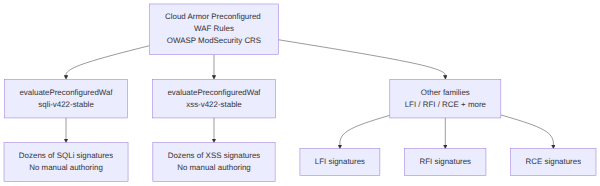
How it meets the requirements
- Inspects Layer 7 requests at the edge: When added to a Cloud Armor security policy and attached to a backend service, preconfigured WAF rules inspect incoming HTTP/HTTPS requests (including up to the first 8 kB of the request body by default) and drop malicious traffic at the edge of Google's infrastructure before it reaches the backend.
- Mitigates OWASP Top 10 vulnerabilities: These rules provide built-in detection and blocking for common application-layer threats, including SQL injection (SQLi), cross-site scripting (XSS), Local File Inclusion (LFI), Remote File Inclusion (RFI), and Remote Code Execution (RCE).
- Eliminates manual signature authoring: Because Google Cloud provides these rules with pre-compiled signatures, administrators can evaluate dozens of traffic signatures by referencing a named rule expression rather than defining every signature manually.
Key advantages and capabilities
- Comprehensive signature sets: Evaluates incoming web requests against dozens of industry-standard attack patterns simultaneously.
- Upstream edge enforcement: Blocks malicious requests at Google's global network edge, preventing unwanted traffic from consuming backend compute resources or entering Virtual Private Cloud (VPC) networks.
- Rule tuning flexibility: Allows security teams to tune preconfigured rules by disabling specific noisy or unnecessary signatures to reduce false positives.
- Composability with custom rules: Can be combined with other attributes (such as IP address ranges or geographic regions) using the Cloud Armor custom rules language.
- Hybrid and multi-cloud protection: Protects workloads whether they are hosted on Google Cloud, on-premises, or with a third-party cloud provider.
Why this is optimal
Unlike network-layer DDoS protections or basic IP filtering, preconfigured WAF rules inspect actual Layer 7 application payloads for code injection attempts while removing the burden of writing and maintaining complex custom regular expressions from scratch.
Try 10 interactive questions like this one, free
Answer them yourself and get your score the moment you finish. No account needed.
Full access includes
- 3,070 practice questions across all 6 exam domains
- Every answer explained: why it is right, and why the others are not
- Scout, an AI tutor that answers your follow-up questions
- Readiness tracking by domain, so you know when to book the exam
Related free sample questions
Keep the momentum going with these hand-picked practice scenarios
FundamentalCloud Digital Leader
Cloud Armor Edge DDoS Mitigation
Describe how an organization can protect against network attacks using Google products, including distributed denial-of-service (DDoS) using Google Cloud Armor.
FundamentalCloud Digital Leader
Google Cloud Armor Security Policies
Describe how an organization can protect against network attacks using Google products, including distributed denial-of-service (DDoS) using Google Cloud Armor.
FundamentalCloud Digital Leader
Multi-Zone High Availability Architecture
Describe the importance of designing resilient, fault-tolerant, and scalable infrastructure and processes for high availability and disaster recovery.
FundamentalCloud Digital Leader
Titan Security Chip Hardware Root of Trust
Describe the benefits of Google designing and building its own data centers, using purpose-built servers, networking, and custom security hardware / software.
FundamentalCloud Digital Leader
Digital Transformation Challenges
Describe the drivers and challenges that lead organizations to undergo a digital transformation.
IntermediateProfessional Cloud Database Engineer
AlloyDB HTAP Instance Sizing
Size database compute and storage based on performance requirements
Last updated