Fundamental
Prepare and test your skills

Fundamental
Prepare and test your skills
How Data Quality Shapes AutoML Accuracy
Free sample question with answers and detailed explanation below. The Cloud Digital Leader practice bank has an additional 3,070 practice questions.Try 10 free realistic questions: instant score, no credit card, and no account required.
A digital retail company wants to generate business value by using AutoML to train a custom multi-class classification model. The goal is to segment new customers into marketing personas using the company's proprietary tabular transaction data. During data preparation, the team discovers two issues in their dataset:
- Categorical feature columns contain inconsistent capitalization and spelling errors (such as
"Winter Coat"and"winter coat"). - Historical purchase records were collected exclusively during the winter holiday season.
How will these dataset characteristics affect the custom AutoML model if they are not resolved before training?
Explanations
The model will interpret the inconsistent text strings as separate categories and fail to generalize accurately to customer purchasing behaviors during other seasons.
The model will interpret the inconsistent text strings as separate categories and fail to generalize accurately to customer purchasing behaviors during other seasons.
What Data Quality and Variation in AutoML Are
Training a custom machine learning model with AutoML relies on supervised machine learning, where the system learns patterns directly from an organization's proprietary example data. For a tabular multi-class classification model to deliver business value and accurate inferences, the underlying training dataset must have clean, consistent feature columns and capture the full diversity of the real-world problem space.
How It Addresses the Scenario Requirements
- Impact of Inconsistent Categorical Features: When tabular data contains formatting variations, misspellings, or inconsistent capitalization (such as
"Winter Coat"and"winter coat"), AutoML does not know they represent the same concept. Instead, it treats each unique text string as a distinct category, splitting the training signal and degrading model accuracy. - Impact of Limited Seasonal Variation: A model can only learn from the patterns present in its training set. By providing purchase records exclusively from the winter season, the dataset lacks diversity. Consequently, the trained model will struggle to generalize when predicting customer personas or summer purchasing preferences in production.
Winter-Only Training Fails to Generalize
Set Relationship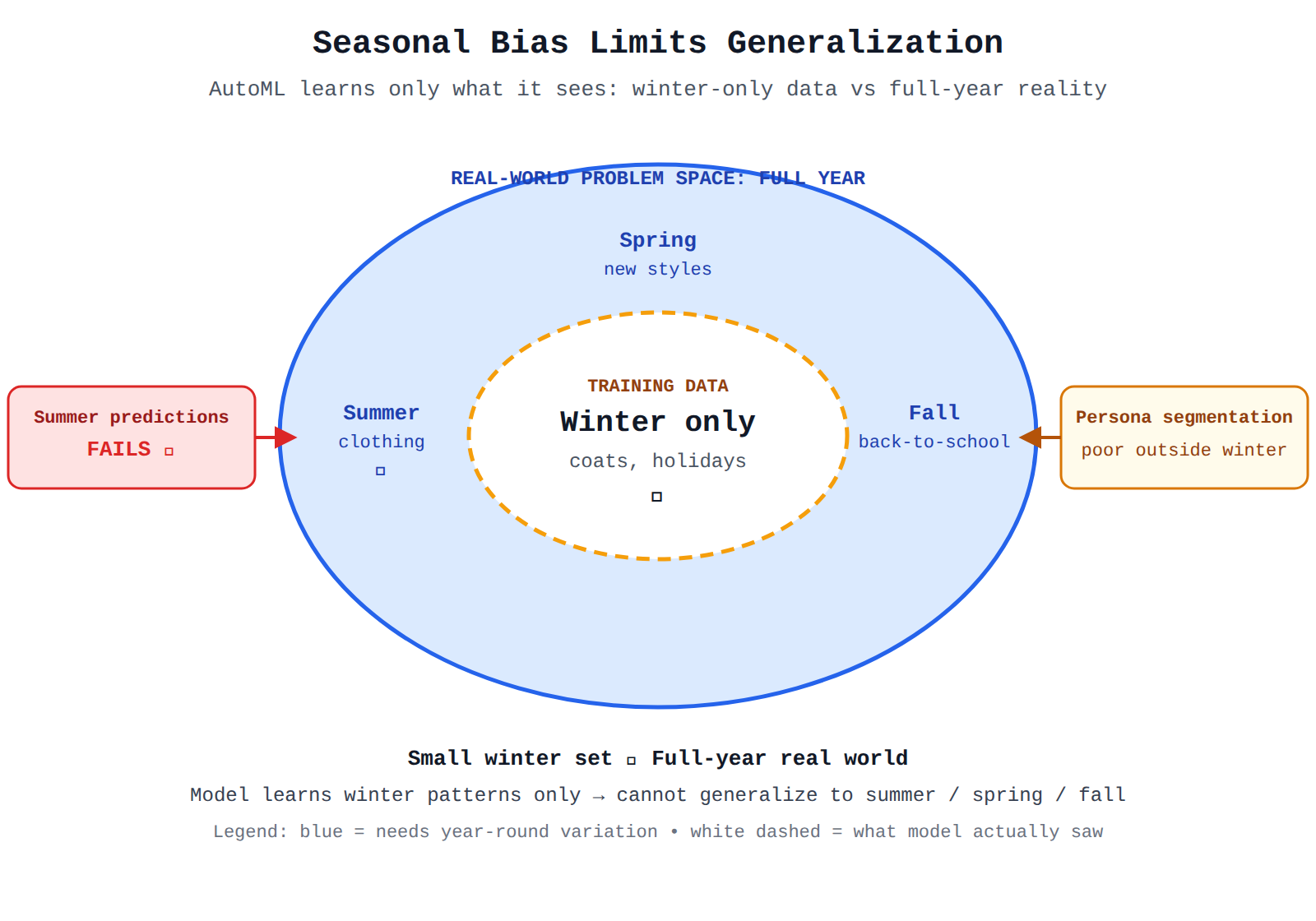
Key Capabilities of High-Quality Proprietary Data
- Improved Generalization: Capturing year-round variation ensures the model performs reliably across diverse real-world scenarios and changing seasonal demands.
- Accurate Pattern Recognition: Cleaning and standardizing categorical labels consolidates training examples, giving the algorithm stronger statistical signals per category.
- Relevant Business Predictions: Using proprietary customer history—such as spending frequency, item categories, and promotional responses—enables tailored persona segmentation that generic pre-trained models cannot achieve.
- Reduced Model Bias: Representative datasets prevent the model from becoming overly skewed toward a narrow subset of customer behavior.
Why This Is Optimal
Recognizing both the categorization split caused by dirty data and the generalization failure caused by seasonal bias directly identifies how data preparation governs AutoML performance. Unlike manual rule-based systems, machine learning models depend entirely on the statistical quality and breadth of their training examples to drive operational efficiency and personalized customer experiences.
The model will experience data leakage during evaluation because the winter purchase features are directly correlated with the target marketing personas.
The model will experience data leakage during evaluation because the winter purchase features are directly correlated with the target marketing personas.
What Data Leakage Is
Data leakage is a machine learning flaw that occurs when input features used during model training inadvertently contain information about the target outcome that would not be available when requesting real-time inferences in production. It often happens when a historical dataset includes a future event or a proxy metric recorded after the target outcome has already occurred.
Why It Doesn't Meet the Requirement
Training a model exclusively on winter transaction records represents a lack of dataset variation (or sampling bias), not data leakage. Having a strong correlation between legitimate historical purchase behavior and a customer persona is normal when patterns exist in seasonal data. However, because the dataset lacks examples from spring, summer, and fall, the model fails due to poor generalization rather than leaked future target data.
Key Characteristics and Limitations
- Deceptive Evaluation Metrics: Data leakage causes a model to display exceptionally high accuracy on the test set during evaluation, followed by poor performance when deployed to production.
- Correlation Flagging: It is typically identified by reviewing feature correlations before training and flagging input columns that are suspiciously correlated with the target column.
- Time-Split Contamination: Leakage can also occur if time-series records from the exact same date are accidentally distributed across the training set, validation set, and test set.
This Answer Would Be Correct If
The retail team was building a binary classification model to predict whether a customer will sign up for a loyalty subscription next month, and they mistakenly included "next month's subscription payment amount" as an input feature in the training table.
Additional Context
It is important to distinguish between data leakage, training-serving skew, and insufficient data variation. While data leakage gives false confidence during testing by exposing the answer prematurely, seasonal bias simply starves the model of the diverse examples needed to understand year-round customer behavior.
AutoML will automatically reject the dataset during the import phase because supervised learning pipelines cannot run when inconsistencies or missing values are present.
AutoML will automatically reject the dataset during the import phase because supervised learning pipelines cannot run when inconsistencies or missing values are present.
What Dataset Import and Validation in AutoML Do
During the data preparation and import phase of the AutoML workflow, the platform ingests proprietary data from sources like Cloud Storage or BigQuery and analyzes the schema. It automatically infers the variable type (such as numeric, categorical, or timestamp) and checks the nullability of each column so that training can proceed with minimal manual coding.
Why It Doesn't Meet the Requirement
AutoML does not block or reject a dataset simply because categorical strings have inconsistent capitalization or because the data lacks seasonal diversity. The platform cannot inherently know whether "Winter Coat" and "winter coat" are intended to be the same category or two purposefully distinct product lines. Similarly, AutoML can still execute a training job even when datasets contain noise, biases, or missing values—it will simply produce a lower-quality model.
Key Characteristics and Limitations
- Handling Missing Values: AutoML can natively handle or impute missing values in nullable columns, though providing complete data yields more optimal prediction accuracy.
- Automatic Type Detection: The service automatically assigns data types based on column values, requiring human review to verify that features are interpreted as intended.
- Garbage In, Garbage Out: While the training pipeline will successfully complete and deploy a model to the Model Registry, the resulting inferences will be unreliable if the input data is flawed.
This Answer Would Be Correct If
The scenario described a critical schema or formatting violation—such as importing a dataset with fewer than the mandatory minimum number of rows, or having duplicate timestamps within the same time series during a tabular forecasting training job, which triggers a hard validation error.
Additional Context
A common misconception among beginners is that automated machine learning tools automatically fix semantic data quality issues. While AutoML automates feature engineering and hyperparameter tuning, data sourcing, cleaning, and bias mitigation remain the responsibility of the organization.
AutoML will bypass supervised training and apply classical rule-based programming to merge the misspelled categories and extrapolate summer buying trends.
AutoML will bypass supervised training and apply classical rule-based programming to merge the misspelled categories and extrapolate summer buying trends.
What Classical Rule-Based Programming Is
Classical programming is a traditional software development approach where human programmers write explicit, step-by-step conditional rules (such as if-then statements) for a computer to follow. It is used for deterministic tasks where every possible input variation and business rule can be defined in advance.
Why It Doesn't Meet the Requirement
AutoML does not revert to classical rule-based programming when confronted with messy or incomplete data. AutoML is built specifically for supervised machine learning, where algorithms learn statistical weights and patterns from labeled examples rather than executing hard-coded manual filters. Furthermore, neither classical rules nor supervised models can magically extrapolate summer buying preferences solely from winter data without relevant training examples.
Key Characteristics and Limitations
- Inability to Scale with Complexity: Manual rule-based filters quickly break down when applied to complex data with broad variations, such as diverse customer purchasing habits, free-form text comments, or images.
- Dependence on Labeled Examples: AutoML requires a designated target column (for tabular data) or annotations (for image data) to iteratively train and validate neural network parameters.
- Tokenization Behavior: When processing text strings, AutoML tokenizes words separated by spaces, meaning any uncleaned typographical errors or inconsistent strings are processed literally as distinct tokens or categories.
This Answer Would Be Correct If
The organization decided not to use machine learning at all, and instead tasked software engineers with writing a traditional data-cleansing script (using regular expressions or string-matching rules) to standardize text capitalization before importing the table into AutoML.
Additional Context
Organizations adopt AutoML precisely because classical programming cannot easily calculate personas for new customers with limited purchase histories or adapt to complex behavioral patterns. However, for supervised learning to outperform traditional approaches, the organization must supply clean, representative example data.
Try 10 interactive questions like this one, free
Answer them yourself and get your score the moment you finish. No account needed.
Full access includes
- 3,070 practice questions across all 6 exam domains
- Every answer explained: why it is right, and why the others are not
- Scout, an AI tutor that answers your follow-up questions
- Readiness tracking by domain, so you know when to book the exam
Related free sample questions
Keep the momentum going with these hand-picked practice scenarios
FundamentalCloud Digital Leader
Managed Services with Elastic Autoscaling
Discuss benefits of infrastructure modernization and application modernization by using Google Cloud.
FundamentalCloud Digital Leader
Vertex AI Model Registry Endpoint Deployment
Discuss how building custom models by using Google Cloud’s Vertex AI can create opportunities for business differentiation.
FundamentalCloud Digital Leader
Google Cloud Defense-in-Depth Security Model
Explain the business value of Google’s defense-in-depth multilayered approach to infrastructure security.
FundamentalCloud Digital Leader
Containerization with CI/CD Pipelines
Discuss the advantages of modern cloud application development.
FundamentalCloud Digital Leader
API Abstraction and Productization
Explain how organizations can create new business opportunities by exposing and monetizing public-facing APIs.
FundamentalAssociate Cloud Engineer
Gcloud Services List and Enable
Enabling APIs within projects
Last updated