Fundamental
Prepare and test your skills
Fundamental
Prepare and test your skills
Regional Revenue with GROUP BY SUM and AVG
Free sample question, answered and explained below. The Associate Data Practitioner practice bank has 1,156 more like it. Try 10 free: instant score, no account.
A business analyst is analyzing an e-commerce orders dataset in BigQuery. The retail operations manager asks for a regional performance breakdown to answer two specific business questions:
- What is the total monetary revenue generated by each sales region?
- What is the average order value across transactions in each sales region?
The dataset orders contains columns order_id, region, and order_amount.
Which GoogleSQL query should the analyst write to segment the dataset and answer both business inquiries?
Explanations
SELECT region, TOTAL(order_amount) AS total_revenue, MEAN(order_amount) AS average_order_value FROM project.dataset.orders GROUP BY region
SELECT region, TOTAL(order_amount) AS total_revenue, MEAN(order_amount) AS average_order_value FROM project.dataset.orders GROUP BY region
What the option is:
This query attempts to calculate summary metrics by calling hypothetical functions named TOTAL() and MEAN() grouped by region.
Why it doesn't meet the requirement:
- Invalid SQL function names (✗): GoogleSQL in BigQuery does not recognize
TOTAL()orMEAN()as valid built-in aggregate functions. Attempting to execute this query will return an error stating that the functions do not exist. - Conflates programming languages (✗): While
mean()is standard in Python libraries like Pandas or NumPy, SQL standards universally employAVG()for arithmetic means andSUM()for summations.
Key characteristics and limitations:
- In BigQuery GoogleSQL, the standard aggregate function for summation is
SUM(). - In BigQuery GoogleSQL, the standard aggregate function for central tendency (mean) is
AVG(). - Descriptive statistics functions in SQL have standardized naming conventions distinct from Python or R.
This answer would be correct if:
The analyst were writing Pandas code in a Jupyter notebook on a DataFrame (e.g., df.groupby('region')['order_amount'].agg(total_revenue='sum', average_order_value='mean')), but in SQL dialect, TOTAL and MEAN are invalid.
Additional context:
When transitioning between Python data analysis (e.g., Pandas methods .mean() and .sum()) and SQL in BigQuery, practitioners must ensure they use SQL standard keywords (AVG and SUM).
SELECT region, SUM(order_amount) AS total_revenue, AVG(order_amount) AS average_order_value FROM project.dataset.orders GROUP BY region
SELECT region, SUM(order_amount) AS total_revenue, AVG(order_amount) AS average_order_value FROM project.dataset.orders GROUP BY region
What the solution is:
This SQL query combines standard aggregate functions (SUM and AVG) with a GROUP BY clause in GoogleSQL to compute descriptive statistics categorized across distinct attribute values.
How it meets the requirements:
- Total revenue calculation (✓): The
SUM(order_amount)function aggregates the numerical values withinorder_amountby adding them together for each group, producing the total monetary revenue. - Central tendency calculation (✓): The
AVG(order_amount)function calculates the arithmetic mean oforder_amountfor each group, determining the average transaction size. - Regional segmentation (✓): The
GROUP BY regionclause partitions the rows into subsets based on unique values in theregioncolumn, ensuring both summary metrics are computed independently per region.
GROUP BY Regional Segmentation Flow
Process Flow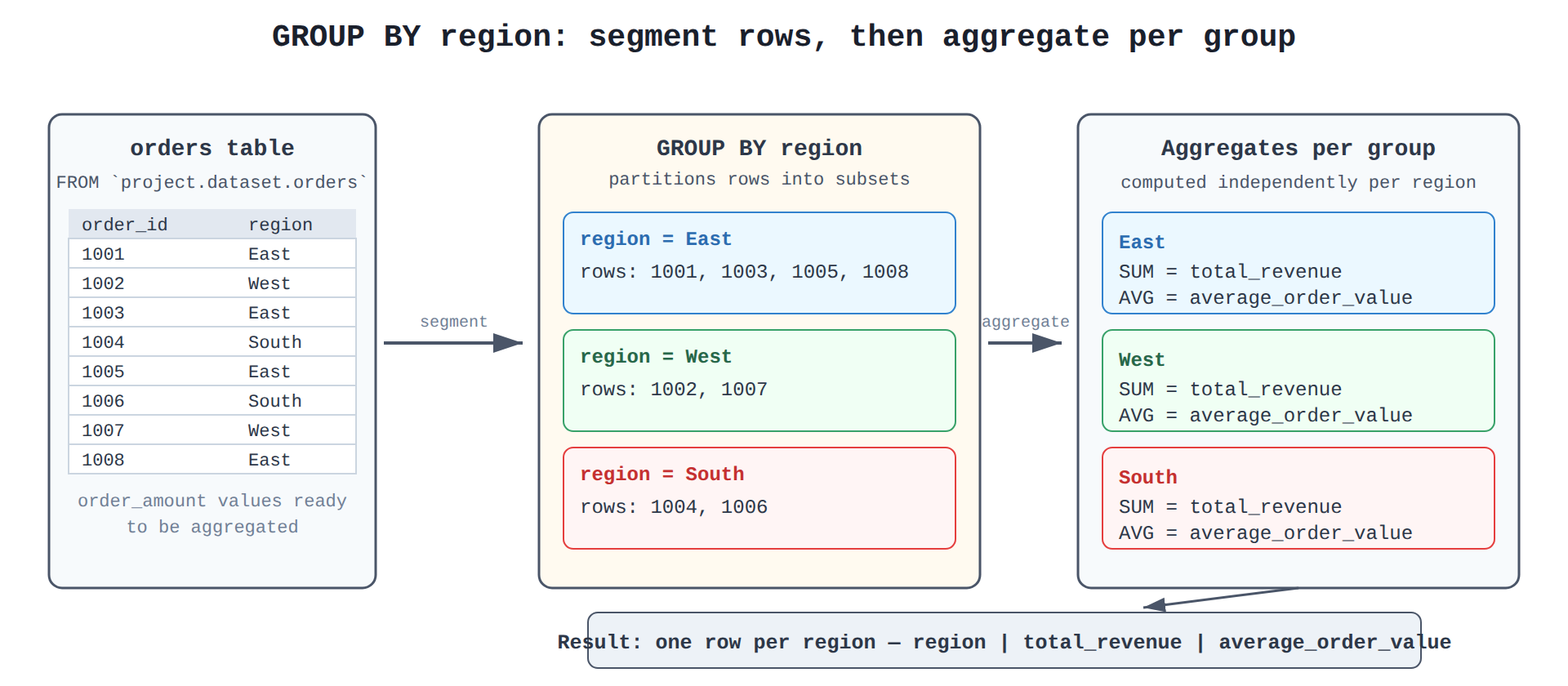
Key advantages and capabilities:
- Native BigQuery optimization: Standard aggregate functions like
SUMandAVGrun efficiently across distributed data partitions in BigQuery. - Deterministic segmentation: Grouping by categorical dimensions allows multidimensional slicing of large transactional tables into compact summary records.
- Direct business answers: Producing both aggregate sum totals and central tendencies provides immediate insight into regional volume versus individual purchasing behavior.
Why this is optimal:
In standard SQL syntax used by BigQuery, whenever non-aggregated columns such as region appear in the SELECT list alongside aggregation functions like SUM() and AVG(), they must be specified in the GROUP BY clause. This query adheres strictly to standard SQL semantics while utilizing the correct, built-in aggregation functions.
SELECT region, COUNT(order_amount) AS total_revenue, AVG(order_amount) AS average_order_value FROM project.dataset.orders GROUP BY region
SELECT region, COUNT(order_amount) AS total_revenue, AVG(order_amount) AS average_order_value FROM project.dataset.orders GROUP BY region
What the option is:
This query utilizes the COUNT() aggregate function in place of SUM() alongside AVG() and groups the results by region.
Why it doesn't meet the requirement:
- Wrong metric calculated (✗):
COUNT(order_amount)computes the total number of non-null rows or order records rather than the total financial sum. It returns order volume (count of transactions) instead of total revenue generated. - Misinterprets business inquiry (✗): The business stakeholder specifically requested total revenue (a monetary sum), not total order frequency.
Key characteristics and limitations:
COUNT(expression)counts the number of non-NULL evaluated expressions.COUNT(*)returns the total row count for the table or group.- Neither
COUNTvariation computes totals of monetary or numerical amounts.
This answer would be correct if:
The business question had asked: "What is the total number of orders placed and the average order value for each sales region?"
Additional context:
Confusing COUNT and SUM is a common pitfall when working with numerical fields. COUNT tallies rows, whereas SUM adds the quantitative values inside those rows.
SELECT region, SUM(order_amount) AS total_revenue, AVG(order_amount) AS average_order_value FROM project.dataset.orders ORDER BY region
SELECT region, SUM(order_amount) AS total_revenue, AVG(order_amount) AS average_order_value FROM project.dataset.orders ORDER BY region
What the option is:
This query attempts to aggregate data using SUM() and AVG() while applying an ORDER BY sorting clause instead of a GROUP BY clause.
Why it doesn't meet the requirement:
- Syntax and execution error (✗): In BigQuery standard SQL, including a non-aggregated column (
region) in theSELECTstatement alongside aggregate functions (SUM,AVG) without aGROUP BYclause raises a syntax error: "SELECT list expression references column region which is neither grouped nor aggregated". - Fails to segment results (✗):
ORDER BYonly sorts the final output rows; it does not partition rows into groups for categorical metric computation.
Key characteristics and limitations:
ORDER BYcontrols the display order (ascending or descending) of the query result set.- Aggregation across categorical subsets strictly requires the
GROUP BYclause. - An aggregation query without
GROUP BYcalculates a single scalar summary across the entire table.
This answer would be correct if:
The table already contained pre-aggregated regional totals and only needed sorting alphabetically by region, or if GROUP BY region was included before the ORDER BY region clause.
Additional context:
GROUP BY and ORDER BY serve distinct purposes in SQL. GROUP BY determines how data rows collapse into summarized groups, while ORDER BY defines the sequence in which the output records appear.
Try 10 interactive questions like this one, free
Answer them yourself and get your score the moment you finish. No account needed.
Full access includes
- 1,156 practice questions across all 4 exam domains
- Every answer explained: why it is right, and why the others are not
- Scout, an AI tutor that answers your follow-up questions
- Readiness tracking by domain, so you know when to book the exam
Related questions
Keep the momentum going with these hand-picked practice scenarios
FundamentalAssociate Data Practitioner
BigQuery %%bigquery Cell Magic DataFrame
Analyze data to answer business questions
FundamentalAssociate Data Practitioner
BigQuery APPROX_QUANTILES for Percentile Analysis
Analyze data to answer business questions
FundamentalAssociate Data Practitioner
BigQuery BI Engine
Compare Looker and Looker Studio for different analytics use cases
FundamentalAssociate Data Practitioner
Pub/Sub BigQuery Subscriptions
Identify use cases for event-driven data ingestion from Pub/Sub to BigQuery
FundamentalAssociate Data Practitioner
BigQuery Data Transfer Service and Dataform for ELT
Differentiate between different data manipulation methodologies (e.g., ETL, ELT, ETLT)
AdvancedProfessional Cloud Security Engineer
VPC Service Controls with CMEK and PSC
Determining security requirements for IaaS-hosted and PaaS-hosted training models.
Last updated