Fundamental
Prepare and test your skills
Fundamental
Prepare and test your skills
Decoupled Event Ingestion with Pub/Sub to BigQuery
Free sample question, answered and explained below. The Associate Data Practitioner practice bank has 1,132 more like it. Try 10 free: instant score, no account.
A retail company is designing a data ingestion pipeline to process customer purchases and inventory adjustments. The architecture must satisfy the following requirements:
- Ingest and make event data available in BigQuery for near real-time operational analytics as events occur
- Fully decouple the event producers from downstream analytics systems so that new analytical consumers can be added later without modifying existing producers
- Support asynchronous messaging that records factual events rather than requiring producers to manage downstream consumer state
Which architectural approach best addresses these requirements?
Explanations
Implement an event-driven architecture using Pub/Sub to publish event messages asynchronously and route them to BigQuery subscriptions.
Implement an event-driven architecture using Pub/Sub to publish event messages asynchronously and route them to BigQuery subscriptions.
What the solution is:
An event-driven architecture using Google Cloud Pub/Sub is a decoupled, asynchronous messaging pattern where producers publish individual event records (such as purchase transactions or delta inventory changes) to topics without needing knowledge of downstream subscribers. Subscriptions allow downstream services—such as BigQuery—to ingest the streaming data continuously for immediate analytical availability.
How it meets the requirements:
- Near real-time data availability (✓): Event-driven ingestion with Pub/Sub processes events immediately as they are generated, eliminating batch collection delays and making data available in BigQuery within seconds.
- Decoupled producer and consumer architecture (✓): In a Pub/Sub model, publishers broadcast messages to a shared topic. As new business requirements emerge, teams can attach new subscriptions for additional consumers without modifying upstream applications or duplicating publisher logic.
- Asynchronous event state handling (✓): Event-driven messaging sends factual records of what occurred (e.g.,
{"inventory": -1}) rather than rigid state-setting commands. Messages are sent asynchronously, allowing high-throughput scaling without waiting for consumer acknowledgments.
Events vs Commands: Out-of-Order Resilience
Comparison Matrix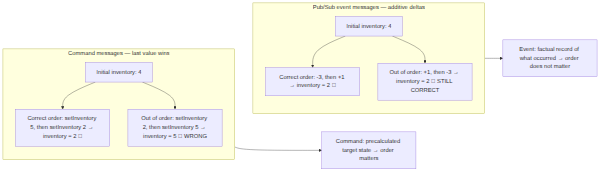
Key advantages of event-driven ingestion with Pub/Sub:
- Seamless horizontal scalability: Asynchronous event publication removes bottlenecks, enabling producers and consumers to scale independently.
- Zero-impact extensibility: New consumers attach new subscriptions to the existing topic without placing additional load or code dependencies on the publisher.
- Resilience to out-of-order data: Emitting delta events rather than absolute state changes makes downstream aggregation robust against out-of-order or late-arriving messages.
- Direct BigQuery integration: Pub/Sub supports direct BigQuery subscriptions, routing streaming data straight into tables without requiring complex custom intermediary infrastructure.
Why this is optimal:
Compared to scheduled batch pipelines or command-driven message queues, event-driven streaming with Pub/Sub minimizes data latency, reduces producer complexity, and provides the flexibility to support multiple independent analytical workloads simultaneously.
Implement an hourly cron job that exports CSV dumps from local servers to Cloud Storage and triggers BigQuery load jobs.
Implement an hourly cron job that exports CSV dumps from local servers to Cloud Storage and triggers BigQuery load jobs.
What the option is:
An hourly file-based batch ingestion process uses scheduled scripts or cron jobs to export transaction logs into flat files (such as CSV), upload them to Cloud Storage, and trigger batch load jobs into BigQuery.
Why it doesn't meet the requirements:
- Hourly latency delay (✗): File-based cron export mechanisms introduce up to an hour of latency, making real-time dashboard updates impossible.
- Fragile operational maintenance (✗): Relying on server-level cron jobs and file exports introduces potential failure points such as missing files, network interruptions, and disk space exhaustion.
- Lacks publish-subscribe decoupling (✗): File exports do not provide a native publish-subscribe mechanism for multiple independent analytics systems to consume the same event stream dynamically.
Key limitations:
- Manual error recovery: Failures in cron job execution or file generation require custom retry logic and manual intervention.
- No continuous event streaming: Data is batched in discrete files rather than emitted as fluid, asynchronous events.
- Unstructured schema drift: CSV files lack robust schema evolution and metadata controls compared to managed messaging schemas.
This answer would be correct if:
The upstream source system was a legacy mainframe or third-party appliance that only supported periodic flat-file batch exports, and where near real-time analytics was not a requirement.
Implement a centralized message-queue architecture that sends synchronous state-change commands directly to target database endpoints.
Implement a centralized message-queue architecture that sends synchronous state-change commands directly to target database endpoints.
What the option is:
A centralized message-queue architecture (a command-oriented "smart pipes, dumb endpoints" model) sends explicit imperative commands from producers to specific queues, directing downstream targets to change their state to a precalculated value (e.g., setInventory(2)).
Why it doesn't meet the requirements:
- Tight coupling between producers and consumers (✗): In a traditional message-queue command model, the producer must understand the business logic and endpoints of each specific consumer. Adding new analytical consumers requires modifying the producer to publish to new targeted queues.
- Single point of failure and scaling limits (✗): Centralized message brokers that manage per-subscriber delivery state and enforce strict sequential ordering create operational bottlenecks and limit scaling compared to asynchronous publish-subscribe architectures.
- Vulnerability to out-of-order messages (✗): Because command messages dictate the final state rather than delta events, delayed or out-of-order messages result in incorrect data states in target databases.
Key limitations:
- High blast radius for changes: Modifying consumer business logic often requires updating producer code.
- Complex rollback procedures: When bad data or duplicate commands arrive, reversing state is difficult without historical baseline references.
- Higher operational overhead: Managing centralized routing logic adds administrative complexity under high throughput.
This answer would be correct if:
The scenario required a legacy point-to-point workflow where a single downstream service must execute a strict transactional command requiring synchronous acknowledgment before the caller can continue.
Implement a scheduled batch extraction pipeline that executes daily SQL queries against transactional databases and loads the delta into BigQuery.
Implement a scheduled batch extraction pipeline that executes daily SQL queries against transactional databases and loads the delta into BigQuery.
What the option is:
A scheduled batch extraction pipeline periodically queries an operational database (e.g., every 24 hours) using tools like Cloud Composer or Cloud Data Fusion to extract accumulated records and load them into BigQuery in bulk.
Why it doesn't meet the requirements:
- High data latency (✗): Batch processing introduces significant delays (hours or days) between when an event occurs and when it becomes queryable in BigQuery, failing the near real-time requirement.
- Source database overhead (✗): Running large batch extraction queries on operational transactional databases can degrade production application performance during peak extraction windows.
- Not event-driven (✗): Batch pipelines process static snapshots at predetermined intervals rather than responding asynchronously to continuous event streams.
Key limitations of batch pipelines for streaming needs:
- Delayed operational insights: Dashboards only reflect data up to the last batch run timestamp.
- Spiky resource consumption: Batch jobs demand massive compute resources during extraction and transformation, followed by idle periods.
- Inflexible consumer onboarding: Downstream consumers must wait for scheduled extraction cycles rather than consuming events on demand.
This answer would be correct if:
The scenario required processing historical data for monthly financial reconciliation, generating non-time-sensitive executive summaries, or performing large-scale machine learning model training where sub-second latency is not required.
Try 10 interactive questions like this one, free
Answer them yourself and get your score the moment you finish. No account needed.
Full access includes
- 1,132 practice questions across all 4 exam domains
- Every answer explained: why it is right, and why the others are not
- Scout, an AI tutor that answers your follow-up questions
- Readiness tracking by domain, so you know when to book the exam
Related questions
Keep the momentum going with these hand-picked practice scenarios
FundamentalAssociate Data Practitioner
Pub/Sub BigQuery Subscription
Identify use cases for event-driven data ingestion from Pub/Sub to BigQuery
FundamentalAssociate Data Practitioner
Pub/Sub to BigQuery Streaming Ingestion
Identify use cases for event-driven data ingestion from Pub/Sub to BigQuery
FundamentalAssociate Data Practitioner
Cloud Storage Regional Location
Choose the appropriate data storage location type (e.g., regional, dual-regional, multi-regional, zonal)
FundamentalAssociate Data Practitioner
ETL with Dataflow Pre-Load Transformations
Differentiate between different data manipulation methodologies (e.g., ETL, ELT, ETLT)
FundamentalAssociate Data Practitioner
Uniform Bucket-Level Access
Compare methods of access control for Cloud Storage (e.g., public or private access, uniform access)
IntermediateProfessional Cloud Architect
Cloud Pub/Sub vs Self-Managed Messaging
Decision-making processes
Last updated