Fundamental
Prepare and test your skills

Fundamental
Prepare and test your skills
Cloud Run Scale to Zero for Stateless Services
Free sample question with answers and detailed explanation below. The Associate Cloud Engineer practice bank has an additional 2,014 practice questions.Try 10 free realistic questions: instant score, no credit card, and no account required.
A startup is deploying a new containerized REST API that serves mobile application clients. The architecture and operational requirements include:
- The service is completely stateless and handles incoming HTTPS requests.
- Traffic is highly unpredictable, experiencing traffic spikes during marketing campaigns and long idle periods during the night.
- The team wants to eliminate cluster and infrastructure management overhead.
- The solution must automatically scale down to zero instances when idle to minimize costs.
Which Google Cloud compute service should the team select?
Explanations
App Engine Standard Environment
App Engine Standard Environment
What App Engine Standard Environment Is
App Engine Standard Environment is a Platform-as-a-Service (PaaS) designed to run web applications using specific language-specific runtimes (such as Python, Java, Node.js, or Go) in sandboxed, managed environments.
Why It Doesn't Meet the Requirement
- Deployment Format Restrictions: App Engine Standard is designed around deploying source code to predefined runtime environments rather than arbitrary custom container images with custom system packages.
- Modern Container Standardization: Modern cloud-native microservices packaged as OCI/Docker container images are intended to run on modern container platforms like Cloud Run rather than App Engine Standard runtimes.
- Less Flexibility: App Engine standard imposes runtime sandbox constraints that limit networking, custom binaries, and container customizations compared to Cloud Run.
Key Characteristics and Limitations
- Code must conform to specific runtime versions provided by the platform.
- Limited support for deploying arbitrary custom container binaries or system libraries.
- Uses legacy application-level configurations (
app.yaml) rather than standard container definitions.
This Answer Would Be Correct If
You were deploying pure application source code using supported programming languages without creating custom container images, and you preferred a traditional PaaS model over containerized deployments.
Additional Context
While App Engine Standard does support scaling to zero, Cloud Run represents the modern evolution of serverless application hosting on Google Cloud, combining the simplicity of serverless scaling with the portability of custom containers.
Cloud Run
Cloud Run
What Cloud Run Is
Cloud Run is a fully managed, serverless compute platform that enables you to run stateless containerized applications directly on Google Cloud infrastructure without needing to create or manage Kubernetes clusters or virtual machine instances.
How It Meets the Requirements
- Stateless HTTPS Workload: Cloud Run is purpose-built for stateless microservices and web applications, automatically provisioning a secure HTTPS endpoint for every deployed service revision.
- Unpredictable Traffic & Rapid Scaling: Cloud Run provides fast, request-based autoscaling, adding container instances quickly when traffic surges and tearing them down when demand drops.
- Zero Cluster Management: Developers deploy their container images directly to the platform without provisioning nodes, configuring control planes, or maintaining underlying operating systems.
- Scale to Zero & Cost Optimization: When no incoming requests are received, Cloud Run automatically scales instances down to zero, ensuring you are not billed for idle compute resources under the default request-based pricing model.
Cloud Run Scale to Zero Timeline
Timeline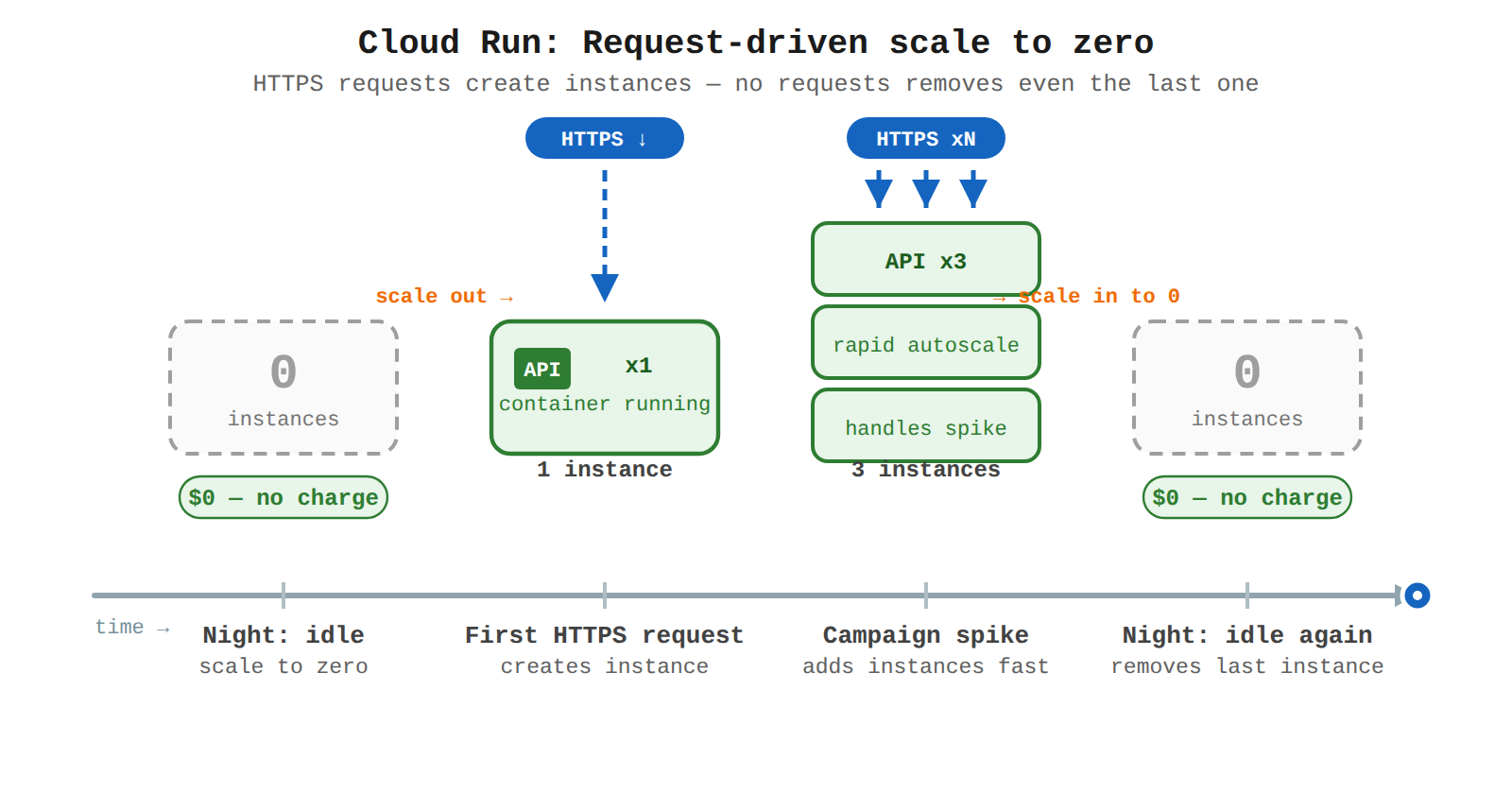
Key Advantages and Capabilities
- Automatic HTTPS Provisioning: Provides managed TLS certificates and default domains for quick public or private routing.
- Granular Billing: Charges only for compute resources consumed while actively processing incoming requests (measured at sub-second increments).
- Concurrency Support: Allows multiple concurrent requests to be handled by a single container instance, improving throughput and lowering overall instance count.
- Native Container Portability: Accepts standard OCI container images built from any language or framework.
Why This Is Optimal
Unlike Google Kubernetes Engine (GKE), which requires managing cluster configurations and typically incurs baseline costs for underlying nodes, Cloud Run provides a serverless execution environment optimized for request-driven, stateless microservices with zero operational cluster overhead.
Compute Engine with Managed Instance Groups
Compute Engine with Managed Instance Groups
What Compute Engine Managed Instance Groups Are
Compute Engine Managed Instance Groups (MIGs) allow you to operate homogeneous pools of virtual machine (VM) instances based on an instance template, supporting automated healing, regional replication, and metric-based autoscaling.
Why It Doesn't Meet the Requirement
- High Operational Overhead: Using VM instances requires full lifecycle management of the operating system, including patching, security hardening, container runtime installations, and boot disk management.
- Slow Autoscaling: Provisioning and booting full VM instances takes several minutes, making it poorly suited to handle abrupt, unpredictable traffic spikes compared to lightweight container startup times.
- No Native Scale to Zero: While a MIG can theoretically scale down to zero instances, doing so causes long cold-start delays (minutes to spin up new VMs and initialize services) and requires external load balancers and complex trigger mechanisms.
Key Characteristics and Limitations
- Provides full OS-level access (IaaS) rather than a serverless container environment.
- Slower scale-out times due to full virtual machine initialization.
- Requires manual configuration of load balancers, health checks, and autoscaling policies.
This Answer Would Be Correct If
Your workload required custom OS-level kernel modules, legacy monolithic architectures that cannot run inside containers, or direct bare-metal/hardware-level configurations.
Additional Context
Compute Engine sits at the lowest level of abstraction among Google Cloud compute offerings, providing maximum control but demanding the highest operational effort from developers.
Google Kubernetes Engine (GKE) Standard
Google Kubernetes Engine (GKE) Standard
What GKE Standard Is
Google Kubernetes Engine (GKE) Standard is a managed container orchestration platform powered by open-source Kubernetes. In Standard mode, users define and manage node pools composed of Compute Engine virtual machines where containerized Pods are scheduled.
Why It Doesn't Meet the Requirement
- Management Overhead: GKE Standard requires operators to configure, maintain, scale, and upgrade node pools, container runtimes, and cluster networking settings.
- No Native Scale to Zero Without Cost: Even if all workload Pods scale to zero, the underlying Compute Engine VM instances in the node pool continue running and incurring hourly compute and storage charges unless manually decommissioned.
- Excess Complexity: Deploying a simple, single-container stateless API on GKE introduces unnecessary orchestration layers such as Kubernetes Deployments, Services, and Ingress manifests.
Key Characteristics and Limitations
- Requires managing cluster architecture, node sizing, and machine families.
- Incurs ongoing infrastructure costs for node VMs regardless of actual application traffic.
- Best suited for multi-container orchestration, persistent storage integration, and deep networking control.
This Answer Would Be Correct If
Your application required complex multi-container orchestration, custom kernel configurations, native persistent disk attachments (PersistentVolumes), non-HTTP protocols, or fine-grained control over underlying cluster infrastructure and hardware accelerators.
Additional Context
While GKE provides extensive flexibility for enterprise-scale container orchestration, using it for a simple, stateless HTTP microservice creates substantial operational overhead compared to a fully managed serverless platform like Cloud Run.
Try 10 interactive questions like this one, free
Answer them yourself and get your score the moment you finish. No account needed.
Full access includes
- 2,014 practice questions across all 4 exam domains
- Every answer explained: why it is right, and why the others are not
- Scout, an AI tutor that answers your follow-up questions
- Readiness tracking by domain, so you know when to book the exam
Related free sample questions
Keep the momentum going with these hand-picked practice scenarios
FundamentalAssociate Cloud Engineer
Cloud Run Functions with Functions Framework
Selecting appropriate compute choices for a given workload (e.g., Compute Engine, Google Kubernetes Engine [GKE], Cloud Run, Cloud Run functions, Knative serving)
FundamentalAssociate Cloud Engineer
Compute Engine Full OS Control
Selecting appropriate compute choices for a given workload (e.g., Compute Engine, Google Kubernetes Engine [GKE], Cloud Run, Cloud Run functions, Knative serving)
FundamentalAssociate Cloud Engineer
Database Center Fleet Management
Using Database Center to manage the Google Cloud database fleet
FundamentalAssociate Cloud Engineer
kubectl describe vs kubectl get
Viewing current running GKE cluster inventory (e.g., nodes, Pods, Services)
FundamentalAssociate Cloud Engineer
VPC Firewall Ingress Rule Attributes
Creating and applying Cloud Next Generation Firewall (Cloud NGFW) policies with ingress and egress rules and attributes (e.g., action, source, destination, targets, protocols, ports)
AdvancedProfessional Cloud Network Engineer
NGFW Firewall Endpoint and Enforcement Order
Enabling and reviewing Cloud Logging for networking components (e.g., Cloud VPN, Cloud Router, VPC Service Controls, Cloud Next Generation Firewall [NGFW], Firewall Insights, VPC Flow Logs, Cloud DNS, Cloud NAT, and Network Connectivity Center).
Last updated