Fundamental
Prepare and test your skills

Fundamental
Prepare and test your skills
Real-Time Clickstream Pipeline with Pub/Sub and Dataflow
Free sample question with answers and detailed explanation below. The Associate Cloud Engineer practice bank has an additional 2,014 practice questions.Try 10 free realistic questions: instant score, no credit card, and no account required.
An e-commerce company is designing a real-time data processing architecture on Google Cloud to capture user clickstream events from web and mobile applications.
The architecture must satisfy the following requirements:
- Ingest high-volume event streams asynchronously and reliably from distributed clients
- Transform and enrich streaming data in real time using a managed, serverless pipeline
- Store the transformed records in a fully managed data warehouse for large-scale SQL analytics and reporting
Which combination of Google Cloud services should the company implement?
Explanations
Memorystore for event ingestion, Cloud Data Fusion for stream processing, and Cloud Bigtable for analytics data warehousing
Memorystore for event ingestion, Cloud Data Fusion for stream processing, and Cloud Bigtable for analytics data warehousing
What the Option Is and Does
This option suggests using Memorystore (managed in-memory Redis or Memcached) to capture events, Cloud Data Fusion for ETL pipelines, and Cloud Bigtable (a wide-column NoSQL database) for warehousing and SQL reporting.
Why It Doesn't Meet the Requirement
- Event Ingestion: Memorystore provides in-memory key-value caching. While fast, it is not a distributed, persistent, event-driven messaging service with publisher/subscriber decoupling and automatic topic management.
- Data Warehousing: Cloud Bigtable is a low-latency NoSQL wide-column store optimized for high-throughput single-row key lookups and operational time-series data. It is not an enterprise SQL analytics data warehouse.
Key Characteristics and Limitations
- Memorystore does not provide native pub/sub subscription fan-out, dead-letter queuing, or long-term message durability.
- Cloud Bigtable does not natively execute multi-table analytical SQL queries or integrate directly with standard business intelligence reporting tools without external query engines.
- Cloud Data Fusion focuses on code-free graphical ETL integration rather than unified, auto-scaling stream processing pipelines built with Apache Beam.
This Answer Would Be Correct If
The organization needed an in-memory application cache (Memorystore), a visual interface for batch ETL orchestration (Cloud Data Fusion), and a scalable NoSQL store for sub-10-millisecond operational reads and writes (Cloud Bigtable).
Cloud SQL for event ingestion, Dataproc for stream processing, and Firestore for analytics data warehousing
Cloud SQL for event ingestion, Dataproc for stream processing, and Firestore for analytics data warehousing
What the Option Is and Does
This option proposes using Cloud SQL (a managed relational database) for event capture, Dataproc (managed Apache Spark and Hadoop clusters) for streaming transformations, and Firestore (a NoSQL document database) for data warehousing.
Why It Doesn't Meet the Requirement
- Event Ingestion: Cloud SQL is a relational OLTP database engine (MySQL, PostgreSQL, SQL Server) designed for transactional integrity, not for buffering massively distributed, asynchronous clickstream event streams at scale.
- Data Warehousing and Analytics: Firestore is optimized for low-latency operational document lookups and mobile synchronization. It is not designed to function as an enterprise data warehouse or run complex SQL analytical queries across terabytes of data.
Key Characteristics and Limitations
- Cloud SQL connection limits and single-instance write ceilings make it a poor fit as an asynchronous message ingestion buffer.
- Dataproc requires provisioning, configuring, and managing virtual machine clusters rather than offering a serverless processing model.
- Firestore lacks native support for complex multi-table SQL joins and aggregation queries typical of analytical reporting.
This Answer Would Be Correct If
The workload required a traditional relational database backend for web transactions (Cloud SQL), an existing Apache Spark workload migrated from on-premises infrastructure (Dataproc), and a document store for mobile client state management (Firestore).
Pub/Sub for event ingestion, Dataflow for stream processing, and BigQuery for analytics data warehousing
Pub/Sub for event ingestion, Dataflow for stream processing, and BigQuery for analytics data warehousing
What the Solution Is
Pub/Sub, Dataflow, and BigQuery form Google Cloud's foundational reference architecture for real-time streaming ingestion, unified data processing, and large-scale analytical storage.
How It Meets the Requirements
- Ingest high-volume event streams: Pub/Sub provides a fully managed, globally available messaging system designed to ingest event streams at any scale asynchronously. It acts as an elastic buffer between distributed client applications and processing systems.
- Transform streaming data in real time: Dataflow is a serverless data processing service built on Apache Beam. It executes unified stream and batch processing pipelines with autoscaling compute resources, handling windowing, aggregation, and real-time transformations without requiring manual server management.
- Store records for SQL analytics: BigQuery is Google Cloud's serverless, petabyte-scale enterprise data warehouse. It allows data analysts and business intelligence tools to run high-performance SQL queries directly against large datasets.
Key Advantages and Capabilities
- Serverless Architecture: All three services are fully managed and serverless, eliminating operational overhead for provisioning, patching, or scaling underlying infrastructure.
- Decoupled Architecture: Pub/Sub decouples data producers from downstream consumers, preventing client-side spikes from overwhelming data processing workers.
- Unified Processing Model: Dataflow uses the Apache Beam SDK, allowing developers to express both batch and streaming pipelines with the same unified programming model.
- Native Integrations: Dataflow offers high-throughput built-in I/O connectors for reading from Pub/Sub and writing directly to BigQuery tables.
Decoupled Streaming: Pub/Sub Buffers, Dataflow Pulls
Sequence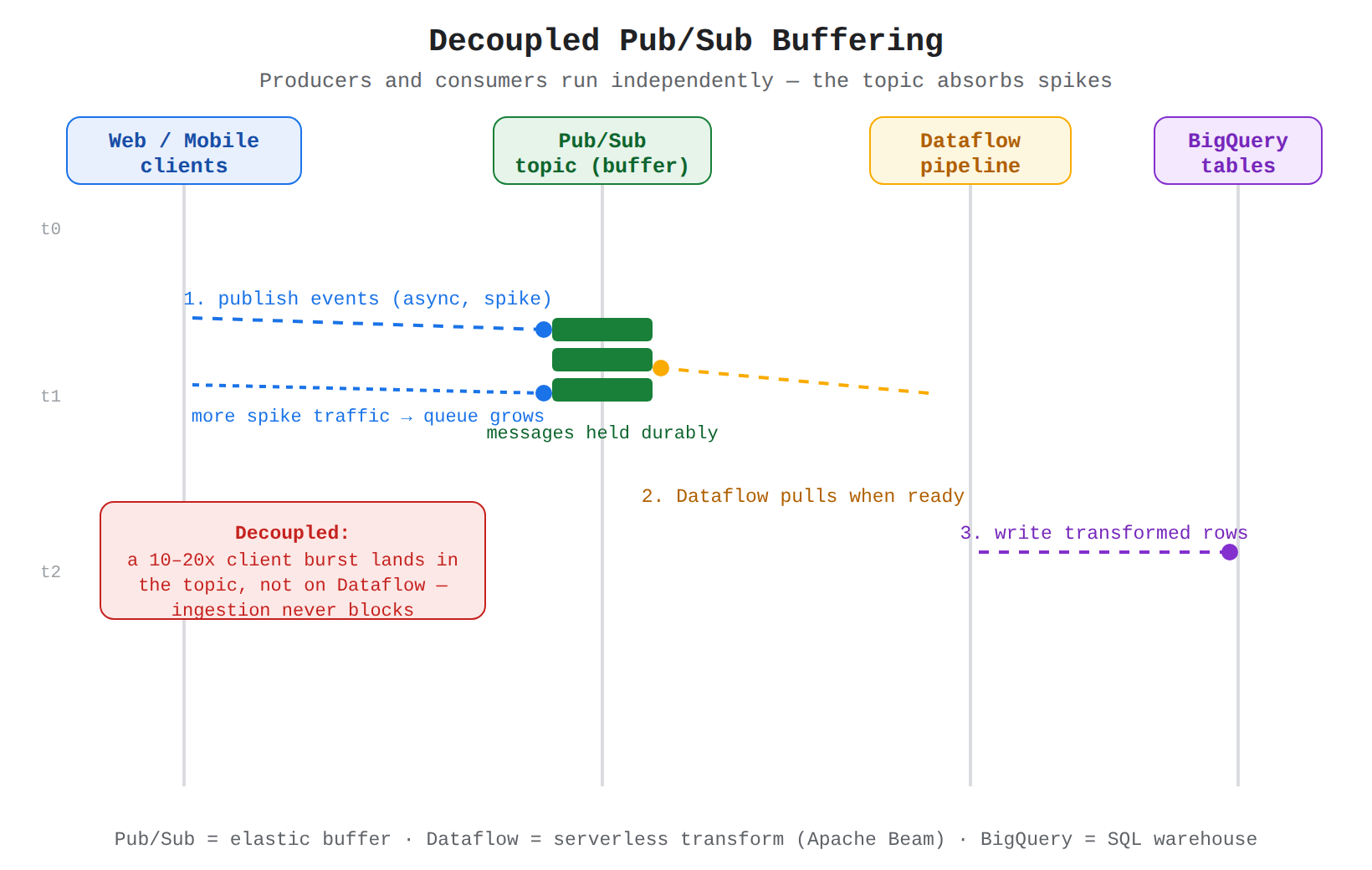
Storage Transfer Service for event ingestion, Cloud Composer for stream processing, and Cloud Spanner for analytics data warehousing
Storage Transfer Service for event ingestion, Cloud Composer for stream processing, and Cloud Spanner for analytics data warehousing
What the Option Is and Does
This option pairs Storage Transfer Service for ingestion, Cloud Composer (managed Apache Airflow) for stream transformation, and Cloud Spanner (a globally distributed relational database) for analytics warehousing.
Why It Doesn't Meet the Requirement
- Event Ingestion: Storage Transfer Service is designed for scheduled batch transfers of files between object storage systems (such as AWS S3 to Cloud Storage), not for streaming micro-events from applications.
- Stream Processing: Cloud Composer is an orchestration and workflow scheduling tool based on Apache Airflow. It triggers and monitors batch workflows as Directed Acyclic Graphs (DAGs) but does not execute continuous, real-time streaming data transformations.
- Analytics Warehousing: Cloud Spanner is an operational OLTP database providing global consistency and horizontal scale for transactional applications, not an analytical data warehouse optimized for scanning massive datasets with ad hoc SQL queries.
Key Characteristics and Limitations
- Storage Transfer Service operates on files in storage buckets rather than real-time application event payloads.
- Cloud Composer schedules tasks; it relies on underlying compute services (like Dataflow or Dataproc) to actually execute heavy data transformations.
- Cloud Spanner costs significantly more than BigQuery for storing and querying large analytical historical datasets.
This Answer Would Be Correct If
The organization needed to automate scheduled batch file copies between cloud object stores (Storage Transfer Service), orchestrate end-to-end multi-step DAG workflows (Cloud Composer), and maintain globally synchronized operational transactions (Cloud Spanner).
Try 10 interactive questions like this one, free
Answer them yourself and get your score the moment you finish. No account needed.
Full access includes
- 2,014 practice questions across all 4 exam domains
- Every answer explained: why it is right, and why the others are not
- Scout, an AI tutor that answers your follow-up questions
- Readiness tracking by domain, so you know when to book the exam
Related free sample questions
Keep the momentum going with these hand-picked practice scenarios
FundamentalAssociate Cloud Engineer
Firestore in Datastore Mode ACID Transactions
Choosing and deploying data products (e.g., Cloud SQL, BigQuery, Firestore, Spanner, Bigtable, AlloyDB, Dataflow, Pub/Sub, Google Cloud Managed Service for Apache Kafka, Memorystore)
FundamentalAssociate Cloud Engineer
Memorystore High Availability SLA Requirements
Choosing and deploying data products (e.g., Cloud SQL, BigQuery, Firestore, Spanner, Bigtable, AlloyDB, Dataflow, Pub/Sub, Google Cloud Managed Service for Apache Kafka, Memorystore)
FundamentalAssociate Cloud Engineer
Cloud Identity Groups For IAM
Managing users and groups in Cloud Identity (manually and automated)
FundamentalAssociate Cloud Engineer
Kubernetes Deployment Rolling Updates
Working with Kubernetes resources (e.g., Pods, Services, StatefulSets)
FundamentalAssociate Cloud Engineer
Managed Instance Group Autoscaling
Creating an autoscaled managed instance group by using an instance template
IntermediateProfessional Cloud Developer
Memorystore Private Services Access Migration
Implementing caching solutions (e.g., Memorystore)
Last updated