Fundamental
Prepare and test your skills

Fundamental
Prepare and test your skills
Autoscaling Stateless Web Services with Managed Instance Groups
Free sample question with answers and detailed explanation below. The Associate Cloud Engineer practice bank has an additional 2,014 practice questions.Try 10 free realistic questions: instant score, no credit card, and no account required.
An organization is deploying a public-facing, stateless web service on Google Cloud Compute Engine. You have created an instance template that defines the base VM configuration. The application sits behind an HTTP(S) Load Balancer and experiences unpredictable spikes and drops in user requests throughout the day.
You need to automatically adjust the number of VM instances to meet changing demand while preventing over-provisioning and controlling infrastructure costs.
Which configuration should you implement?
Explanations
Deploy the application on a single oversized Compute Engine VM, and configure vertical instance scaling policies through Cloud SQL.
Deploy the application on a single oversized Compute Engine VM, and configure vertical instance scaling policies through Cloud SQL.
What Vertical Scaling and Cloud SQL Are
Vertical scaling involves increasing or decreasing the compute capacity (vCPU and RAM) of an individual machine or managed database rather than adding more instances. Cloud SQL is a managed relational database service (MySQL, PostgreSQL, SQL Server) and is not used to host application compute servers.
Why It Doesn't Meet the Requirement
- Wrong Service Layer: Cloud SQL manages databases, not Compute Engine application servers or HTTP(S) Load Balancer backend instances.
- Single Point of Failure: Running on a single oversized VM removes high availability and redundancy. If that single VM fails or undergoes maintenance, the web service becomes unavailable.
- No Dynamic Horizontal Elasticity: Vertical scaling requires modifying VM machine types, which generally entails reboot downtime and cannot rapidly respond to real-time spikes in web traffic.
Key Characteristics and Limitations
- Database Focus: Cloud SQL scaling features are specific to managed relational database workloads.
- Inefficient Cost Model: Provisioning a single large VM forces the organization to pay for peak capacity even during off-peak hours.
This Answer Would Be Correct If
You were scaling the hardware specifications (CPU and memory) of a managed relational backend database to accommodate increased transactional read/write workloads.
Create a managed instance group (MIG) using the instance template, configure an autoscaling policy using CPU utilization or HTTP load balancing serving capacity, and set minimum and maximum instance limits.
Create a managed instance group (MIG) using the instance template, configure an autoscaling policy using CPU utilization or HTTP load balancing serving capacity, and set minimum and maximum instance limits.
What Managed Instance Groups and Autoscaling Policies Are
A Managed Instance Group (MIG) is a collection of identical Compute Engine virtual machines (VMs) deployed from a single instance template. An autoscaling policy automatically adjusts the number of VM instances in the group (scaling out by adding VMs during high load and scaling in by deleting VMs during low load) based on target utilization metrics.
How It Meets the Requirements
- Dynamic Resource Matching: Setting scaling signals such as average CPU utilization or HTTP load balancing serving capacity ensures that the autoscaler dynamically provisions additional instances as web traffic increases and deletes unneeded instances when demand subsides.
- Cost and Capacity Boundaries: Defining minimum and maximum instance limits guarantees that a baseline number of VMs is always available to handle initial traffic while placing a strict upper boundary on instance count to avoid unexpected cloud spend.
- Template-Based Deployment: Using the existing instance template ensures all provisioned VM instances share uniform operating system images, machine types, startup scripts, and networking configurations.
Key Advantages and Capabilities
- Automatic Traffic Handling: Scales out seamlessly during unexpected traffic spikes to prevent application downtime or degraded user response times.
- Multiple Scaling Signals: Supports combining signals (such as CPU utilization, Cloud Monitoring metrics, and Load Balancing capacity), scaling according to whichever signal requests the largest instance count.
- Cost Optimization: Shuts down surplus VMs during quiet periods to reduce operational expenditure.
- High Availability: Automatically replaces unhealthy or terminated instances to maintain service availability.
Why This Is Optimal
A Managed Instance Group with an autoscaling policy is the native, Google-recommended compute solution for managing stateless, horizontally scalable workloads behind a load balancer.
Create individual standalone Compute Engine VM instances, and configure an autoscaling policy directly in Cloud Monitoring to provision new instances.
Create individual standalone Compute Engine VM instances, and configure an autoscaling policy directly in Cloud Monitoring to provision new instances.
What Standalone VMs and Cloud Monitoring Are
Standalone Compute Engine VMs are independent virtual machine instances that are not attached to an instance group. Cloud Monitoring provides visibility into performance metrics, logs, and operational health across Google Cloud resources.
Why It Doesn't Meet the Requirement
- No Direct VM Provisioning from Monitoring: Cloud Monitoring collects metrics and triggers alert notifications, but it cannot directly act as an autoscaler to spin up or delete standalone VM instances without orchestrating compute resources through a managed group.
- Lack of Centralized Scaling: Compute Engine autoscaling requires a Managed Instance Group (MIG) controller to manage VM lifecycles based on measured load.
Key Characteristics and Limitations
- Independent Lifecycle: Standalone instances cannot be automatically scaled out or scaled in dynamically.
- Monitoring Focus: Cloud Monitoring alerts administrators or triggers webhooks, but it does not replace the native Compute Engine MIG autoscaler.
- Operational Overhead: Requires custom automation code or manual intervention to provision new instances.
This Answer Would Be Correct If
The goal was to configure notification alerts (such as email or PagerDuty incidents) when aggregate VM resource utilization exceeded defined thresholds.
Create an unmanaged instance group using the instance template, and enable autoscaling based on HTTP load balancing serving capacity.
Create an unmanaged instance group using the instance template, and enable autoscaling based on HTTP load balancing serving capacity.
What Unmanaged Instance Groups Are
An unmanaged instance group is a collection of heterogeneous Compute Engine VM instances that do not share a common configuration template and must be created and configured individually.
Why It Doesn't Meet the Requirement
- No Autoscaling Support: Unmanaged instance groups do not support autoscaling, auto-healing, rolling updates, or instance template-based deployment.
- Manual Management Only: Compute Engine autoscaling requires homogeneous instances managed under a Managed Instance Group (MIG) so that the autoscaler can automatically add or delete identical VMs.
Key Characteristics and Limitations
- Heterogeneous Workloads: Designed solely for grouping together pre-existing, dissimilar VMs that require individual management.
- No Automated Scaling: Cannot dynamically scale in or out in response to traffic load or performance metrics.
- High Administrative Burden: Every change in capacity must be performed manually by an administrator.
This Answer Would Be Correct If
You needed to apply load balancing across a legacy set of pre-existing, differently configured VMs that do not support automated scaling or uniform templating.
Try the scenario
Autoscaling a Stateless Web Service on Compute Engine
Change the inputs and watch how the outcome changes.
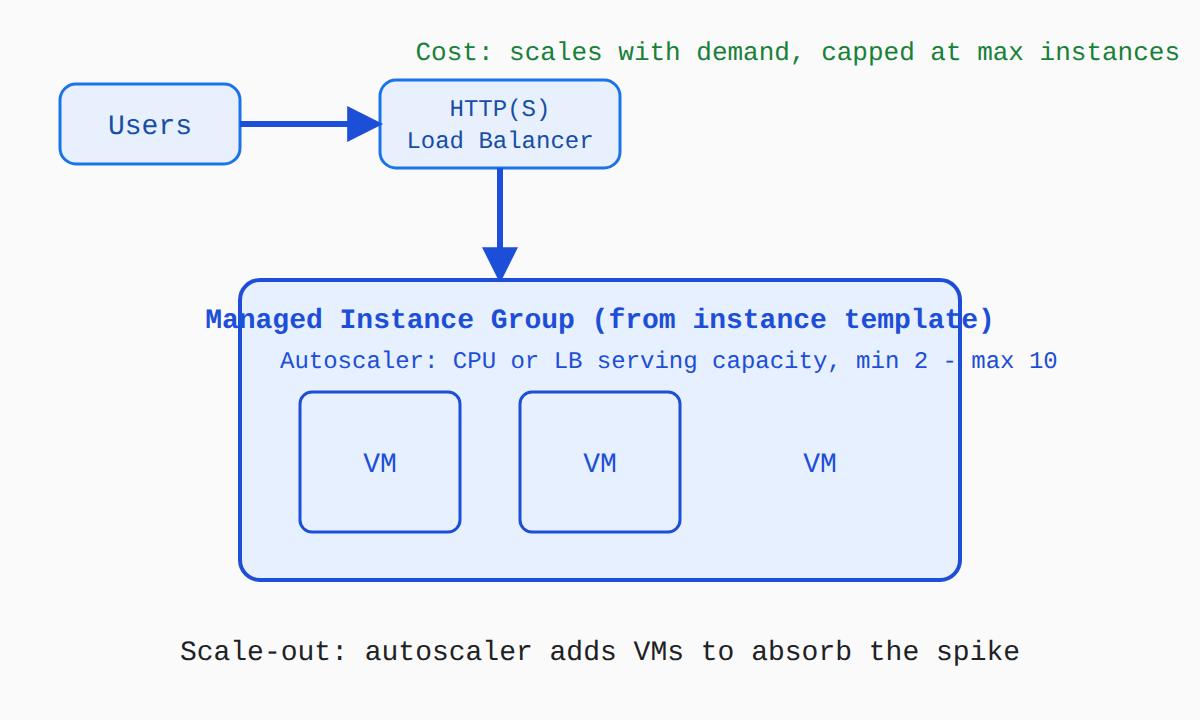
Switch the backend architecture and traffic conditions to see how each configuration handles unpredictable demand.
Try 10 interactive questions like this one, free
Answer them yourself and get your score the moment you finish. No account needed.
Full access includes
- 2,014 practice questions across all 4 exam domains
- Every answer explained: why it is right, and why the others are not
- Scout, an AI tutor that answers your follow-up questions
- Readiness tracking by domain, so you know when to book the exam
Related free sample questions
Keep the momentum going with these hand-picked practice scenarios
FundamentalAssociate Cloud Engineer
Compute Engine Instance Templates
Creating an autoscaled managed instance group by using an instance template
FundamentalAssociate Cloud Engineer
MIG Autohealing Initial Delay
Creating an autoscaled managed instance group by using an instance template
FundamentalAssociate Cloud Engineer
Cloud SQL Service Account Storage Permissions
Loading data (e.g., command-line upload, load data from Cloud Storage, Storage Transfer Service)
FundamentalAssociate Cloud Engineer
Persistent Disk Snapshot Schedules
Working with snapshots and images (e.g., create, view, and delete images or snapshots; schedule a snapshot)
FundamentalAssociate Cloud Engineer
Data Access Audit Logs
Configuring audit logs
IntermediateProfessional Cloud Database Engineer
Cloud Storage CMEK Encryption Enforcement
Schedule database exports
Last updated