Fundamental
Prepare and test your skills

Fundamental
Prepare and test your skills
Stateless Replica Management Using Kubernetes Deployments
Free sample question with answers and detailed explanation below. The Associate Cloud Engineer practice bank has an additional 2,014 practice questions.Try 10 free realistic questions: instant score, no credit card, and no account required.
Your company is deploying a customer-facing frontend web service to a Google Kubernetes Engine (GKE) cluster. The frontend application is stateless, does not persist client session data locally, and requires five interchangeable replicas to satisfy user traffic demand.
The operations team requires that any future updates to the container image must be automated as a zero-downtime rolling update, with the ability to immediately roll back to a previous revision if defects are detected.
Which Kubernetes workload resource should you configure to manage these Pods?
Explanations
Deployment
Deployment
What a Deployment is
A Kubernetes Deployment is a declarative workload controller designed specifically for managing stateless applications. It manages the desired state of an application, defining parameters such as container images, replica counts, labels, and update strategies. Under the hood, a Deployment creates and manages ReplicaSets, which in turn manage individual Pod lifecycles.
How it meets the requirements
- Stateless and interchangeable Pods: Deployments treat Pods as uniform, non-unique entities that can be created, destroyed, or rescheduled onto any healthy cluster node without losing application functionality.
- Maintains desired state: By defining
spec.replicas: 5, the Deployment controller continuously reconciles actual cluster state against the desired state, immediately creating replacements if any Pod crashes or a node fails. - Automated rolling updates: When the container image is updated (such as via
kubectl applyorkubectl set image), the Deployment automatically initiates a rolling update by spinning up a new ReplicaSet with updated Pods while progressively terminating older Pods according to configured surge and availability limits. - Built-in rollback mechanism: Deployments record revision history, allowing operations teams to execute
kubectl rollout undoto instantly revert to a previous working revision if an update introduces defects.
Deployment Rolling Update & Rollback
Timeline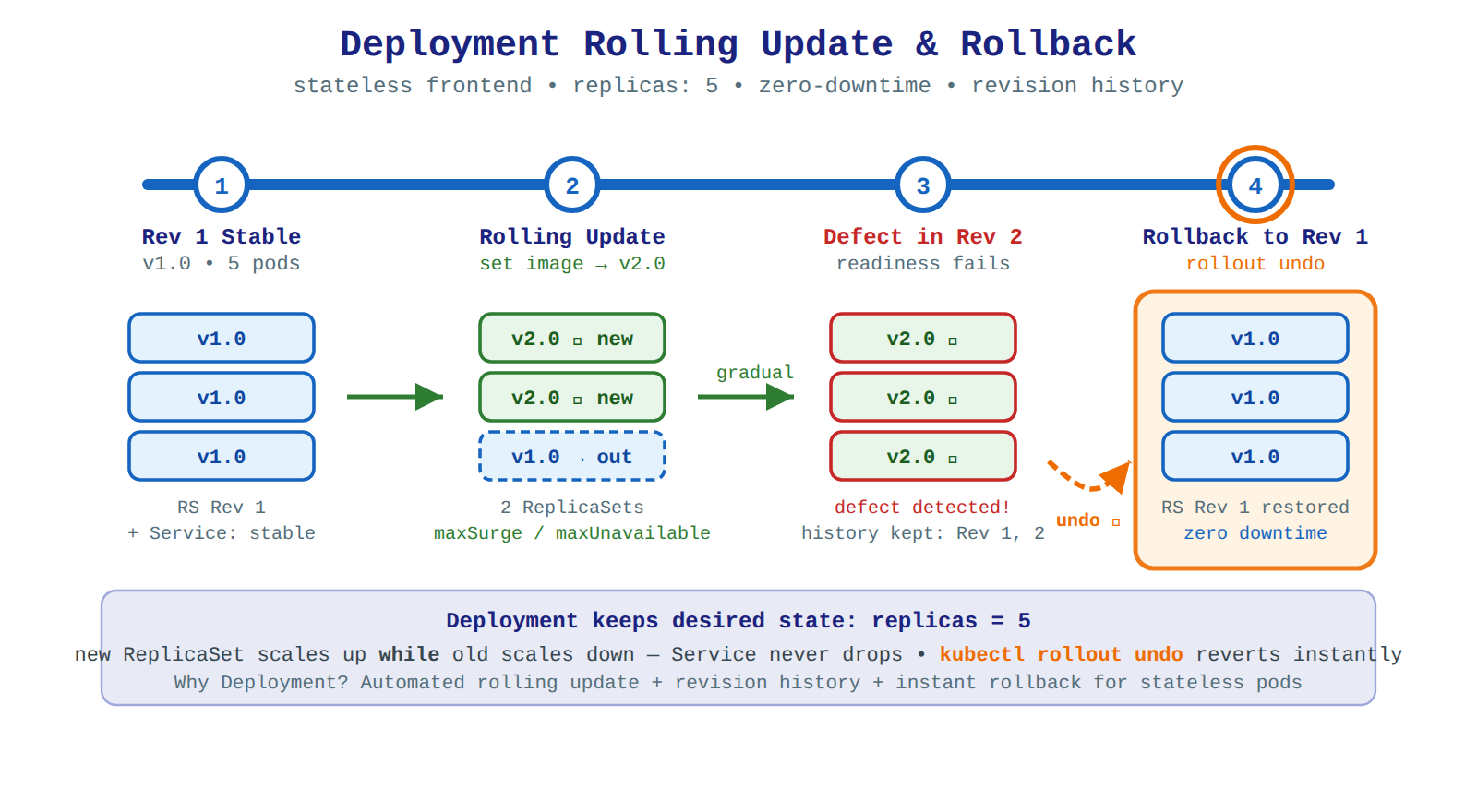
Key advantages and capabilities
- Declarative desired state: Automatically detects drift and replaces failed Pods to maintain high availability.
- Seamless rolling rollouts: Configurable
maxSurgeandmaxUnavailablesettings guarantee zero downtime during updates. - Revision history tracking: Preserves rollout revisions to facilitate quick rollbacks.
- Scalability: Allows horizontal scaling manually (
kubectl scale) or automatically with the Horizontal Pod Autoscaler (HPA). - Integrated health checking: Interacts with container readiness and liveness probes before directing traffic or terminating older replicas.
Why this is optimal
Deployments represent the standard best practice for managing stateless container workloads in GKE. Unlike lower-level primitives like bare Pods or standalone ReplicaSets, Deployments automate update lifecycles and rollout management without manual intervention.
Standalone ReplicaSet objects
Standalone ReplicaSet objects
What a standalone ReplicaSet is
A ReplicaSet is a Kubernetes controller whose sole responsibility is to maintain a stable set of replica Pods running at any given time, ensuring that the number of Pods matching a label selector matches the specified count.
Why it doesn't meet the requirement
While a ReplicaSet can maintain the desired replica count of five Pods, it does not provide declarative, automated rolling update capabilities or rollout history management. If you update the Pod template image inside a standalone ReplicaSet, existing Pods continue running unmodified; new Pods are only created with the new image if existing ones are manually deleted. In contrast, a Deployment orchestrates multiple ReplicaSets to execute automated rolling updates and rollback rollouts seamlessly.
Key characteristics and limitations
- Maintains replica counts: Ensures a specified number of Pods exist matching specific selector labels.
- No rolling update mechanism: Changing the template does not automatically replace existing running Pods.
- No revision history or rollbacks: Lacks native tracking of release revisions or rollout undo commands.
- Intended as an internal controller: Designed primarily to be managed by higher-level Deployment controllers rather than interacted with directly.
This answer would be correct if
You were implementing a custom controller or custom orchestration tool that handles rollout logic independently and only requires Kubernetes to guarantee a fixed pool of identical worker Pods.
Additional context
In modern Kubernetes and GKE administration, direct usage of standalone ReplicaSet manifests is strongly discouraged. Deployments are designed as the declarative management layer on top of ReplicaSets precisely to facilitate zero-downtime rolling updates.
StatefulSet
StatefulSet
What a StatefulSet is
A Kubernetes StatefulSet is a workload controller purpose-built for managing stateful applications that require unique network identities, ordered deployments, or persistent storage per instance.
Why it doesn't meet the requirement
The application described is strictly stateless and composed of interchangeable, uniform replicas. A StatefulSet introduces unnecessary operational complexity by assigning sticky, predictable identities (e.g., web-0, web-1), performing sequential, ordered scaling and updates, and dedicating individual storage volumes. Because the frontend Pods are completely interchangeable and store no local session state, the overhead and sequential rollout behavior of StatefulSets are counterproductive.
Key characteristics and limitations
- Unique network identifiers: Pods receive ordinal-based hostnames that persist across restarts and rescheduling.
- Ordered lifecycle management: Provisions, updates, and scales down Pods sequentially rather than concurrently.
- Persistent volume binding: Typically paired with
volumeClaimTemplatesto maintain persistent disk attachment per ordinal index. - Not optimized for stateless rolling updates: Sequential rollouts are slower than concurrent rolling updates in Deployments.
This answer would be correct if
The application were a distributed database (such as MongoDB, Cassandra, or PostgreSQL) or a clustered key-value store where each instance requires a stable network hostname, dedicated persistent disk attachment, and graceful, ordered deployment steps.
Additional context
In GKE, stateful workloads rely on StatefulSets to prevent split-brain scenarios and data corruption. Stateless web services should avoid StatefulSets because they restrict Kubernetes from rapidly spinning up and destroying Pods as needed during dynamic load fluctuations.
Standalone Pod objects
Standalone Pod objects
What standalone Pods are
A Pod is the smallest deployable computing unit in Kubernetes, representing a single instance of a running process consisting of one or more co-located containers with shared storage and network namespaces.
Why it doesn't meet the requirement
Standalone (or unmanaged) Pods lack an associated controller to supervise their lifecycle. If a standalone Pod crashes, experiences an out-of-memory error, or if its host node fails, Kubernetes does not automatically reschedule or recreate it. Furthermore, standalone Pods have no built-in mechanism to maintain a desired replica count, nor can they coordinate automated rolling updates or rollbacks across multiple instances when an image changes.
Key characteristics and limitations
- Ephemeral and mortal: Once a standalone Pod terminates or its node fails, it is permanently lost.
- No self-healing: Cannot reconcile desired state or replace unhealthy instances.
- No replica coordination: Creating five standalone Pods requires maintaining five separate manifests without unified scaling.
- Manual updates: Updating an image requires deleting and recreating individual Pods manually, causing unavoidable downtime.
This answer would be correct if
You were running a brief, one-off diagnostic utility, troubleshooting container behavior locally, or testing a temporary debugging container directly in a development environment.
Additional context
Production workloads in GKE should virtually never be deployed as standalone Pods. Higher-level controllers like Deployments wrap Pod templates to provide fault tolerance, self-healing, and automated lifecycle operations.
Try 10 interactive questions like this one, free
Answer them yourself and get your score the moment you finish. No account needed.
Full access includes
- 2,014 practice questions across all 4 exam domains
- Every answer explained: why it is right, and why the others are not
- Scout, an AI tutor that answers your follow-up questions
- Readiness tracking by domain, so you know when to book the exam
Related free sample questions
Keep the momentum going with these hand-picked practice scenarios
FundamentalAssociate Cloud Engineer
StatefulSet with volumeClaimTemplates
Working with Kubernetes resources (e.g., Pods, Services, StatefulSets)
FundamentalAssociate Cloud Engineer
Cloud DNS Managed Private Zones
Working with Cloud DNS and Cloud NAT
FundamentalAssociate Cloud Engineer
Cloud Billing Actual vs Forecasted Budget Alerts
Establishing billing budgets and alerts
FundamentalAssociate Cloud Engineer
Cloud Run Internal Ingress Setting
Creating and applying Cloud Next Generation Firewall (Cloud NGFW) policies with ingress and egress rules and attributes (e.g., action, source, destination, targets, protocols, ports)
FundamentalAssociate Cloud Engineer
Cloud Billing Account Project Relationship
Linking projects to a billing account
IntermediateProfessional Cloud Database Engineer
Cloud Storage CMEK Encryption Enforcement
Schedule database exports
Last updated