Fundamental
Prepare and test your skills

Fundamental
Prepare and test your skills
Automated Ops Agent Install With Startup Scripts
Free sample question with answers and detailed explanation below. The Associate Cloud Engineer practice bank has an additional 2,014 practice questions.Try 10 free realistic questions: instant score, no credit card, and no account required.
Your organization is deploying a fleet of virtual machines in Compute Engine using an instance template. You need to ensure that every newly provisioned VM automatically collects and sends system metrics to Cloud Monitoring and logs to Cloud Logging. You want to automate this process to eliminate manual intervention and avoid configuration inconsistencies across the fleet.
Which method should you use to automatically install and run the Ops Agent on each VM instance?
Explanations
Add the Ops Agent installation commands to a startup script configured within the VM instance template
Add the Ops Agent installation commands to a startup script configured within the VM instance template
What Startup Scripts in Instance Templates Are
A startup script is a script specified in Compute Engine instance metadata that automatically runs when a virtual machine boots up. When specified inside an instance template, the startup script executes on every single virtual machine provisioned from that template, ensuring uniform provisioning across both standalone VMs and Managed Instance Groups (MIGs).
Startup Script Fleet Provisioning Flow
Process Flow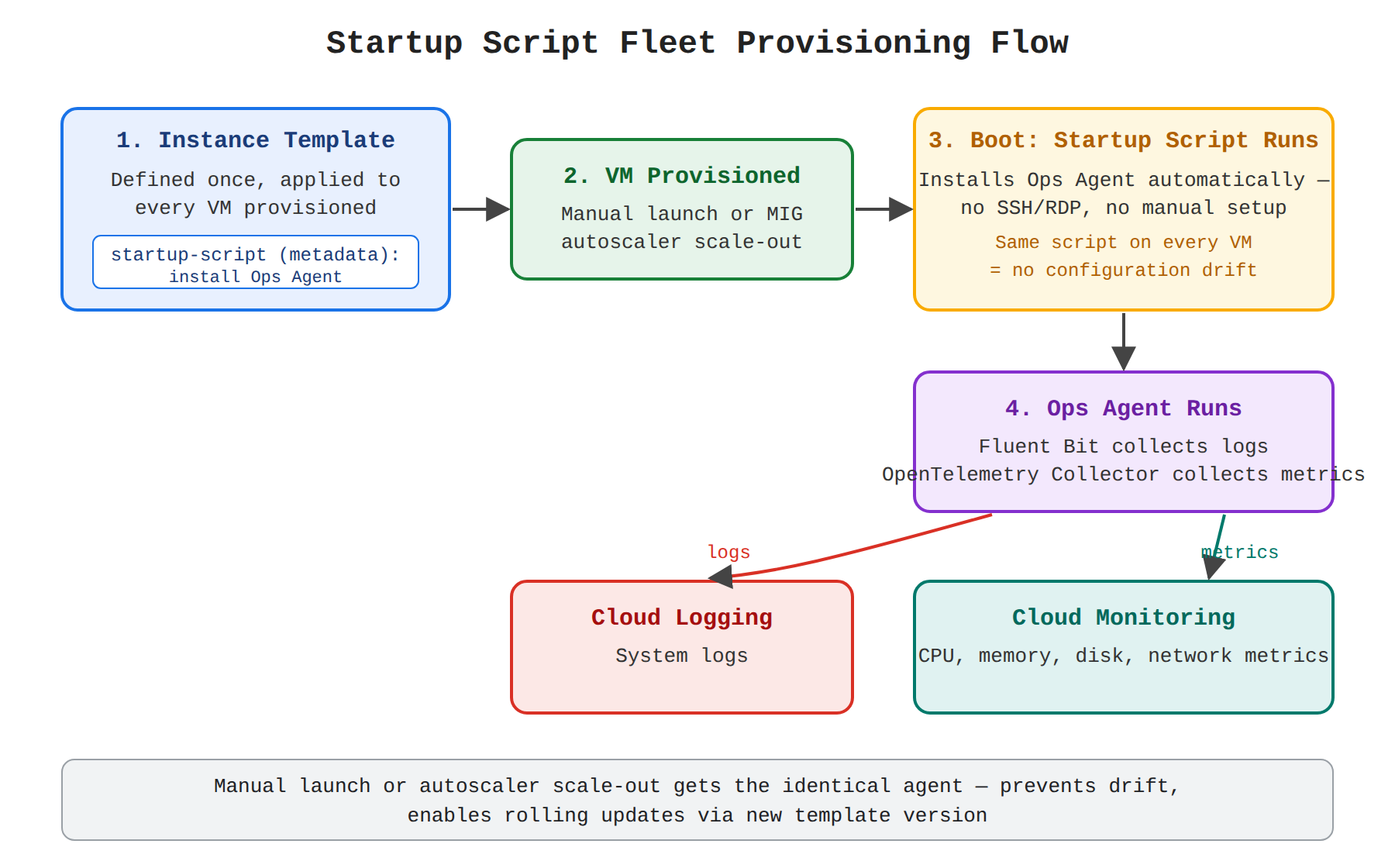
How It Meets the Requirements
- Automates deployment across instances: Including the installation command inside the startup script ensures that every time a new instance starts—whether manually launched or dynamically created by an autoscaler—the Google Cloud Ops Agent is installed without requiring human intervention.
- Prevents configuration drift: Because the script executes consistently during the initialization phase of every VM, all machines deploy the exact same software stack, avoiding differences caused by manual setups.
- Enables immediate telemetry collection: The agent begins streaming system metrics (CPU, memory, disk, network) and operating system logs to Cloud Monitoring and Cloud Logging as soon as the VM completes its startup routine.
Key Advantages and Capabilities
- Zero operational overhead: Eliminates the need to log into individual instances to run package management commands.
- Compatibility with autoscaling: When workload demand increases and a Managed Instance Group scales out new VM instances, the Ops Agent is immediately installed on each new node.
- Centralized configuration: Updating the script within a new instance template version allows for standardized, rolling updates across the entire fleet.
- Supports standard Linux and Windows repositories: Can pull the official Google agent repository and install packages using native tools (
apt,yum, or PowerShell).
Why This Is Optimal
Using an instance template with a startup script delivers fully automated, repeatable, and hands-off installation. Compared to manual configuration via SSH or RDP, it prevents human error and works seamlessly with dynamic cloud architectures.
Configure an uptime check in Cloud Monitoring to automatically deploy the Ops Agent whenever an HTTP endpoint becomes unresponsive
Configure an uptime check in Cloud Monitoring to automatically deploy the Ops Agent whenever an HTTP endpoint becomes unresponsive
What Cloud Monitoring Uptime Checks Are
An uptime check is an external monitoring feature in Cloud Monitoring that periodically issues network requests (such as HTTP, HTTPS, or TCP pings) from geographically distributed servers to test whether a service or endpoint is publicly accessible and responding as expected.
Why It Doesn't Meet the Requirement
- Cannot deploy software: Uptime checks operate strictly as external diagnostic probes. They have no mechanism, permissions, or access to interact with the internal operating system of a VM instance or install software packages.
- Reactive rather than proactive: Triggering an action only when an endpoint becomes unresponsive does not address the need to have telemetry available from the moment a VM starts up.
- Wrong functional area: Uptime checks generate incident alerts or trigger notifications; they are not deployment automation tools.
Key Characteristics and Limitations
- External network probing: Verifies response codes, latency, and content matching from outside the VPC network.
- No OS-level execution: Does not run commands inside the virtual machine guest operating system.
- Alerting mechanism: Integrates with notification channels (e.g., email, SMS, webhooks) to notify teams of outages rather than remediating software installation.
This Answer Would Be Correct If
The requirement were to periodically verify that a public-facing web server is responding with HTTP 200 OK status codes and to notify an on-call engineer when the endpoint experiences downtime.
Additional Context
Cloud Monitoring consumes metrics and logs produced by agents; it does not push software agents to instances via uptime checks. Package deployment must be handled by Compute Engine lifecycle tools such as startup scripts, VM Manager (OS Config), or custom images.
Connect to each VM instance using SSH after it launches and manually execute the agent installation script
Connect to each VM instance using SSH after it launches and manually execute the agent installation script
What Manual Installation via SSH Is
Manual installation involves an administrator using SSH (for Linux) or RDP (for Windows) to establish an interactive session with an individual VM after it has started, followed by manually executing shell commands to download and run the Ops Agent installation script.
Why It Doesn't Meet the Requirement
- Fails automation requirements: Connecting interactively to each instance violates the core requirement to automate the deployment process and remove manual intervention.
- Does not scale: If the fleet uses a Managed Instance Group that autoscales during traffic spikes, manual intervention cannot keep pace with instances spinning up dynamically.
- Introduces configuration drift: Manual steps are prone to human error, missed steps, or slight variations across servers, resulting in non-standardized configurations.
Key Characteristics and Limitations
- Labor-intensive: Requires administrative time for every single virtual machine created in the environment.
- High operational latency: Metrics and logs are not captured until an administrator notices the new VM and manually deploys the agent.
- Security risk: Requires granting broad administrative login access to engineers across production instances rather than relying on declarative infrastructure.
This Answer Would Be Correct If
This approach would be appropriate only for one-off troubleshooting, testing the Ops Agent in an isolated development environment, or evaluating custom agent configuration files on a single standalone virtual machine before rolling out an automated policy.
Additional Context
In modern cloud operations, manual SSH connections create unrepeatable environments. Best practices emphasize automating provisioning tasks through startup scripts, OS Config policies, or baked VM images.
Preload the Ops Agent installation package onto a Local SSD attached to the instance template so it runs during system reboots
Preload the Ops Agent installation package onto a Local SSD attached to the instance template so it runs during system reboots
What Local SSD Storage Is
A Local SSD is a high-performance physical solid-state drive that is directly attached to the physical server hosting the Compute Engine virtual machine. It is designed to provide maximum IOPS and extremely low latency for temporary storage.
Why It Doesn't Meet the Requirement
- Data is ephemeral: Local SSD data is not persistent across instance stop and start cycles. When an instance stops, all data stored on an attached Local SSD is completely lost, making it unsuitable for persistent software binaries.
- Does not execute software: Simply storing an installation binary or script on a disk volume does not cause the operating system to execute it upon system boot. An execution engine—such as a startup script or system service—is still required.
- Cannot be pre-populated via an instance template: Instance templates do not provide a mechanism to bake files directly into blank Local SSDs before a VM boots.
Key Characteristics and Limitations
- Non-durable storage: Designed specifically as scratch space for temporary caches, intermediate processing, or high-performance scratch disks.
- Requires manual formatting: When a VM boots with a new Local SSD, the disk must first be partitioned, formatted, and mounted before files can even be written to it.
- High cost: Provisioning Local SSD capacity solely to store an agent installation script is an expensive and inappropriate architectural pattern.
This Answer Would Be Correct If
The workload required a high-speed, non-durable scratch drive for temporary cache storage, memory paging, or database temporary tables where ultra-low latency is required and data loss upon instance termination is acceptable.
Additional Context
To ensure software is installed reliably and automatically during VM provisioning, developers should leverage startup scripts or bake the software into a custom persistent boot disk image rather than relying on ephemeral local block storage.
Try 10 interactive questions like this one, free
Answer them yourself and get your score the moment you finish. No account needed.
Full access includes
- 2,014 practice questions across all 4 exam domains
- Every answer explained: why it is right, and why the others are not
- Scout, an AI tutor that answers your follow-up questions
- Readiness tracking by domain, so you know when to book the exam
Related free sample questions
Keep the momentum going with these hand-picked practice scenarios
FundamentalAssociate Cloud Engineer
Ops Agent hostmetrics collection_interval
Configuring and deploying Ops Agent
FundamentalAssociate Cloud Engineer
Private Google Access and VPC Flow Logs
Adding a subnet to an existing VPC
FundamentalAssociate Cloud Engineer
Organization Administrator vs Billing Account Administrator
Setting up standalone organizations
FundamentalAssociate Cloud Engineer
Cloud Storage Lifecycle Asynchronous Execution
Setting object lifecycle management policies for Cloud Storage buckets
FundamentalAssociate Cloud Engineer
IAM Policy Inheritance and Union
Creating a resource hierarchy
AdvancedProfessional Cloud Security Engineer
Binary Authorization Attestor Policy Rules
Configuring Binary Authorization to secure GKE clusters or Cloud Run.
Last updated