Fundamental
Prepare and test your skills

Fundamental
Prepare and test your skills
Pod-Level Google Cloud Authentication With Workload Identity
Free sample question with answers and detailed explanation below. The Associate Cloud Engineer practice bank has an additional 2,014 practice questions.Try 10 free realistic questions: instant score, no credit card, and no account required.
You are deploying a reporting service as a Pod on Google Kubernetes Engine (GKE). The service needs to read data files from a specific Cloud Storage bucket.
Your deployment must meet the following security requirements:
- Follow the principle of least privilege by granting access only to the reporting service Pod.
- Avoid creating, storing, or rotating long-lived service account keys.
- Prevent other workloads co-located on the same GKE node pool from accessing the Cloud Storage bucket.
Which authentication method should you configure?
Explanations
Configure Workload Identity to link a Kubernetes service account to a Google Cloud service account, and run the Pod with that Kubernetes service account
Configure Workload Identity to link a Kubernetes service account to a Google Cloud service account, and run the Pod with that Kubernetes service account
What Workload Identity Is
Workload Identity Federation for GKE is the Google-recommended approach for authenticating applications running inside Google Kubernetes Engine to Google Cloud APIs. It establishes a secure mapping between a Kubernetes service account (KSA) operating within the cluster and a Google Cloud service account (GSA) in Cloud IAM. This allows the application Pod to seamlessly authenticate to external services using short-lived tokens without requiring credential files.
How It Meets the Requirements
- Principle of least privilege: Permissions are scoped specifically to the designated Kubernetes service account. Other Pods running within the cluster or on the same node do not inherit this identity.
- Eliminates static keys: The GKE metadata server transparently exchanges the Pod's Kubernetes token for short-lived Google Cloud OAuth 2.0 access tokens. No long-lived private keys need to be created, downloaded, or rotated.
- Node-level isolation: Access is completely decoupled from the underlying Compute Engine VM node. Other workloads co-located on the same worker node cannot access the Cloud Storage bucket unless they are explicitly assigned an authorized identity.
GKE Per-Pod Isolation via Workload Identity
System Architecture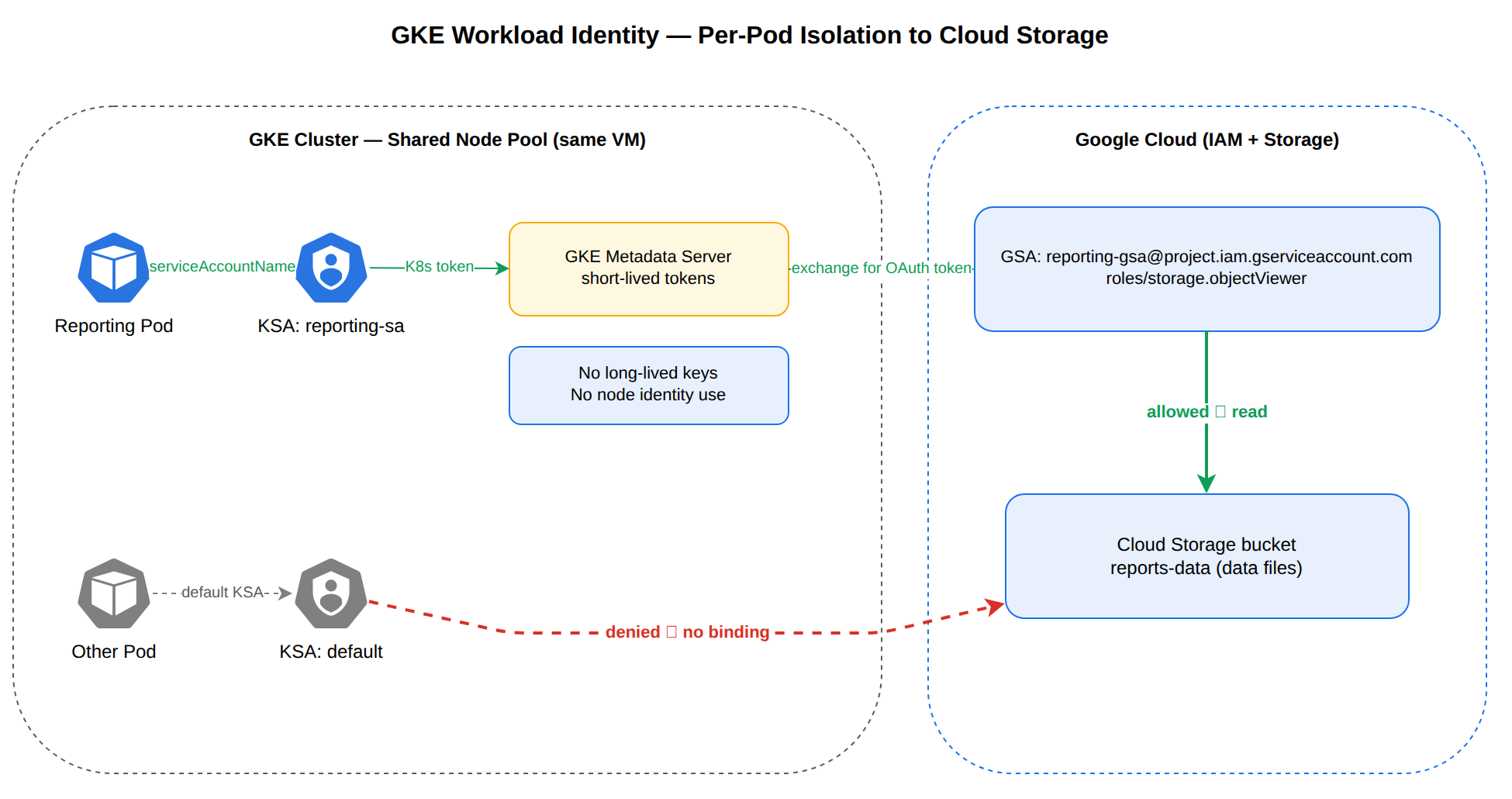
Key Advantages and Capabilities
- Granular authorization: Enables fine-grained IAM role bindings at the individual Pod level rather than the node level.
- Automated credential lifecycle: Issues short-lived, self-refreshing access tokens via Google Cloud's workload identity pool (
PROJECT_ID.svc.id.goog). - Auditing and traceability: Cloud Audit Logs capture the specific service account identity responsible for each API call, simplifying compliance.
- Declarative configuration: Deployments simply specify
serviceAccountNamein their Pod manifest, requiring zero code changes when using standard Google Cloud client libraries.
Why This Is Optimal
Workload Identity replaces risky static private keys and overly broad node-level permissions with native, automated, and secure short-lived tokens, making it the industry standard for GKE workload authentication.
Generate a JSON service account private key, store it in a Kubernetes Secret, and mount it into the Pod container as a credential file
Generate a JSON service account private key, store it in a Kubernetes Secret, and mount it into the Pod container as a credential file
What Storing Keys in Secrets Is
This method requires creating an exportable service account private key in JSON format from Cloud IAM, encoding that file into a native Kubernetes Secret, and mounting it into the Pod's filesystem. The application container then reads the file by referencing the GOOGLE_APPLICATION_CREDENTIALS environment variable.
Why It Does Not Meet the Requirements
- Violates key management constraints: The scenario explicitly requires avoiding creating, storing, or rotating long-lived service account keys.
- High security risk: Static service account keys do not expire automatically. If a key is accidentally exposed in logs, committed to source control, or leaked via container vulnerability, it remains valid until manually deleted.
- Operational burden: Managing keys requires implementing complex key rotation schedules, secure storage mechanisms, and strict Secret access controls within Kubernetes.
Key Characteristics and Limitations
- Long-lived credentials: Keys remain active for up to 10 years or until explicit revocation in Cloud IAM.
- Increased attack surface: Anyone with
getorviewpermissions on Secrets in that Kubernetes namespace can extract the plaintext private key. - Maintenance overhead: Manual tracking and rotation pipelines are required to comply with organizational security policies.
This Answer Would Be Correct If
The application workload were running in a legacy on-premises environment or on a third-party cloud provider that cannot establish an OpenID Connect (OIDC) trust relationship with Google Cloud IAM.
Additional Context
Google Cloud security best practices strongly advise against downloading service account private keys whenever native options like Workload Identity Federation are available.
Attach the service account to the GKE control plane and configure node access scopes to allow Cloud Storage API access
Attach the service account to the GKE control plane and configure node access scopes to allow Cloud Storage API access
What Control Plane Attachment and Access Scopes Are
This option proposes attaching an IAM service account to the GKE control plane and relying on node access scopes to regulate Cloud Storage interactions. In GKE, the control plane hosts the Kubernetes API server and control loops, while access scopes are legacy Compute Engine settings that define the upper bound of API access for an instance's default service account.
Why It Does Not Meet the Requirements
- Architecturally invalid: The GKE control plane is fully managed by Google Cloud. Customers cannot attach application service accounts to the master nodes or control plane.
- Access scopes do not grant permissions: Access scopes merely establish a permission ceiling; they do not grant IAM roles. IAM permissions must still be granted separately to a service account.
- Lacks container granularity: Node access scopes apply uniformly to all virtual machines in the node pool, meaning they cannot isolate access to an individual reporting Pod.
Key Characteristics and Limitations
- Legacy mechanism: Access scopes are a legacy method for restricting VM API access and have largely been superseded by IAM roles.
- Host-level scope: Access scopes apply across all processes running on the host node, failing pod-level least privilege.
- No workload mapping: Scopes have no concept of Kubernetes namespaces, service accounts, or container boundaries.
This Answer Would Be Correct If
You were provisioning a legacy Compute Engine VM directly and needed to establish baseline API boundary limits for the VM's default service account.
Additional Context
Best practice for modern GKE clusters is to configure node pools with the cloud-platform access scope and manage all granular security boundaries using Workload Identity and Cloud IAM.
Assign the Storage Object Viewer IAM role to the default Compute Engine service account attached to the GKE worker nodes
Assign the Storage Object Viewer IAM role to the default Compute Engine service account attached to the GKE worker nodes
What Node-Level Authentication Is
In Google Kubernetes Engine, cluster worker nodes are Compute Engine virtual machines. Each node pool runs using an attached service account (frequently the Compute Engine default service account). If workloads inside the cluster do not have individual identities configured, calls to Google Cloud APIs fall back to the identity of the host node.
Why It Does Not Meet the Requirements
- Violates least privilege: Granting permissions to the node's attached service account allows every Pod scheduled on those nodes to access the Cloud Storage bucket, regardless of its namespace or function.
- Fails node isolation: If another container running on the same node pool is compromised, an attacker can query the metadata server and inherit full access to the Cloud Storage data files.
- Over-privileged defaults: Relying on the Compute Engine default service account exposes broad editor-like permissions unless heavily customized and restricted.
Key Characteristics and Limitations
- Host-level assignment: Permissions apply broadly across the entire VM host rather than isolating individual containers.
- Shared credentials: Any container sharing the node has access to the identical set of IAM permissions via the node metadata server.
- Security risk: Increases the blast radius of any container compromise within the cluster.
This Answer Would Be Correct If
The workload was a node-level daemon (such as a DaemonSet for host logging or node monitoring) where every node in the cluster uniformly required identical permissions to send telemetry to Google Cloud.
Additional Context
Relying on node-level service accounts is an obsolete design pattern that violates multi-tenant security practices. Modern GKE architectures should isolate workloads at the Pod level.
Try 10 interactive questions like this one, free
Answer them yourself and get your score the moment you finish. No account needed.
Full access includes
- 2,014 practice questions across all 4 exam domains
- Every answer explained: why it is right, and why the others are not
- Scout, an AI tutor that answers your follow-up questions
- Readiness tracking by domain, so you know when to book the exam
Related free sample questions
Keep the momentum going with these hand-picked practice scenarios
FundamentalAssociate Cloud Engineer
ClusterPodMonitoring vs PodMonitoring
Deploying Google Cloud Managed Service for Prometheus
FundamentalAssociate Cloud Engineer
Cloud Run Revision Tags and Traffic Splitting
Adjusting application traffic splitting parameters (e.g., Cloud Run, Cloud Run functions, GKE)
FundamentalAssociate Cloud Engineer
Cloud Logging jsonPayload Field Filtering
Viewing and filtering logs in Cloud Logging
FundamentalAssociate Cloud Engineer
gcloud Components Install Kubectl
Installing and configuring the command-line interface (CLI) for Kubernetes (kubectl)
FundamentalAssociate Cloud Engineer
AlloyDB Automated vs On-Demand Backups
Backing up and restoring database instances (e.g., Cloud SQL, Firestore, Spanner, AlloyDB, Bigtable)
IntermediateProfessional Cloud Architect
Cloud KMS Admin vs CryptoKey Encrypter/Decrypter
Managing customer-managed encryption keys with Cloud Key Management Service (Cloud KMS)
Last updated