Fundamental
Prepare and test your skills

Fundamental
Prepare and test your skills
GKE VPA Off Mode for Zero Disruption
Free sample question with answers and detailed explanation below. The Associate Cloud Engineer practice bank has an additional 2,014 practice questions.Try 10 free realistic questions: instant score, no credit card, and no account required.
An operations team is deploying a microservice workload to a Google Kubernetes Engine (GKE) cluster.
They want to utilize Vertical Pod Autoscaling (VPA) to analyze historical container resource usage and generate recommended CPU and memory requests. Because the service is sensitive to disruption, the team must ensure that running Pods are never evicted or restarted by the autoscaler while collecting these recommendations.
Which VPA updateMode should the team configure?
Explanations
Auto
Auto
What the "Auto" update mode does
The Auto update mode instructs the Vertical Pod Autoscaler (VPA) to manage container resource sizing automatically throughout the entire workload lifecycle. It sets CPU and memory requests when new Pods are scheduled and actively evicts running Pods when their current allocations deviate significantly from calculated recommendations.
Why it doesn't meet the requirement
- Causes Pod evictions and restarts: When VPA determines that a container needs more or fewer resources, it forcefully evicts the running Pod so the controller can recreate it with new requests.
- Violates stability constraints: Because the team requires that running Pods are never restarted or disrupted,
Automode is inappropriate.
Key characteristics and limitations
- Full automation: Dynamically adjusts resource bounds during runtime.
- Relies on Pod disruption budgets: Uses
PodDisruptionBudget(PDB) to throttle evictions, but evictions still take place. - Risk of disruption: Can cause service instability if workloads take a long time to warm up or do not handle graceful terminations cleanly.
This answer would be correct if
The goal was to fully automate container right-sizing dynamically at runtime, where the application architecture is fully stateless, horizontally resilient, and tolerant of frequent rolling restarts.
Off
Off
What the "Off" update mode is
In Google Kubernetes Engine (GKE), the Vertical Pod Autoscaler (VPA) with updateMode: "Off" enables resource analysis without actively applying changes to running or new Pods. In this mode, the VPA recommender component monitors historical and current CPU and memory consumption, calculates optimal request values, and writes these recommendations directly to the status subresource of the VerticalPodAutoscaler object.
VPA Off Mode Recommendation Flow
System Architecture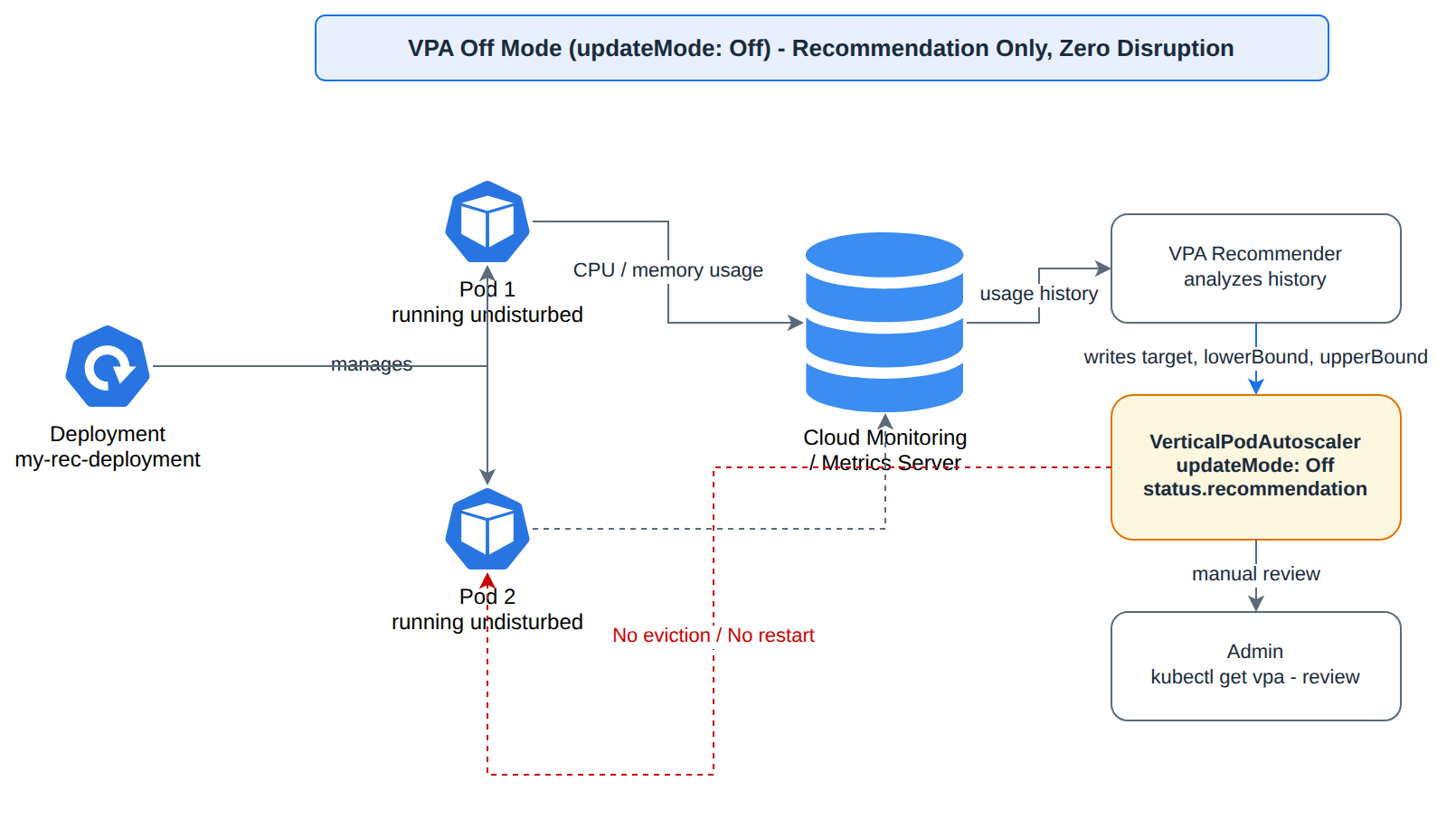
How it meets the requirements
- Analyzes historical resource consumption: The VPA continuously observes workload metrics to determine accurate target resource allocations.
- Prevents Pod restarts and eviction: The autoscaler does not attempt to mutate live containers or trigger Pod recreations. Pods run undisturbed with their original resource specifications while administrators evaluate the data.
Key advantages and capabilities
- Zero disruption: Safe for latency-critical and stateful workloads where unexpected evictions could degrade application availability.
- Actionable insights: Provides clear visibility into minimum, target, lower bound, and upper bound recommendations for container CPU and memory requests.
- Controlled adoption: Enables platform engineers to validate recommendations before transitioning to automated updates or manually applying them to deployment manifests.
- Cost and capacity planning: Helps identify over-provisioned and under-provisioned workloads across the cluster.
Why this is optimal
Setting updateMode: "Off" is the standard, risk-free recommendation mechanism in GKE. It fulfills the goal of capturing sizing metrics from actual workloads without altering the Pod lifecycle.
Initial
Initial
What the "Initial" update mode does
The Initial update mode configures the Vertical Pod Autoscaler (VPA) to apply CPU and memory recommendations only during the Pod creation phase (via an admission webhook). Once a Pod is running, VPA will not evict it to update its resource requests.
Why it doesn't meet the requirement
- Modifies new Pod specifications: While it avoids evicting running Pods, it automatically alters the resource requests of any new Pod instances created during scaling events, rolling updates, or node repairs.
- Incomplete observation mode: If the team solely wants to evaluate recommendations before modifying container configurations,
Initialmode alters workload resources without manual verification.
Key characteristics and limitations
- Admission-time injection: Assigns recommended requests only when a Pod is first admitted to the cluster.
- Static during Pod lifetime: Does not trigger evictions or restarts on active containers.
- Potential drift: Long-running Pods may keep obsolete resource requests until they are restarted by an external event.
This answer would be correct if
The team wanted newly scheduled Pods to immediately adopt VPA recommendations while ensuring that already running Pods are never evicted mid-execution.
Recreate
Recreate
What the "Recreate" update mode does
The Recreate update mode causes the Vertical Pod Autoscaler (VPA) to assign resource requests upon Pod creation and evict running Pods whenever their resource consumption necessitates updated requests.
Why it doesn't meet the requirement
- Explicitly triggers Pod restarts: Like
Auto,Recreatedirectly evicts active Pods whose container request sizes need adjustments so that the deployment controller will recreate them. - Violates non-disruption requirement: It introduces potential downtime or restart latency for sensitive workloads that need uninterrupted execution.
Key characteristics and limitations
- Active eviction behavior: Actively terminates running Pod instances to apply new CPU and memory values.
- Functional overlap: Operates similarly to
Autoin current Kubernetes versions when in-place resource resizing is not enabled. - Requires restart tolerance: Workloads must be architected with sufficient replica redundancy to tolerate ongoing pod restarts.
This answer would be correct if
The team required running Pods to be restarted whenever recommended resource allocations changed, ensuring that outdated container limits are promptly removed from the cluster.
Try 10 interactive questions like this one, free
Answer them yourself and get your score the moment you finish. No account needed.
Full access includes
- 2,014 practice questions across all 4 exam domains
- Every answer explained: why it is right, and why the others are not
- Scout, an AI tutor that answers your follow-up questions
- Readiness tracking by domain, so you know when to book the exam
Related free sample questions
Keep the momentum going with these hand-picked practice scenarios
FundamentalAssociate Cloud Engineer
HPA CPU Resource Requests Requirement
Managing horizontal and vertical Pod autoscaling configurations
FundamentalAssociate Cloud Engineer
Eventarc Cloud Run Invoker Role
Deploying an application to serverless compute platforms, including for the processing of Google Cloud events (e.g., Pub/Sub events, Cloud Storage object change notification events, Eventarc)
FundamentalAssociate Cloud Engineer
Non-Disruptive Subnet Expansion
Expanding a subnet to have more IP addresses
FundamentalAssociate Cloud Engineer
Organization Administrator vs Billing Account Administrator
Setting up standalone organizations
FundamentalAssociate Cloud Engineer
Trace and SpanId Log Correlation
Viewing specific log message details in Cloud Logging
AdvancedProfessional Data Engineer
BigQuery Capacity and Physical Storage Billing
Mapping business requirements
Last updated