Fundamental
Prepare and test your skills

Fundamental
Prepare and test your skills
How GKE Scopes Pods Services and Nodes
Free sample question with answers and detailed explanation below. The Associate Cloud Engineer practice bank has an additional 2,014 practice questions.Try 10 free realistic questions: instant score, no credit card, and no account required.
An administrator manages a multi-tenant Google Kubernetes Engine (GKE) cluster where workloads are logically partitioned across separate namespaces for different development teams. The administrator needs to inventory the running application components for a tenant residing in the team-a namespace while also checking the underlying cluster infrastructure.
Which statement correctly distinguishes between namespace-scoped and cluster-wide resources in the cluster?
Explanations
Pods and Nodes are namespace-scoped resources isolated within team-a, while Services and ConfigMaps are cluster-wide resources that span the entire cluster.
Pods and Nodes are namespace-scoped resources isolated within team-a, while Services and ConfigMaps are cluster-wide resources that span the entire cluster.
What This Option Proposes
This option groups Pods with Nodes as namespace-scoped entities, while categorizing Services and ConfigMaps as cluster-wide infrastructure objects.
Why It Doesn't Meet the Requirement
- Nodes cannot be namespace-scoped: A Node is a physical or virtual machine running kubelet and container runtime agents. It is a shared infrastructure resource managed at the cluster root level.
- Services and ConfigMaps are namespace-scoped: Services (which provide network endpoints for pods) and ConfigMaps (which hold configuration data) must reside within the same namespace as the pods that consume them to maintain tenant isolation and avoid cross-tenant configuration leaks.
Key Characteristics and Limitations
- Service discovery: A Service within
team-ais discoverable within that namespace using its local DNS name (e.g.,my-service) or cross-namespace using the fully qualified domain name (e.g.,my-service.team-a.svc.cluster.local). - Configuration boundaries: ConfigMaps and Secrets are strictly namespace-scoped so that sensitive tenant data is protected by namespace-level RBAC policies.
This Answer Would Be Correct If
Network routing rules and configuration objects were globally shared across all projects and teams, while hardware instances were dedicated on a per-namespace basis.
Nodes and Services are namespace-scoped resources isolated within team-a, while Pods and Deployments are cluster-wide resources that span the entire cluster.
Nodes and Services are namespace-scoped resources isolated within team-a, while Pods and Deployments are cluster-wide resources that span the entire cluster.
What This Option Proposes
This option incorrectly asserts that Nodes and Services are confined to specific namespaces, whereas Pods and Deployments operate as cluster-wide objects.
Why It Doesn't Meet the Requirement
- Misclassifies Nodes: Nodes represent the worker compute instances in a GKE cluster. They provide aggregate CPU and memory for the entire cluster and are never bound to a single namespace.
- Misclassifies Pods and Deployments: Pods and Deployments represent containerized application workloads and controller definitions. They are fundamentally namespace-scoped objects, ensuring that tenant workloads are partitioned and managed independently.
Key Characteristics and Limitations
- Nodes are cluster-wide: When you inspect nodes using
kubectl get nodes, you query the global pool of compute instances; passing a-nnamespace flag to a node query has no scoping effect. - Workloads are namespace-bound: Deployments and Pods must be created within a namespace (falling back to
defaultif unspecified).
This Answer Would Be Correct If
Kubernetes placed actual compute instances into isolated tenant partitions by default and managed container runtime instances as global shared entities across all tenants, which is the opposite of how Kubernetes architecture is designed.
All cluster resources, including Nodes, Pods, and Services, are strictly namespace-scoped and must be queried within specific namespaces.
All cluster resources, including Nodes, Pods, and Services, are strictly namespace-scoped and must be queried within specific namespaces.
What This Option Proposes
This option asserts that all Kubernetes API objects and infrastructure resources are namespace-scoped without exception.
Why It Doesn't Meet the Requirement
- Ignores cluster-scoped architecture: Kubernetes explicitly maintains a distinction between objects that live within a logical partition (namespace) and global objects that govern or provide compute to the entire cluster.
- Nodes and cluster resources are global: Resources such as Nodes, Namespaces, StorageClasses, PersistentVolumes, and ClusterRoles exist outside of namespaces. Attempting to restrict them to a single namespace is architecturally invalid.
Key Characteristics and Limitations
- API discovery: Running
kubectl api-resourcesdisplays all supported Kubernetes object kinds and explicitly indicates whether each kind is namespaced (trueorfalse). - Global entities: Global resources represent underlying hardware, storage backends, or global security configurations that must be administered independently of individual development teams.
This Answer Would Be Correct If
Kubernetes operated as a fully shared-nothing architecture where every physical node, storage class, and role definition were cloned and encapsulated strictly inside individual tenant namespaces.
Pods and Services are namespace-scoped resources isolated within team-a, while Nodes and Namespaces are cluster-wide resources that span the entire cluster.
Pods and Services are namespace-scoped resources isolated within team-a, while Nodes and Namespaces are cluster-wide resources that span the entire cluster.
What Resource Scoping in Kubernetes Is
In Google Kubernetes Engine (GKE) and Kubernetes, resources are architecturally divided into two distinct scopes: namespace-scoped resources and cluster-wide (cluster-scoped) resources. Namespaces provide a mechanism for isolating groups of resources and dividing cluster resources between multiple users, teams, or environments.
How It Meets the Inventory Requirements
- Namespace-scoped inventory: Pods, Services, Deployments, ConfigMaps, and Secrets belong to specific namespaces. When inventorying
team-a, these resources are isolated within that specific partition and can be targeted directly using namespace filtering (such askubectl get pods -n team-aorkubectl get services -n team-a). - Cluster-wide inventory: Physical or virtual infrastructure components like Nodes, storage abstractions like PersistentVolumes, and the Namespaces themselves are cluster-wide. They exist at the root cluster level and are shared across all tenants rather than belonging to any individual namespace.
Namespace vs Cluster Scoping in GKE
Set Relationship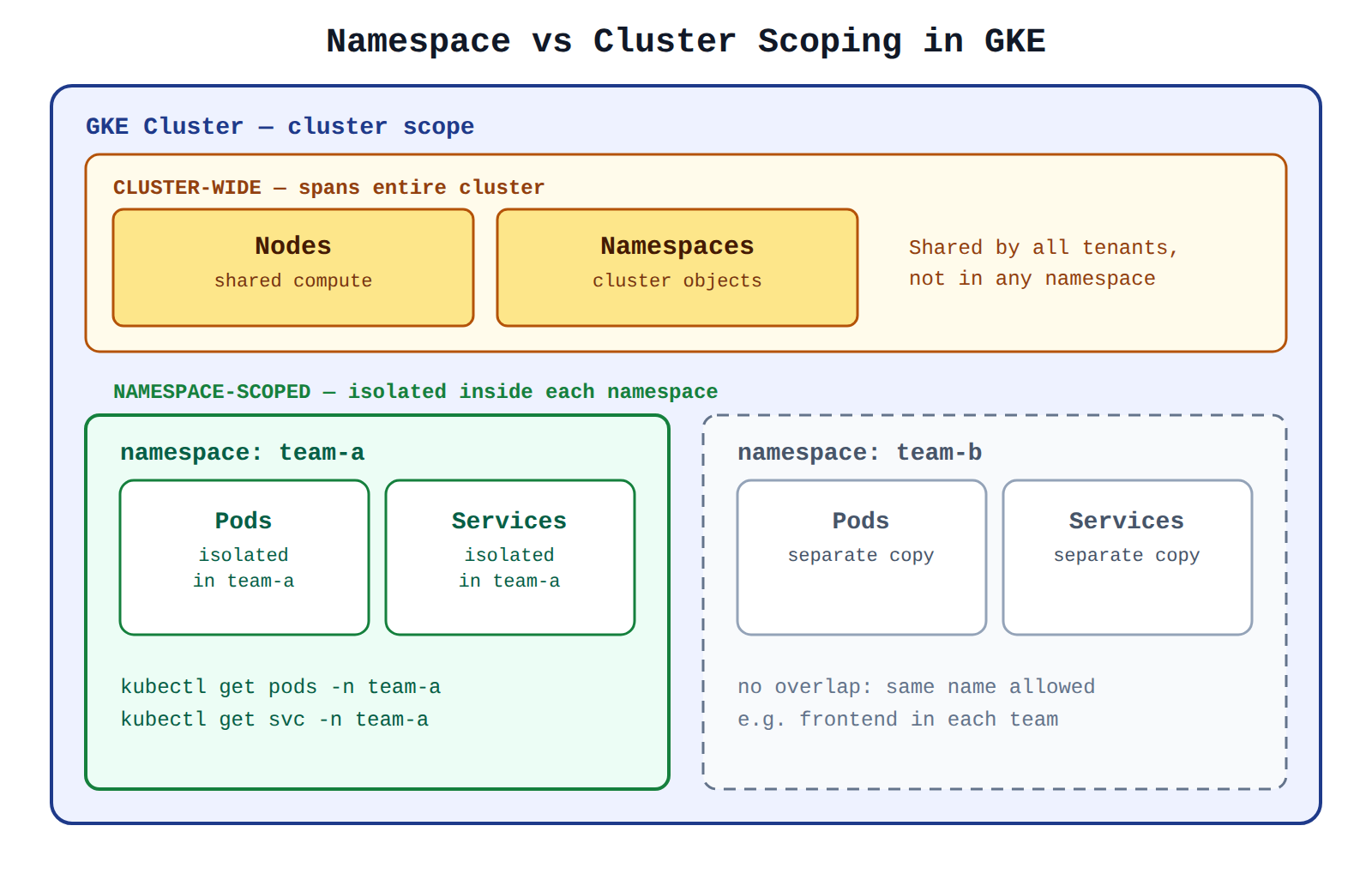
Key Advantages and Capabilities
- Multi-tenant isolation: Logical segmentation prevents naming collisions between teams (e.g., both
team-aandteam-bcan have a Service namedfrontend). - Targeted visibility: Administrators can query objects belonging strictly to a single team without retrieving the entire cluster's workloads.
- Fine-grained access control: Role-Based Access Control (RBAC) policies can grant permissions scoped exclusively to specific namespaces (
RolesandRoleBindings). - Centralized node management: Worker Nodes provide compute capacity to the entire cluster, allowing the Kubernetes scheduler to place pods across available nodes regardless of namespace.
Why This Is Optimal
Distinguishing between namespace-scoped objects (Pods, Services) and cluster-scoped objects (Nodes, Namespaces) reflects the core Kubernetes resource model. It allows operators to accurately inspect tenant-specific workloads while maintaining a global view of shared underlying hardware.
Try 10 interactive questions like this one, free
Answer them yourself and get your score the moment you finish. No account needed.
Full access includes
- 2,014 practice questions across all 4 exam domains
- Every answer explained: why it is right, and why the others are not
- Scout, an AI tutor that answers your follow-up questions
- Readiness tracking by domain, so you know when to book the exam
Related free sample questions
Keep the momentum going with these hand-picked practice scenarios
FundamentalAssociate Cloud Engineer
GKE Workloads Console Page
Viewing current running GKE cluster inventory (e.g., nodes, Pods, Services)
FundamentalAssociate Cloud Engineer
kubectl describe vs kubectl get
Viewing current running GKE cluster inventory (e.g., nodes, Pods, Services)
FundamentalAssociate Cloud Engineer
Compute Engine VM Instances Page
Viewing current running Compute Engine instances
FundamentalAssociate Cloud Engineer
Regional Persistent Disk Synchronous Replication
Choosing the appropriate storage for Compute Engine (e.g., zonal Persistent Disk, regional Persistent Disk, Google Cloud Hyperdisk)
FundamentalAssociate Cloud Engineer
Cloud NAT Outbound-Only Internet Access
Working with Cloud DNS and Cloud NAT
IntermediateProfessional Cloud Developer
Binary Authorization Cluster Admission Rules
Securing application artifacts using Binary Authorization
Last updated