Fundamental
Prepare and test your skills

Fundamental
Prepare and test your skills
Outbound Internet Access With Cloud NAT
Free sample question with answers and detailed explanation below. The Associate Cloud Engineer practice bank has an additional 2,014 practice questions.Try 10 free realistic questions: instant score, no credit card, and no account required.
An organization runs backend application workloads on Google Compute Engine virtual machine (VM) instances inside a custom VPC subnet. To maintain a strong security posture, none of the VM instances have external IPv4 addresses assigned to their network interfaces.
The applications on these VMs require access to the public internet to download critical operating system patches and repository updates. However, security policy strictly prohibits systems on the public internet from initiating inbound connections to these instances.
Which Google Cloud networking solution should you implement to meet these requirements?
Explanations
Enable Private Google Access on the subnet containing the VM instances
Enable Private Google Access on the subnet containing the VM instances
What Private Google Access does
Private Google Access allows Compute Engine instances that lack external IP addresses to reach the public IP addresses of Google APIs and services (such as Cloud Storage, BigQuery, and Artifact Registry) through internal routing.
Why it doesn't meet the requirement
- Limited to Google APIs: Private Google Access only routes traffic destined for Google APIs and supported Google-managed services. It does not provide general outbound internet connectivity to third-party public package repositories (e.g., Ubuntu, Debian, Red Hat, or GitHub package mirrors).
- No general internet access: Any outbound traffic sent toward non-Google public IPv4 destinations is dropped if Private Google Access is the only mechanism configured.
Key characteristics and limitations
- Google APIs only: Restricted strictly to reaching Google Cloud services and APIs without traversing the public internet.
- Internal routing: Uses internal Google network paths rather than assigning or translating public IPv4 NAT addresses.
- Subnet configuration: Enabled at the subnet level to bypass external IP requirements for Google service endpoints.
This answer would be correct if
The private VM instances only needed to interact with Google services—such as downloading container images from Artifact Registry or reading objects from Cloud Storage buckets—without needing to contact external third-party internet endpoints.
Configure a Cloud NAT gateway on a Cloud Router associated with the subnet
Configure a Cloud NAT gateway on a Cloud Router associated with the subnet
What Cloud NAT is
Cloud NAT (Network Address Translation) is a fully managed, distributed, software-defined Google Cloud networking service that enables resources without external IP addresses to access the public internet or external networks.
How it meets the requirements
- Outbound internet access for private VMs: Public NAT allows Compute Engine VMs without external IP addresses to initiate outbound IPv4 connections to external repositories and package servers on the internet by translating private internal IP addresses to allocated public NAT IP addresses.
- Prevents unsolicited inbound connections: Cloud NAT only translates addresses for established inbound response packets (via stateful destination NAT / DNAT). External systems on the public internet cannot initiate new, unsolicited connections to the private instances, thereby preserving VM isolation.
- Subnet-level application: A Cloud NAT gateway is configured alongside a Cloud Router control plane and can be scoped directly to the IP address range of the target subnet.
Key advantages and capabilities
- Software-defined architecture: Built on Google's Andromeda software-defined networking stack, eliminating the need to deploy, manage, or scale intermediary proxy VMs or physical NAT appliances.
- Full VM bandwidth: Cloud NAT does not introduce networking bottlenecks or reduce per-VM throughput allocations.
- Automatic scaling and allocation: Supports automatic NAT IP allocation as traffic expands, as well as manual static IP reservation for external IP allowlisting.
- Comprehensive telemetry: Integrates with Cloud Logging and Cloud Monitoring to trace active connections, bandwidth consumption, and error states.
Why this is optimal
Cloud NAT is purpose-built to deliver scalable, secure, outbound-only internet connectivity for private Compute Engine instances without compromising security by exposing them to inbound internet traffic.
Cloud NAT Blocks Unsolicited Inbound
Sequence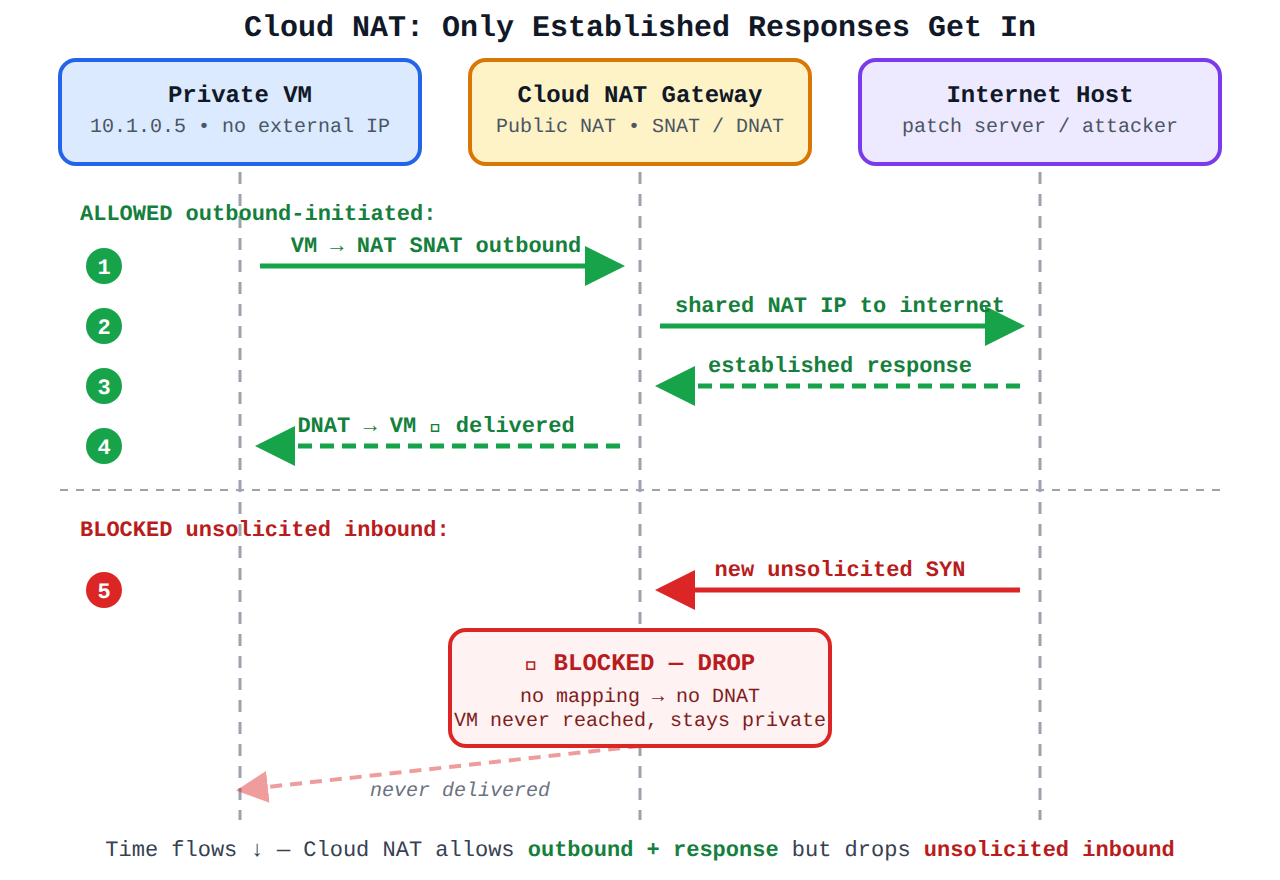
Assign an ephemeral external IPv4 address to each VM instance and configure ingress firewall rules to deny all incoming traffic
Assign an ephemeral external IPv4 address to each VM instance and configure ingress firewall rules to deny all incoming traffic
What assigning external IPv4 addresses does
Assigning an ephemeral external IPv4 address directly attaches a public IP address from Google's pool to each VM instance's network interface, allowing direct two-way routing to and from the public internet.
Why it doesn't meet the requirement
- Direct public exposure: Giving VMs individual external IP addresses exposes them directly to the public internet routing table, violating the requirement to maintain private instances without external IPs.
- Management overhead and security risk: Relying solely on firewall rules to block unsolicited incoming traffic introduces unnecessary attack surfaces and configuration complexity. If a firewall rule is misconfigured or accidentally removed, instances become immediately reachable from the public internet.
- IP exhaustion and cost: Managing individual public IP addresses across dozens or hundreds of VMs is inefficient and significantly increases external IP reservation and usage costs.
Key characteristics and limitations
- Publicly routable: External IP addresses make VMs addressable over the internet.
- Increased attack surface: Any misconfiguration in firewall rules leaves the VM exposed to external port scans and attacks.
- No shared egress pooling: Each VM consumes an individual public IP address rather than sharing a managed pool of NAT IP addresses.
This answer would be correct if
The VM instances were internet-facing hosts, such as public bastion hosts or standalone web servers, that genuinely required dedicated external IP addresses to accept direct incoming connections.
Deploy an external Application Load Balancer in front of the VM instances
Deploy an external Application Load Balancer in front of the VM instances
What an external Application Load Balancer does
An external Application Load Balancer is a reverse proxy system that distributes incoming client traffic from the public internet across a backend pool of instances or endpoints.
Why it doesn't meet the requirement
- Inbound-only architecture: Load balancers are designed specifically for inbound traffic distribution (ingress). They do not provide general outbound (egress) network address translation for backend VMs attempting to initiate arbitrary connections to external internet repositories.
- Opposite traffic flow: While an external load balancer allows private backend instances to serve web requests initiated by outside clients, it does not enable private VMs to reach external package mirrors or arbitrary public IP addresses.
- Mismatched purpose: Configuring a load balancer would attempt to expose the backend application to the internet, contrary to the organization's requirement to prevent unsolicited inbound access.
Key characteristics and limitations
- Reverse proxy design: Terminates incoming HTTP/HTTPS connections and forwards them to backend instances.
- No arbitrary egress support: Cannot route arbitrary outbound TCP/UDP traffic from private backend VMs to internet endpoints.
- Targeted for ingress workloads: Intended for public web services, APIs, and content delivery rather than software patching or OS updating.
This answer would be correct if
The primary goal was to securely expose a web application hosted on private VM instances to public internet users with global load balancing, SSL termination, and DDoS protection.
Try 10 interactive questions like this one, free
Answer them yourself and get your score the moment you finish. No account needed.
Full access includes
- 2,014 practice questions across all 4 exam domains
- Every answer explained: why it is right, and why the others are not
- Scout, an AI tutor that answers your follow-up questions
- Readiness tracking by domain, so you know when to book the exam
Related free sample questions
Keep the momentum going with these hand-picked practice scenarios
FundamentalAssociate Cloud Engineer
Cloud NAT with Cloud DNS Private Zones
Working with Cloud DNS and Cloud NAT
FundamentalAssociate Cloud Engineer
Cloud DNS Managed Private Zones
Working with Cloud DNS and Cloud NAT
FundamentalAssociate Cloud Engineer
GKE Regional vs Zonal Cluster
Deploying a GKE cluster with different configurations (e.g., GKE Autopilot, regional clusters, private clusters)
FundamentalAssociate Cloud Engineer
Database Center Fleet Security Posture
Using Database Center to manage the Google Cloud database fleet
FundamentalAssociate Cloud Engineer
gcloud storage cp Recursive Upload
Loading data (e.g., command-line upload, load data from Cloud Storage, Storage Transfer Service)
AdvancedProfessional Data Engineer
Dataflow FlexRS Data Locality
Running jobs in multiple regions or zones
Last updated