Fundamental
Prepare and test your skills

Fundamental
Prepare and test your skills
Decoupling Hyperdisk Performance from Disk Capacity
Free sample question with answers and detailed explanation below. The Associate Cloud Engineer practice bank has an additional 2,014 practice questions.Try 10 free realistic questions: instant score, no credit card, and no account required.
An organization is deploying a transaction processing database on a Google Cloud Compute Engine virtual machine (VM). The workload has the following architectural requirements:
- Storage capacity: 100 GB
- Target performance: 30,000 IOPS and 500 MiB/s throughput
The engineering team wants to meet the performance targets cost-effectively without provisioning unneeded storage capacity.
Which storage type should the team select?
Explanations
Google Cloud Hyperdisk Balanced
Google Cloud Hyperdisk Balanced
What Google Cloud Hyperdisk Balanced is
Google Cloud Hyperdisk Balanced is Google Cloud's next-generation block storage service designed for cloud workloads requiring flexible performance tuning. Unlike traditional persistent disks where input/output operations per second (IOPS) and throughput scale strictly in proportion to disk capacity, Hyperdisk decouples performance from disk size.
Decoupled Performance vs Capacity: Hyperdisk Balanced
Comparison Matrix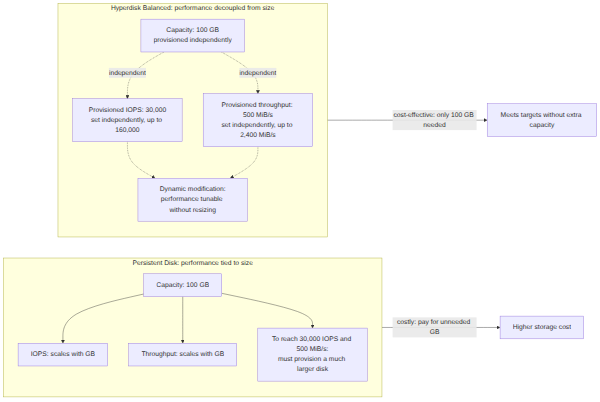
How it meets the performance and cost requirements
- Independent scaling of performance: Hyperdisk Balanced allows you to set custom provisioned IOPS and provisioned throughput independently of the storage capacity (GB).
- High performance with low capacity: The application only requires 100 GB of storage space but needs 30,000 IOPS and 500 MiB/s throughput. With Hyperdisk Balanced, you can provision a 100 GB disk and explicitly assign 30,000 IOPS and 500 MiB/s up to the VM instance limits without purchasing unneeded disk gigabytes.
- Cost-effective optimization: By avoiding artificial disk capacity inflation solely to obtain higher performance tiers, the organization significantly reduces storage expenditures.
Key advantages and capabilities
- Granular provisioning: IOPS, throughput (MiB/s), and capacity (GB) can all be tuned separately.
- Dynamic modification: Performance metrics can be updated dynamically to adapt to changing transactional demands.
- High performance thresholds: Supports tens of thousands of IOPS and gigabytes-per-second throughput on supported modern machine families.
- Broad workload fit: Well-suited for relational databases, analytics engines, and medium-to-large transaction processing systems.
Why this is optimal
Hyperdisk Balanced is the optimal architectural choice because it directly solves the mismatch between storage capacity and performance demands, allowing direct provisioning of 30,000 IOPS and 500 MiB/s on a compact 100 GB disk.
Balanced Persistent Disk (pd-balanced)
Balanced Persistent Disk (pd-balanced)
What Balanced Persistent Disk is
Balanced Persistent Disk (pd-balanced) is an SSD-backed Persistent Disk offering that balances price and performance for general-purpose workloads, web servers, and container boot disks.
Why it doesn't meet the requirement
- Linear capacity-performance coupling: In
pd-balanced, IOPS and throughput scale proportionally with disk size (up to 6 IOPS per GB and 0.28 MiB/s per GB). - Severe performance deficit at 100 GB: A 100 GB
pd-balanceddisk delivers approximately 600 baseline IOPS and 28 MiB/s throughput, far below the required 30,000 IOPS and 500 MiB/s. - Requires wasteful overprovisioning: To achieve 30,000 IOPS with
pd-balanced, the organization would need to provision thousands of gigabytes of disk space that the database does not need, significantly increasing monthly costs.
Key characteristics and limitations
- Backed by solid-state drives (SSDs) designed for general enterprise computing.
- Performance ceiling is locked to provisioned disk volume size.
- Cannot provision independent IOPS or throughput targets without modifying the storage capacity.
This answer would be correct if
The application had standard general-purpose computing requirements where disk capacity naturally aligned with the proportional IOPS and throughput baselines provided by default SSDs.
Additional context
While pd-balanced shares the term "Balanced" with Hyperdisk Balanced, only Hyperdisk provides independent scaling of IOPS and throughput metrics.
SSD Persistent Disk (pd-ssd)
SSD Persistent Disk (pd-ssd)
What SSD Persistent Disk is
SSD Persistent Disk (pd-ssd) is a high-performance, traditional block storage type in Compute Engine designed for enterprise applications and databases that require low latency and high IOPS.
Why it doesn't meet the requirement
- Capacity-linked performance model: In
pd-ssd, performance limits scale directly with provisioned capacity (typically 30 IOPS per GB and 0.48 MiB/s per GB). - Insufficient IOPS on small disks: At 100 GB, a
pd-ssdvolume delivers roughly 3,000 IOPS and 48 MiB/s throughput. It cannot reach 30,000 IOPS or 500 MiB/s without overprovisioning the disk size to at least 1 TB or more. - Lacks decoupling:
pd-ssddoes not support explicit custom IOPS and throughput provisioning independent of disk volume size.
Key characteristics and limitations
- Delivers predictable low-latency SSD storage for database workloads.
- Performance caps are strictly bound to the allocated storage size in GB.
- Forces users to purchase unneeded capacity if high IOPS is needed for small datasets.
This answer would be correct if
The dataset size was naturally large (e.g., several terabytes) such that the proportional IOPS scaling inherently satisfied the 30,000 IOPS requirement without paying for empty storage.
Additional context
pd-ssd represents the previous-generation performance architecture in GCP, which has now been superseded by Google Cloud Hyperdisk for fine-grained performance tuning.
Standard Persistent Disk (pd-standard)
Standard Persistent Disk (pd-standard)
What Standard Persistent Disk is
Standard Persistent Disk (pd-standard) is a standard hard disk drive (HDD) based block storage solution offered in Compute Engine, primarily optimized for large-capacity, sequential I/O workloads such as log processing and cold data archiving.
Why it doesn't meet the requirement
- Coupled performance and low IOPS ceiling: With
pd-standard, performance scales strictly per gigabyte of provisioned space and offers very low baseline performance per GB (typically 0.75 read IOPS and 1.5 write IOPS per GB). - Impossible to reach target on small disks: A 100 GB
pd-standarddisk provides only a few hundred IOPS and single-digit MiB/s throughput, falling drastically short of the required 30,000 IOPS and 500 MiB/s throughput. - No decoupled provisioning: You cannot independently tune IOPS or throughput without expanding the disk size to multi-terabyte scales.
Key characteristics and limitations
- Backed by traditional rotational magnetic media (HDDs).
- Designed for cost-effective bulk storage and large batch reads.
- Significantly higher latency compared to solid-state drive (SSD) and Hyperdisk solutions.
This answer would be correct if
The workload consisted of sequential data pipelines, batch backup files, or cold log storage where low storage cost per gigabyte is the priority and high IOPS is not required.
Additional context
Using HDD-backed storage for transactional databases leads to severe I/O bottlenecks and unacceptable request latency.
Try 10 interactive questions like this one, free
Answer them yourself and get your score the moment you finish. No account needed.
Full access includes
- 2,014 practice questions across all 4 exam domains
- Every answer explained: why it is right, and why the others are not
- Scout, an AI tutor that answers your follow-up questions
- Readiness tracking by domain, so you know when to book the exam
Related free sample questions
Keep the momentum going with these hand-picked practice scenarios
FundamentalAssociate Cloud Engineer
Regional Persistent Disk Synchronous Replication
Choosing the appropriate storage for Compute Engine (e.g., zonal Persistent Disk, regional Persistent Disk, Google Cloud Hyperdisk)
FundamentalAssociate Cloud Engineer
Hyperdisk Balanced Proportional Auto-Growth
Choosing the appropriate storage for Compute Engine (e.g., zonal Persistent Disk, regional Persistent Disk, Google Cloud Hyperdisk)
FundamentalAssociate Cloud Engineer
Cloud NAT Outbound-Only Internet Access
Working with Cloud DNS and Cloud NAT
FundamentalAssociate Cloud Engineer
LogEntry MonitoredResource Field
Viewing specific log message details in Cloud Logging
FundamentalAssociate Cloud Engineer
Kubernetes Deployment Rolling Updates
Working with Kubernetes resources (e.g., Pods, Services, StatefulSets)
AdvancedProfessional Cloud DevOps Engineer
Logs Explorer Histogram Field Explorer Trace Correlation
Analyzing logs using the Logs Explorer and the Logging query language
Last updated