Fundamental
Prepare and test your skills

Fundamental
Prepare and test your skills
Using Custom Images for Consistent VM Deployment
Free sample question with answers and detailed explanation below. The Associate Cloud Engineer practice bank has an additional 2,014 practice questions.Try 10 free realistic questions: instant score, no credit card, and no account required.
Your company needs to deploy several Compute Engine virtual machines (VMs) for an internal web application. Each VM requires a specific operating system, pre-installed proprietary business applications, and customized security configurations.
You want to deploy these instances quickly with a consistent baseline configuration while ensuring the baseline image is private and restricted only to your Google Cloud project.
Which image deployment strategy should you recommend?
Explanations
Create a custom OS image from a configured boot disk and use it to deploy the new VM instances
Create a custom OS image from a configured boot disk and use it to deploy the new VM instances
What Custom OS Images Are
Custom OS images are boot disk images that you create, own, and control within your Google Cloud project. They capture the operating system, installed software, dependencies, and configuration settings from an existing boot disk or external disk import, allowing you to use that standardized state to launch new virtual machines.
How It Meets the Requirements
- Pre-installed software and configurations: By configuring a prototype virtual machine with required applications, custom security settings, and proprietary packages, you can capture that entire setup into a custom image. All VMs deployed from this image start up already configured.
- Fast deployment: Instances launch directly with the applications pre-baked into the boot disk, avoiding long delays during instance startup caused by downloading packages or executing compilation tasks.
- Project privacy and access control: Unlike public images, custom images belong exclusively to your Google Cloud project by default. Access can be tightly controlled using Cloud IAM permissions to ensure internal baselines remain private.
Key Advantages and Capabilities
- Standardization: Guarantees environment consistency across all deployed instances, eliminating configuration drift.
- Rapid scaling: Ideal for autoscaling groups and automated deployment pipelines because instances become operational almost immediately.
- Image families: Allows grouping custom images into image families so instance creation commands can automatically reference the newest version without modifying deployment scripts.
- Lifecycle management: Supports image deprecation, rollback, and granular sharing across specific projects when needed.
Why This Is Optimal
Using a custom image provides the perfect balance of security, private access, consistency, and fast provisioning speed. It eliminates repeated post-boot initialization and protects proprietary configurations inside your project boundary.
Deploy instances using a public OS image and run a startup script on every boot to install the proprietary software
Deploy instances using a public OS image and run a startup script on every boot to install the proprietary software
What Public OS Images and Startup Scripts Are
Public OS images are base operating system images provided and maintained by Google, open-source communities, and third-party vendors. A startup script is a script specified in VM metadata that runs automatically every time the virtual machine boots or restarts to perform initialization tasks.
Why It Doesn't Meet the Requirement
- Slow provisioning: Downloading, compiling, and configuring large proprietary applications and security settings via a startup script on every deployment significantly increases VM startup time.
- Network and repository dependency: Startup scripts rely on external package repositories and network connectivity during boot. If an external package repository or repository server is down or changes versions, instance creation can fail or introduce inconsistencies.
- Lacks pre-baked consistency: Startup scripts install software dynamically at runtime rather than deploying an immutable, pre-verified baseline.
Key Characteristics and Limitations
- Public images provide a bare-bones operating system without organization-specific tooling or proprietary binaries.
- Startup scripts run on every boot by default, adding runtime compute overhead and potential failure points.
- Complex configurations deployed through scripts are harder to audit than pre-validated custom images.
This Answer Would Be Correct If
You needed to deploy standard, unmodified open-source operating systems across projects where software requirements change continuously or where maintaining custom base images introduces unnecessary operational maintenance.
Deploy instances using a public image family and grant project-level IAM permissions to the public image project
Deploy instances using a public image family and grant project-level IAM permissions to the public image project
What Public Image Families and Public Projects Are
An image family points to the latest non-deprecated version of an OS image within a project. Public image projects (such as debian-cloud, ubuntu-os-cloud, or windows-cloud) are globally accessible projects managed by Google and third-party operating system vendors that host base public images for all Google Cloud users.
Why It Doesn't Meet the Requirement
- Cannot store proprietary software: Public image projects provide generic OS distributions. You cannot modify public image projects to include proprietary applications or custom organizational baselines.
- Permissions cannot be granted: Customers do not manage or configure IAM permissions on Google's public image projects.
- Not private to your project: Public images are globally accessible to all Google Cloud projects, contradicting the requirement to restrict the baseline image to your specific project.
Key Characteristics and Limitations
- Public image families automatically point to the latest OS release published by Google or vendors.
- They contain vanilla operating system installations requiring complete post-deployment software setup.
- They do not support saving custom tenant-specific disk states.
This Answer Would Be Correct If
Your goal was to ensure virtual machines always provision from the latest patched version of a standard vendor OS (e.g., Debian or SUSE Linux) without proprietary customizations or strict private project isolation.
Create a blank persistent disk, attach it as the boot disk to a new VM, and manually install the OS and software
Create a blank persistent disk, attach it as the boot disk to a new VM, and manually install the OS and software
What Blank Persistent Disks Are
A blank persistent disk is an unformatted block storage volume provisioned without any file system, operating system, or bootloader.
Why It Doesn't Meet the Requirement
- Manual and non-automated: Manually configuring operating systems and software across multiple instances is labor-intensive, error-prone, and impossible to scale efficiently.
- Cannot boot independently: A Compute Engine VM requires a boot disk initialized with a bootable OS image or snapshot. A completely blank disk lacks the master boot record (MBR) or GUID partition table (GPT) structures required to boot the VM.
- Fails consistency requirements: Manual installations inevitably lead to configuration drift and operational inconsistencies between machines.
Key Characteristics and Limitations
- Persistent disks must be formatted and partitioned before a guest OS can write data.
- Compute Engine instance creation requires specifying a source image, snapshot, or existing bootable disk.
- Blank disks are meant for secondary data volumes, not rapid, standardized OS provisioning.
This Answer Would Be Correct If
You were attaching additional block storage volumes to an already running VM to provide secondary file storage or raw database partitions.
Try the scenario
Choosing a VM boot image strategy for a private, pre-configured web app baseline
Change the inputs and watch how the outcome changes.
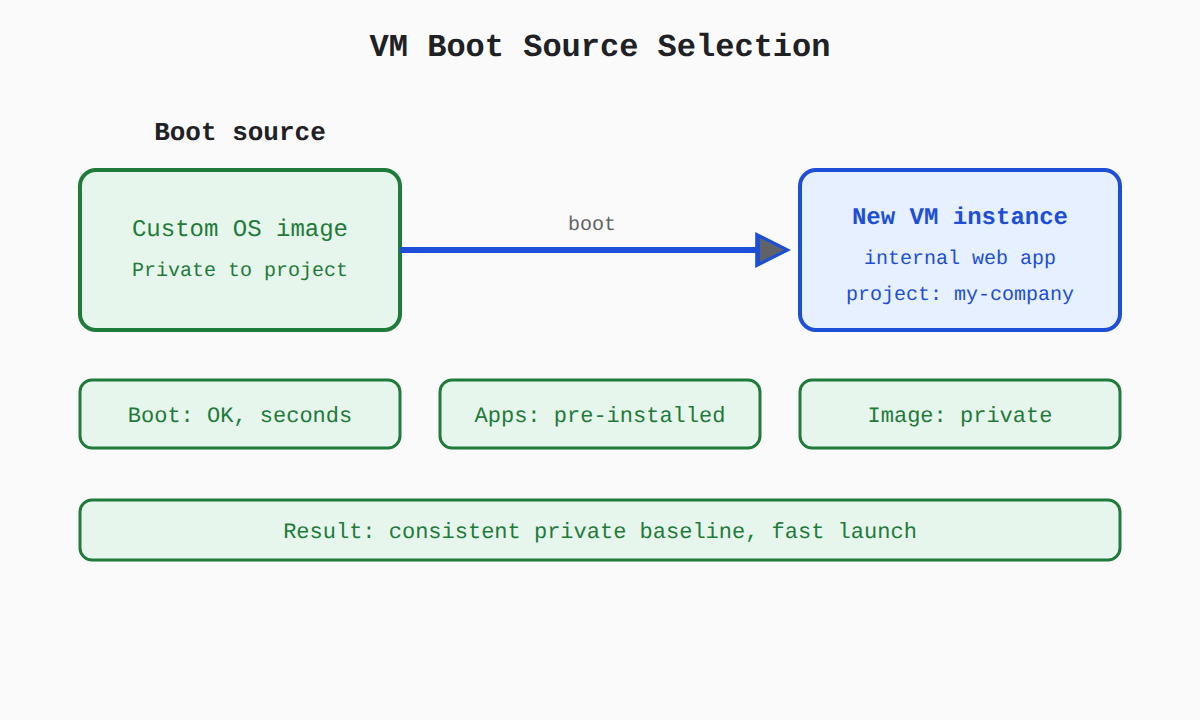
Pick a deployment strategy and workload requirement to see how each VM boots and whether the baseline stays private.
Try 10 interactive questions like this one, free
Answer them yourself and get your score the moment you finish. No account needed.
Full access includes
- 2,014 practice questions across all 4 exam domains
- Every answer explained: why it is right, and why the others are not
- Scout, an AI tutor that answers your follow-up questions
- Readiness tracking by domain, so you know when to book the exam
Related free sample questions
Keep the momentum going with these hand-picked practice scenarios
FundamentalAssociate Cloud Engineer
Windows Sysprep Specialize Script Metadata
Launching a compute instance (e.g., availability policy, SSH keys)
FundamentalAssociate Cloud Engineer
GCE Spot VM Provisioning Model
Launching a compute instance (e.g., availability policy, SSH keys)
FundamentalAssociate Cloud Engineer
Billing Account User Project Linking
Creating one or more billing accounts
FundamentalAssociate Cloud Engineer
Eventarc Cloud Run Invoker Role
Deploying an application to serverless compute platforms, including for the processing of Google Cloud events (e.g., Pub/Sub events, Cloud Storage object change notification events, Eventarc)
FundamentalAssociate Cloud Engineer
Compute OS Login vs OS Admin Login
Configuring OS Login
AdvancedProfessional Data Engineer
Cloud Monitoring AND_WITH_MATCHING_RESOURCE Combiner
Observability of data processes (e.g., Cloud Monitoring, Cloud Logging, BigQuery admin panel)
Last updated