Fundamental
Prepare and test your skills

Fundamental
Prepare and test your skills
Outbound Internet Access for Private Backend VMs
Free sample question with answers and detailed explanation below. The Associate Cloud Engineer practice bank has an additional 2,014 practice questions.Try 10 free realistic questions: instant score, no credit card, and no account required.
An organization is deploying a multi-tier application in Google Cloud. The backend application virtual machines (VMs) reside in a private subnet and do not have external IP addresses to comply with company security policies.
The backend VMs have the following requirements:
- Download security updates and software patches from public internet repositories without allowing unsolicited inbound internet traffic.
- Resolve internal hostnames for services within the VPC as well as external domain names on the internet.
Which networking solution should you implement to meet these requirements?
Explanations
Assign ephemeral external IP addresses to the backend VMs and configure a public Cloud DNS zone with A records pointing to the internal IPs
Assign ephemeral external IP addresses to the backend VMs and configure a public Cloud DNS zone with A records pointing to the internal IPs
What this approach does
Assigning ephemeral external IP addresses directly attaches publicly routable IPv4 addresses to the network interfaces of the backend virtual machines. A public Cloud DNS zone publishes DNS records that are publicly queryable by any system connected to the global internet.
Why it doesn't meet the requirement
- Violates security compliance: The scenario explicitly mandates that backend VMs must not have external IP addresses. Giving VMs public external IPs exposes them directly to internet traffic.
- Exposes internal IP topology: Publishing internal IP addresses in a public Cloud DNS zone exposes internal network details to the public internet, violating the principle of least privilege and network isolation.
- Inbound threat vector: External IP addresses allow potential attackers on the internet to attempt direct connections to the VMs unless strict ingress firewall rules are maintained.
Key characteristics/limitations
- Ephemeral external IP addresses change whenever an instance is stopped and restarted unless converted to static external IPs.
- Public DNS zones are meant for internet-facing services, not internal service discovery within a private VPC.
This answer would be correct if
The application tier were a public-facing web server requiring direct inbound HTTP/HTTPS traffic from public internet clients rather than an isolated private backend tier.
Configure Cloud NAT on a Cloud Router in the region for outbound internet access, and use Cloud DNS private zones along with default VPC DNS resolution for domain lookups
Configure Cloud NAT on a Cloud Router in the region for outbound internet access, and use Cloud DNS private zones along with default VPC DNS resolution for domain lookups
What Cloud NAT and Cloud DNS are
Cloud NAT (Network Address Translation) is a fully managed, software-defined Google Cloud service that enables compute resources without external IP addresses to access the public internet for outbound traffic without allowing inbound connections.
Cloud DNS is a high-performance, resilient Domain Name System service running on Google's global infrastructure that provides both public and private managed DNS zones for internal and external name resolution.
How it meets the requirements
- Outbound internet updates without public IPs: Cloud NAT allows backend instances with only internal IP addresses to initiate outbound connections to external repositories (such as OS update mirrors). Because NAT only translates connections initiated from within the VPC, external internet hosts cannot initiate unsolicited inbound sessions to the private VMs.
- Internal and external name resolution: Google Cloud VPC networks provide built-in internal DNS resolution by default for standard queries, and Cloud DNS private zones allow private internal domains to be resolved securely across VPC networks. Cloud DNS automatically handles recursive resolution for external public domains when VMs query internet repositories.
Key advantages/capabilities
- Serverless and software-defined: Cloud NAT does not require deploying or managing proxy VMs or gateway appliances, eliminating maintenance overhead and scaling bottlenecks.
- High availability and autoscaling: Cloud NAT scales port allocations and bandwidth automatically per VM based on traffic demands within the region.
- Enhanced security posture: Prevents direct exposure of backend instances to the public internet by keeping them on internal-only IP addresses.
- Seamless integration: Works directly with VPC routing and firewall rules without requiring changes to guest OS network configurations.
Why this is optimal
This approach combines Google-native managed services to fulfill outbound connectivity and hybrid/internal naming requirements without provisioning dedicated proxy compute infrastructure or compromising network isolation.
Configure VPC Network Peering with default route exchange to direct internet traffic to an on-premises gateway, and configure Cloud DNS peering to an external public DNS server
Configure VPC Network Peering with default route exchange to direct internet traffic to an on-premises gateway, and configure Cloud DNS peering to an external public DNS server
What this approach does
VPC Network Peering connects two Virtual Private Cloud networks to exchange traffic using internal IP addresses. In a hybrid architecture, custom route advertisements can backhaul cloud internet traffic across Cloud VPN or Cloud Interconnect to an on-premises internet gateway.
Why it doesn't meet the requirement
- Unnecessary latency and cost: Backhauling package update traffic through on-premises infrastructure introduces network latency and consumes costly interconnect or VPN bandwidth for routine software updates.
- VPC Peering route limitations: VPC Network Peering connects VPC networks within Google Cloud, not directly to on-premises routers without hybrid connectivity (such as Cloud Router with BGP).
- Cloud DNS peering misuse: Cloud DNS peering is designed to route private DNS queries to another VPC network's private DNS zone, not to forward public internet DNS queries to public resolvers.
Key characteristics/limitations
- Incurs egress bandwidth charges across hybrid links for internet-destined downloads.
- Increases reliance on on-premises firewall capacity and link availability.
This answer would be correct if
Corporate security policies strictly mandated that all outbound internet traffic from cloud resources must be inspected and routed through an on-premises centralized firewall appliance before reaching the internet.
Deploy a custom Linux VM configured with IP forwarding as a NAT proxy and disable Google Cloud default DNS resolvers
Deploy a custom Linux VM configured with IP forwarding as a NAT proxy and disable Google Cloud default DNS resolvers
What this approach does
This configuration sets up a self-managed Compute Engine instance running network address translation software (such as iptables or a squid proxy) with IP forwarding enabled, acting as a manual gateway for all outbound traffic from private VMs.
Why it doesn't meet the requirement
- Operational overhead and reliability risks: A single custom NAT VM creates a single point of failure and a severe throughput bottleneck unless complex high-availability clusters and custom health-checked routes are managed manually.
- Disabling default DNS breaks resolution: Disabling default DNS resolvers without an alternative managed DNS solution prevents VMs from querying both private zone records and public internet domain names.
- Non-optimal in Google Cloud: Google Cloud provides a fully managed, distributed software-defined solution (Cloud NAT) that eliminates the need to maintain proxy compute instances.
Key characteristics/limitations
- Custom NAT gateways incur compute and licensing costs for the gateway VM.
- Bandwidth is limited by the machine type and network interface limits of the proxy VM.
- Requires manual OS patching, scaling, and routing maintenance.
This answer would be correct if
The workload required deep packet inspection or custom protocol filtering proxy capabilities that are not supported by standard Layer 4 NAT services.
Try the scenario
Private Backend VMs: Outbound Updates and Name Resolution
Change the inputs and watch how the outcome changes.
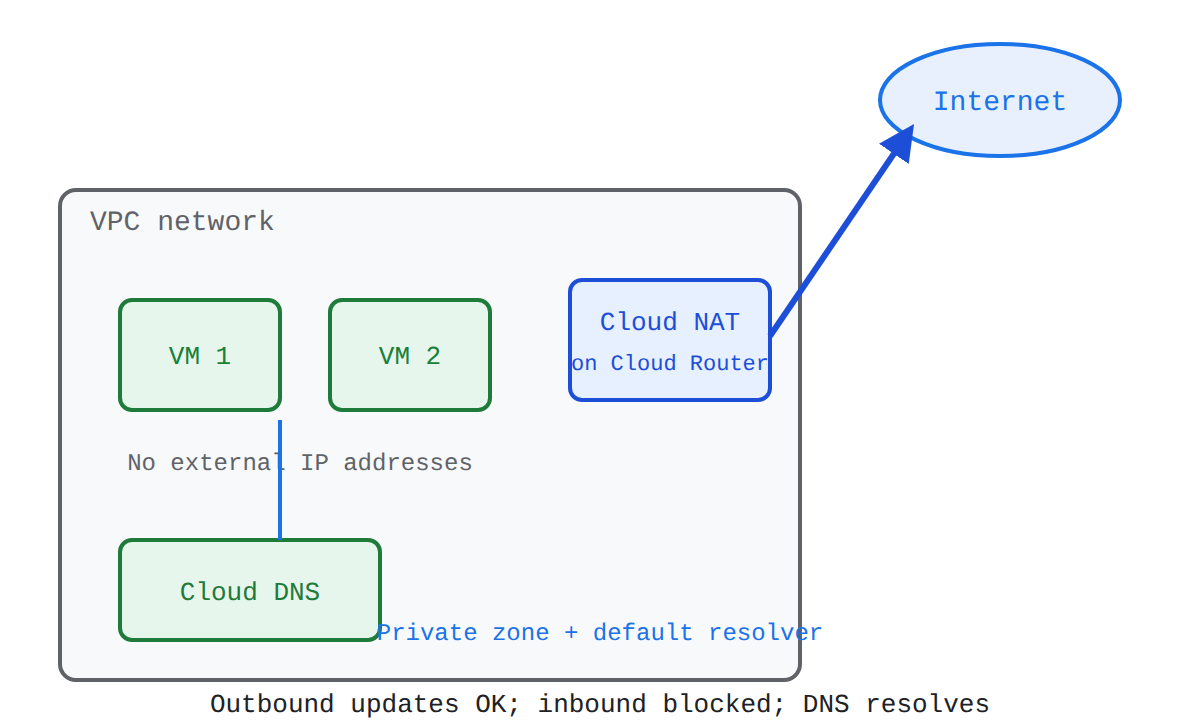
Change the networking approach and workload tier to see how outbound traffic, inbound traffic, and DNS behave.
Try 10 interactive questions like this one, free
Answer them yourself and get your score the moment you finish. No account needed.
Full access includes
- 2,014 practice questions across all 4 exam domains
- Every answer explained: why it is right, and why the others are not
- Scout, an AI tutor that answers your follow-up questions
- Readiness tracking by domain, so you know when to book the exam
Related free sample questions
Keep the momentum going with these hand-picked practice scenarios
FundamentalAssociate Cloud Engineer
Cloud NAT Outbound-Only Internet Access
Working with Cloud DNS and Cloud NAT
FundamentalAssociate Cloud Engineer
Cloud DNS Managed Private Zones
Working with Cloud DNS and Cloud NAT
FundamentalAssociate Cloud Engineer
Kubeconfig Context Switching
Installing and configuring the command-line interface (CLI) for Kubernetes (kubectl)
FundamentalAssociate Cloud Engineer
HPA CPU Resource Requests Requirement
Managing horizontal and vertical Pod autoscaling configurations
FundamentalAssociate Cloud Engineer
Cloud Logging Query Language Filters
Viewing and filtering logs in Cloud Logging
AdvancedProfessional Cloud Security Engineer
Alias IP Ranges and Multi-NIC VMs
Differentiating between private and public IP addressing.
Last updated