Fundamental
Prepare and test your skills

Fundamental
Prepare and test your skills
Manual Subnets Outside the Auto Mode Block
Free sample question with answers and detailed explanation below. The Associate Cloud Engineer practice bank has an additional 2,014 practice questions.Try 10 free realistic questions: instant score, no credit card, and no account required.
An organization operates an existing auto mode Virtual Private Cloud (VPC) network. A cloud engineer needs to manually add a new subnet to this network in the us-central1 region to host a dedicated internal testing service.
The engineer must select a valid primary IPv4 CIDR range that does not overlap with any existing subnets or the predefined IP block allocated for auto mode networks.
Which CIDR range should the engineer assign to the new subnet?
Explanations
169.254.10.0/24
169.254.10.0/24
What this option is
169.254.10.0/24 is a sub-block of 169.254.0.0/16, which is designated by RFC 3927 as link-local address space for non-routable host auto-configuration.
Why it doesn't meet the requirement
- Restricted/Prohibited subnet range: Google Cloud explicitly forbids configuring subnets using the
169.254.0.0/16range or any subnet thereof. - Internal infrastructure conflicts: Google Cloud uses
169.254.0.0/16internally to host virtual metadata servers (e.g.,169.254.169.254) and to establish BGP peering sessions over Cloud Router interfaces.
Key characteristics and limitations
- Link-local addresses are non-routable on the internet and cannot be assigned as primary or secondary VPC subnet ranges.
- Subnet ranges must not match, be narrower than, or be broader than restricted ranges like
169.254.0.0/16. - Other prohibited ranges in Google Cloud VPC include
0.0.0.0/8,127.0.0.0/8,224.0.0.0/4(multicast), and255.255.255.255/32.
This answer would be correct if
You were configuring link-local IP addresses on a Cloud Router BGP interface to establish dynamic routing with an on-premises VPN or Cloud Interconnect peer.
Additional context
Students sometimes confuse link-local IP ranges with RFC 1918 private IP ranges. Only RFC 1918 blocks (10.0.0.0/8, 172.16.0.0/12, 192.168.0.0/16) and valid privately used public IP ranges can be used for VPC subnets.
10.10.0.0/24
10.10.0.0/24
What this CIDR range represents
10.10.0.0/24 is a standard private IPv4 CIDR range within the RFC 1918 10.0.0.0/8 private address space. In Google Cloud, it provides 256 total IPv4 addresses, with 252 usable host addresses after subtracting the four reserved IP addresses required to operate the subnet.
How it meets the requirements
- Avoids the auto mode IP block: Auto mode VPC networks automatically create subnets across all regions using the predefined
10.128.0.0/9address block. Because10.10.0.0/24is part of10.0.0.0/9(10.0.0.0through10.127.255.255), it sits completely outside10.128.0.0/9(10.128.0.0through10.255.255.255). - Avoids subnet route overlap: Because this range does not intersect with any existing or reserved auto mode regional ranges, it does not conflict with existing subnet routes in the VPC.
- Conforms to sizing constraints: A
/24prefix mask is within Google Cloud's allowed subnet mask range (from/8to/29).
Auto-Mode Block: Safe vs Reserved Space
Set Relationship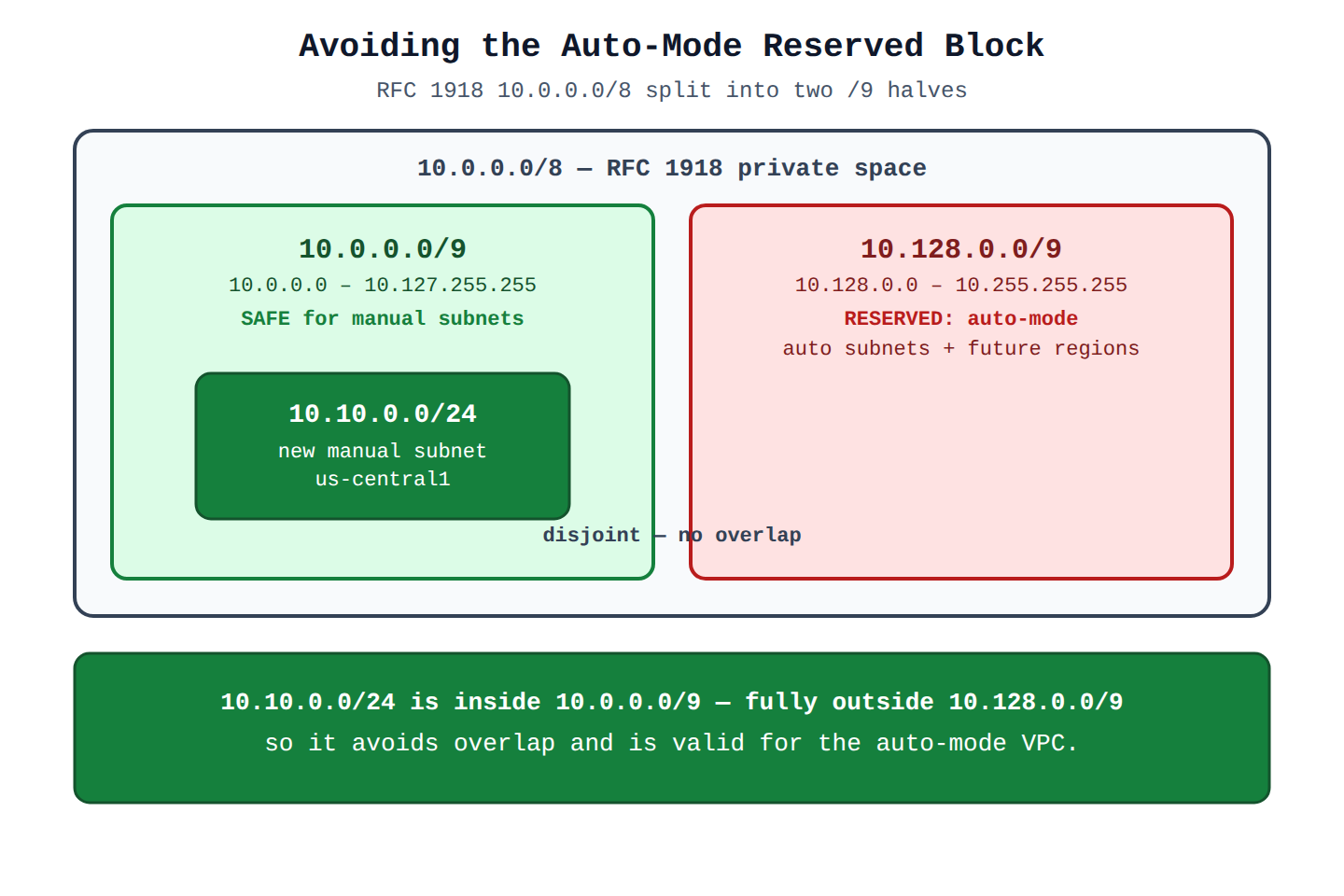
Key advantages and capabilities
- Full manual compatibility: Google Cloud allows manual subnets to be added to auto mode networks as long as their IP ranges fall outside
10.128.0.0/9. - Protection against future collisions: Because Google Cloud provisions new regional subnets in auto mode networks using remaining space in
10.128.0.0/9, using10.10.0.0/24guarantees that future Google Cloud regions will not create an IP collision. - Standard RFC 1918 compliance: Enables private, unexposed communication among internal VM instances and load balancers.
- Clean routing separation: Generates a distinct local subnet route in the VPC routing table without requiring network translation.
Why this is optimal
When working with auto mode VPC networks, any manually added subnet must strictly avoid the 10.128.0.0/9 reservation block. Selecting an RFC 1918 range such as 10.10.0.0/24 satisfies all validation criteria, avoids route conflicts, and permits successful creation of the new subnet.
10.170.0.0/24
10.170.0.0/24
What this option is
10.170.0.0/24 is a /24 subnet block located inside 10.128.0.0/9. In auto mode VPC networks, 10.170.0.0/20 is the predetermined CIDR range assigned to automatically created subnets in the asia-east2 region.
Why it doesn't meet the requirement
- Overlaps with auto mode IP space: The entire
10.128.0.0/9block is reserved for automatically created subnets. Manually created subnets in an auto mode network cannot use addresses inside10.128.0.0/9. - Overlaps an existing regional subnet:
10.170.0.0/24is a subset of10.170.0.0/20. Google Cloud does not allow creating a subnet that matches, nests inside, or overlaps any existing subnet CIDR block within the same VPC.
Key characteristics and limitations
- Resides within
10.128.0.0/9, which Google Cloud reserves for current and future auto mode subnets. - Directly conflicts with the primary IPv4 address space assigned to
asia-east2. - Violates Google Cloud's rule requiring distinct, non-overlapping subnet routes across the entire global VPC.
This answer would be correct if
The network was originally converted from auto mode to custom mode, the automatically created asia-east2 subnet was deleted, and no other resources or routes referenced the 10.170.0.0/24 range.
Additional context
A common misconception is that a narrower subnet mask (such as /24) can be carved out of a larger unused subnet (such as /20). In Google Cloud VPC networking, any overlap with an existing primary or secondary subnet CIDR is strictly prohibited.
10.128.0.0/20
10.128.0.0/20
What this option is
10.128.0.0/20 is the specific predefined IPv4 primary range automatically allocated to the default subnet in the us-central1 region whenever an auto mode VPC network is created.
Why it doesn't meet the requirement
- Direct IP address conflict: Because the VPC network was created in auto mode, a subnet with the range
10.128.0.0/20already exists inus-central1. Attempting to allocate this range for another subnet causes an immediate conflict error. - Duplicate routing conflict: VPC networks require every primary and secondary subnet range to be unique. A duplicate range cannot be inserted into the network's routing table.
Key characteristics and limitations
- Pre-assigned to
us-central1during auto mode network creation. - Spans
10.128.0.0through10.128.15.255, providing 4,092 usable host IP addresses. - Uses
10.128.0.1as the virtual default gateway address. - Cannot be reused or duplicated by another subnet within the same VPC network.
This answer would be correct if
The network were a custom mode VPC network where no subnets had yet been provisioned in us-central1, and an administrator chose to manually assign 10.128.0.0/20 to the first custom subnet.
Additional context
In auto mode networks, each region is automatically populated with a /20 subnet drawn from 10.128.0.0/9. Subnet IP collisions frequently occur when administrators try to reuse these well-known default ranges manually.
Try 10 interactive questions like this one, free
Answer them yourself and get your score the moment you finish. No account needed.
Full access includes
- 2,014 practice questions across all 4 exam domains
- Every answer explained: why it is right, and why the others are not
- Scout, an AI tutor that answers your follow-up questions
- Readiness tracking by domain, so you know when to book the exam
Related free sample questions
Keep the momentum going with these hand-picked practice scenarios
FundamentalAssociate Cloud Engineer
Private Google Access and VPC Flow Logs
Adding a subnet to an existing VPC
FundamentalAssociate Cloud Engineer
Artifact Registry Reader Role for GKE Nodes
Configuring GKE to access Artifact Registry
FundamentalAssociate Cloud Engineer
logging.logEntries.create Permission
Exporting logs to external systems (e.g., on-premises, BigQuery)
FundamentalAssociate Cloud Engineer
Gcloud Custom VPC Subnet Creation
Creating a VPC with subnets (e.g., custom mode VPC, Shared VPC)
FundamentalAssociate Cloud Engineer
Cloud Logging jsonPayload Field Filtering
Viewing and filtering logs in Cloud Logging
FundamentalGenerative AI Leader
LLM Training Data Memorization
Describing privacy considerations (e.g., privacy risks, data anonymization and pseudonymization)
Last updated