Diagram
Managed Identity Access to Key Vault
Sequence
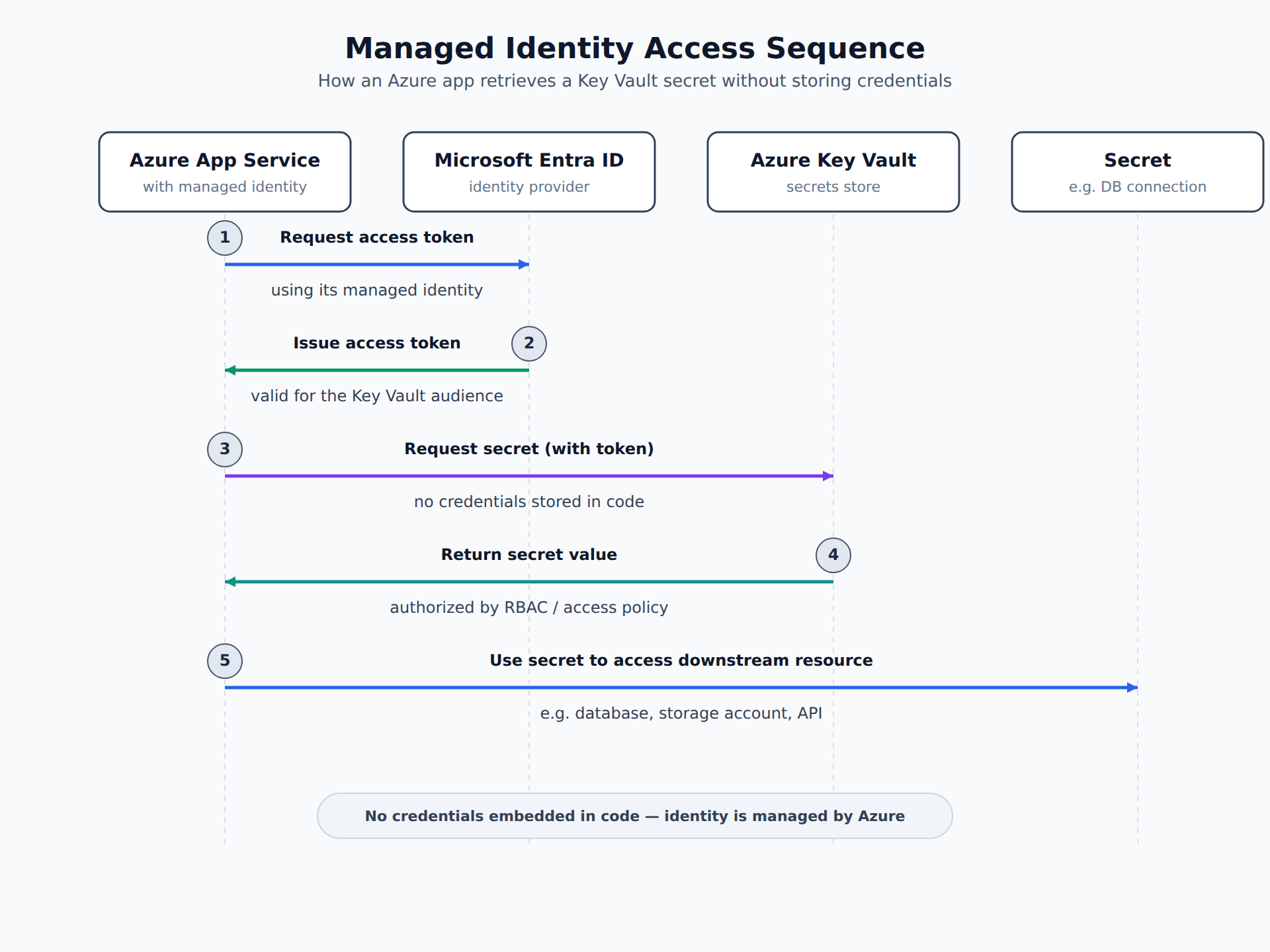
A sequence diagram showing an Azure application using its managed identity to request a token from Microsoft Entra ID, then using that token to authenticate to Azure Key Vault and retrieve a secret without storing credentials in code.
In the Domain
Controlling Access to Secrets and Keys
Access to certificates, secrets, and keys in the vault is controlled through two systems that work together. Azure RBAC defines roles like Key Vault Contributor, Key Vault Crypto User, and Key Vault Reader that grant different permission levels for management and cryptographic operations. Meanwhile, Key Vault access policies let administrators specify exactly which users or applications can read keys, write secrets, or perform other actions. For applications running on Azure compute resources, administrators can enable managed identities so the application accesses vault data without storing credentials in code. These layered controls enforce the principle of least privilege by giving each user or service only the permissions it absolutely needs. In high-security environments, organizations deploy Managed HSM to keep root keys isolated in physical hardware while still allowing authorized applications to use them.
Domain 4 of 8
Manage certificates, secrets, and keys
Read the Domain summaryPractice this Domain
1 practice question
Practice this DomainLast updated