Are you a guardian of your domain? Lean how to leverage your aptitude in security to protect Microsoft Azure technologies, with a goal of earning the Microsoft Certified: Azure Security Engineer Associate certification!
Prepare and test your skills
Prepare and test your skills
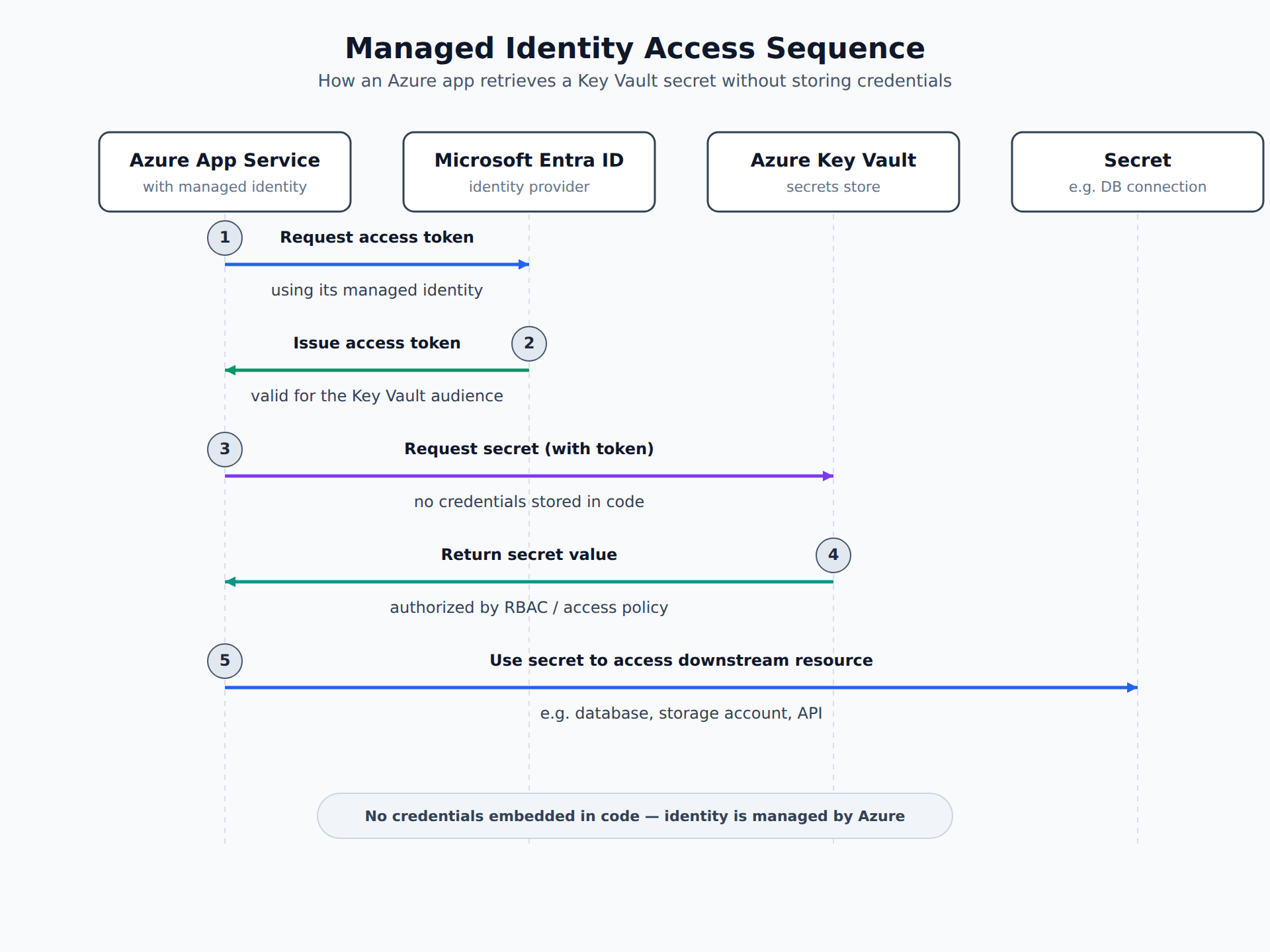
A sequence diagram showing an Azure application using its managed identity to request a token from Microsoft Entra ID, then using that token to authenticate to Azure Key Vault and retrieve a secret without storing credentials in code.
Azure RBAC defines roles like Key Vault Contributor, Key Vault Crypto User, and Key Vault Reader that grant different permission levels for management and cryptographic operations, while Key Vault access policies let administrators specify exactly which users or applications can read keys, write secrets, or perform other actions. Both systems work together to enforce the principle of least privilege.
Administrators create Key Rotation Policies that define how often keys and secrets should be rotated and how many previous versions to retain. When a rotation is due, the vault can generate a new version automatically while keeping the old version available for systems still using it. Integration with Azure Event Grid and Azure Functions enables custom workflows such as sending alerts when certificates approach expiration or triggering certificate renewals.
Administrators configure firewall rules that specify which IP addresses or virtual networks are allowed to access vault endpoints. Private endpoints create a direct connection from a virtual network to the vault through the Azure backbone, keeping all traffic off the public internet. Organizations can also disable public network access entirely, ensuring only traffic from approved networks reaches the vault.
Diagnostic Settings send vault logs, metrics, and audit events to Log Analytics or Microsoft Sentinel workspaces. In Sentinel, built-in analytics rules can alert on suspicious behavior such as mass secret retrieval, unexpected key deletion, or access from unusual IP addresses. Microsoft Defender for Cloud integrates with Key Vault to provide additional threat detection and security posture recommendations.
Azure Key Vault governance starts with setting up policies that apply to all vaults in a subscription. Azure Policy and Azure Blueprints let administrators define rules such as requiring HSM-backed keys, enabling soft-delete, and turning on purge protection. These policies run automatically: when someone tries to create a vault that violates a rule, the policy can either flag it with an audit or block it entirely with a deny effect. This prevents misconfigured vaults from ever going into production and keeps security settings consistent across the organization. The policies also support compliance with the Microsoft cloud security benchmark by checking vaults against corporate standards without manual review.
Access to certificates, secrets, and keys in the vault is controlled through two systems that work together. Azure RBAC defines roles like Key Vault Contributor, Key Vault Crypto User, and Key Vault Reader that grant different permission levels for management and cryptographic operations. Meanwhile, Key Vault access policies let administrators specify exactly which users or applications can read keys, write secrets, or perform other actions. For applications running on Azure compute resources, administrators can enable managed identities so the application accesses vault data without storing credentials in code. These layered controls enforce the principle of least privilege by giving each user or service only the permissions it absolutely needs. In high-security environments, organizations deploy Managed HSM to keep root keys isolated in physical hardware while still allowing authorized applications to use them.
Key Vault includes network-level controls that limit which networks can reach the vault. Administrators configure firewall rules that specify which IP addresses or virtual networks are allowed to access vault endpoints. Private endpoints create a direct connection from a virtual network to the vault through the Azure backbone, keeping all traffic off the public internet. Organizations can disable public network access entirely, ensuring that only traffic from approved networks reaches the vault. Azure Policy can audit vaults automatically to confirm they have the required firewall or private endpoint configurations, closing gaps before attackers can exploit them. This layered defense reduces the attack surface and aligns with network security best practices.
Stale credentials create security risk, so Azure Key Vault supports automated rotation to keep secrets and keys fresh. Administrators create Key Rotation Policies that define how often keys and secrets should be rotated and how many previous versions to retain. When a rotation is due, the vault can generate a new version automatically while keeping the old version available for any systems still using it. Integration with Azure Event Grid and Azure Functions enables custom workflows, such as sending alerts when certificates approach expiration or triggering certificate renewals. Azure Policy can enforce lifecycle management rules across all vaults, ensuring consistent rotation schedules without manual intervention. This automation reduces operational work while maintaining continuous compliance with security standards.
Detecting unauthorized access requires forwarding vault activity logs to security monitoring tools. Diagnostic Settings send vault logs, metrics, and audit events to Log Analytics or Microsoft Sentinel workspaces. Once the data is in Sentinel, built-in analytics rules can alert on suspicious behavior such as mass secret retrieval, unexpected key deletion, or access from unusual IP addresses. Microsoft Defender for Cloud integrates with Key Vault to provide additional threat detection and security posture recommendations. When an alert fires, security teams can investigate using the logged data and trigger automated response playbooks. This complete monitoring pipeline enables rapid detection and response to Key Vault security incidents.
 StudyCerts
 StudyCerts