Intermediate
Prepare and test your skills
Intermediate
Prepare and test your skills
Canary Traffic Splitting with Weighted Backend Services
Free sample question, answered and explained below. The Professional Cloud Architect practice bank has 2,335 more like it. Try 10 free: instant score, no account.
An enterprise organization runs a critical e-commerce service behind an external Application Load Balancer on Google Cloud. The development team needs to deploy a major update using a canary deployment strategy.
The deployment strategy must satisfy the following operational requirements:
- Direct 5% of production user traffic to the canary backend service (
service-v2) to evaluate performance and error rates under real traffic. - Keep 95% of traffic routed to the stable production backend service (
service-v1). - Allow the operations team to incrementally increase traffic to
service-v2or instantly revert to 100% onservice-v1without deploying new infrastructure.
Which traffic management configuration should you recommend?
Explanations
Place both application versions inside the same backend service and adjust the maximum utilization capacity settings of the canary instance group to 5%.
Place both application versions inside the same backend service and adjust the maximum utilization capacity settings of the canary instance group to 5%.
What Backend Balancing Capacity Is
Balancing capacity settings (such as max-utilization or max-rate-per-instance) instruct the load balancer on how many requests or how much CPU utilization an instance group can absorb before spilling traffic over to other backends.
Why It Doesn't Meet the Requirement
- Misaligned Functionality: Capacity controls dictate overload thresholds, not percentage-based canary traffic routing. As long as the canary group is below its maximum utilization threshold, traffic distribution is determined by round-robin/least-connection algorithms rather than a strict 95:5 percentage split.
- Mixed Version Management: Combining two different software versions under a single backend service obscures metrics, complicates health checking, and prevents clean version-isolated rollbacks.
Key Characteristics and Limitations
- Capacity Thresholding: Intended to protect backends from saturating CPU or concurrency limits, not for intentional traffic splitting.
- Spillover Dynamics: If the stable group gets busy, traffic involuntarily spills over to the canary group, violating the 5% cap.
This Answer Would Be Correct If
You wanted to prevent backend instances in a specific region or zone from becoming overloaded by diverting excess load to secondary instance groups.
Configure a Pod Disruption Budget (PDB) on the cluster with minAvailable: 95% to prevent the canary version from receiving more than 5% of total requests.
Configure a Pod Disruption Budget (PDB) on the cluster with minAvailable: 95% to prevent the canary version from receiving more than 5% of total requests.
What Pod Disruption Budgets Are
A Pod Disruption Budget (PDB) is a Kubernetes policy that limits the number of replicated Pods that can be simultaneously unavailable during voluntary disruptions (such as node pool upgrades or cluster maintenance).
Why It Doesn't Meet the Requirement
- No Routing Capability: A PDB does not manage, route, or split incoming network traffic. It only restricts eviction actions triggered by the Kubernetes control plane during administrative operations.
- Wrong Problem Domain: A PDB cannot distribute 5% of live production traffic to a new version or revert traffic in the event of an application error.
Key Characteristics and Limitations
- Voluntary Disruptions Only: Safeguards quorum during node draining and upgrades; has no impact on HTTP/S request steering.
- Cluster-Internal Constraint: Evaluated by the API server during pod evictions, completely separate from ingress load balancing.
This Answer Would Be Correct If
You needed to guarantee that at least 95% of stateful or quorum-critical pods remain online during automated GKE node pool maintenance.
Configure Cloud DNS weighted routing policies to distribute traffic across two distinct external forwarding rule IP addresses pointing to service-v1 and service-v2.
Configure Cloud DNS weighted routing policies to distribute traffic across two distinct external forwarding rule IP addresses pointing to service-v1 and service-v2.
What Cloud DNS Weighted Routing Is
Cloud DNS weighted routing distributes DNS query responses across different IP endpoints according to configured percentage weights.
Why It Doesn't Meet the Requirement
- DNS Caching and Propagation Lag: Client-side and recursive resolver DNS caching causes uneven traffic distribution and significant delays when attempting an urgent rollback, failing the requirement for rapid and precise traffic shifting.
- Increased Architectural Complexity: This approach requires maintaining two separate global forwarding rules and public IP addresses instead of centralizing traffic routing logic in a single load balancer URL map.
- Imprecise Request Splitting: DNS-level routing splits client nameserver lookups, not individual HTTP requests, which can lead to disproportionate traffic distribution if high-volume enterprise proxies resolve the canary IP.
Key Characteristics and Limitations
- Resolver-Dependent: DNS time-to-live (TTL) settings are frequently disregarded by intermediate resolvers and client operating systems.
- Multi-IP Overhead: Requires extra public IPs and frontend load balancing components.
- Coarse Granularity: Well-suited for multi-region failover and geo-routing, but suboptimal for microservice canary rollouts.
This Answer Would Be Correct If
You needed to distribute traffic between entirely separate, isolated data centers or multi-cloud hosting environments across different public IP entry points.
Configure route rules in the load balancer's URL map path matcher that utilize routeAction.weightedBackendServices to assign weight 95 to service-v1 and weight 5 to service-v2.
Configure route rules in the load balancer's URL map path matcher that utilize routeAction.weightedBackendServices to assign weight 95 to service-v1 and weight 5 to service-v2.
What URL Map Weighted Backend Services Are
URL maps in Google Cloud Application Load Balancers provide advanced traffic routing and management capabilities. Using weightedBackendServices under a path matcher's routeAction, you can split incoming HTTP(S) traffic among multiple backend services based on assigned integer weights.
How It Meets the Requirements
- 5% Canary Allocation: Setting
weight: 95onservice-v1andweight: 5onservice-v2distributes incoming production requests proportionately between the two independent backend services. - Incremental Rollout & Instant Rollback: As operational confidence grows, engineers can update the URL map weights (e.g., from 95/5 to 50/50, and eventually 0/100 for full rollout). If issues arise, updating the weights back to 100/0 immediately diverts all incoming traffic back to the known-good version.
- No Infrastructure Re-provisioning: Modifying URL map weights is an in-place control-plane configuration change that requires no redeployment of instances or changes to frontend IP configurations.
Key Advantages
- Granular Traffic Control: Allows percentage-based traffic steering at the load balancer level without requiring custom application routing code.
- Independent Health Checks: Each backend service (
service-v1andservice-v2) maintains its own health checks, ensuring unhealthy instances in the canary group do not take down the stable group. - Low Latency & High Availability: Traffic shifting happens dynamically at the Google Front End (GFE) / Envoy proxies, avoiding DNS propagation delays.
- Support for Advanced Deployment Patterns: Readily accommodates partial canary releases, A/B testing, and blue-green rollouts.
Why This Is Optimal
Using weightedBackendServices within the load balancer's URL map is the native, recommended pattern for managing canary and blue-green releases on Google Cloud Compute Engine and GKE backend workloads.
Weighted Canary Split on External ALB
System Architecture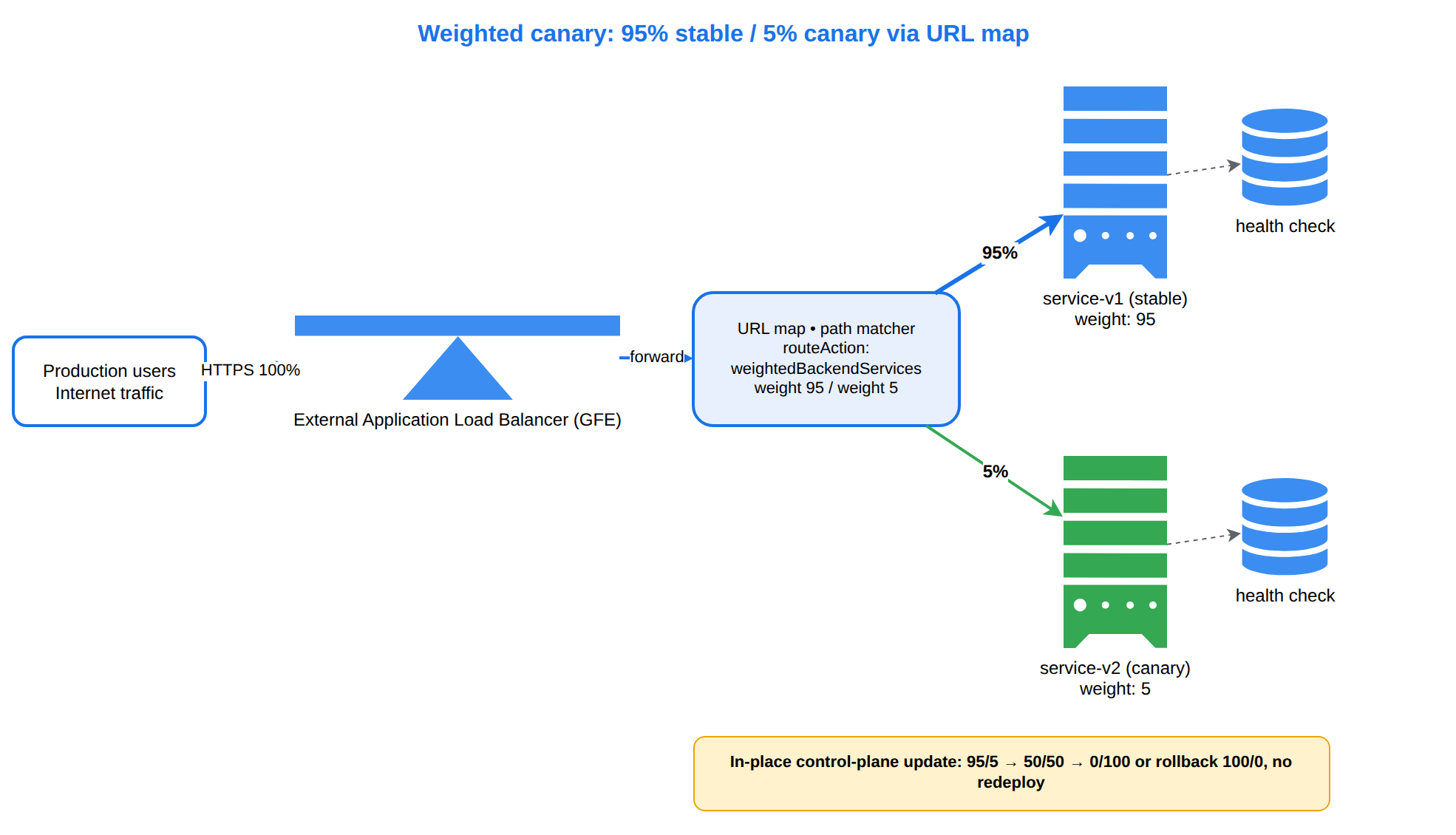
Try 10 interactive questions like this one, free
Answer them yourself and get your score the moment you finish. No account needed.
Full access includes
- 2,335 practice questions across all 6 exam domains
- Every answer explained: why it is right, and why the others are not
- Scout, an AI tutor that answers your follow-up questions
- Readiness tracking by domain, so you know when to book the exam
Related questions
Keep the momentum going with these hand-picked practice scenarios
IntermediateProfessional Cloud Architect
Cloud Run vs Cloud Run Functions vs GKE
Mapping compute needs to platform products (e.g., Google Kubernetes Engine [GKE], Cloud Run, and Cloud Run functions)
IntermediateProfessional Cloud Architect
Highmem VM With Hyperdisk Balanced
Performance and latency
IntermediateProfessional Cloud Architect
Vertex AI Search vs Vertex AI Conversation
Differentiating between the Google AI APIs (e.g., Search, Conversation, Vision, Image, Video, and Audio)
IntermediateProfessional Cloud Architect
Cloud Client Libraries vs Google API Client Libraries
Google API client libraries
IntermediateProfessional Cloud Architect
VM Manager Patch Deployment Zone-by-Zone Disruption Budget
Infrastructure orchestration, resource configuration, and patch management
AdvancedProfessional Cloud DevOps Engineer
Gemini Cloud Assist Root Cause Validation
Leveraging Gemini Cloud Assist for metrics interpretation
Last updated