Intermediate
Prepare and test your skills
Intermediate
Prepare and test your skills
Error Budget Burn Rate Controls Release Decisions
Free sample question, answered and explained below. The Professional Cloud Architect practice bank has 2,335 more like it. Try 10 free: instant score, no account.
An enterprise runs a business-critical order processing microservice on Google Cloud. The Site Reliability Engineering (SRE) team has established a 30-day rolling Service Level Objective (SLO) target of 99.9% availability based on a Service Level Indicator (SLI) measuring successful requests.
During an aggressive deployment cycle, custom Cloud Monitoring dashboards indicate that 90% of the 30-day error budget was consumed in just 4 days due to transient server errors and latency spikes.
According to SRE best practices, how should the team use these SLI/SLO metrics to guide their upcoming operational and development decisions?
Explanations
Ignore the rolling error budget and evaluate infrastructure health exclusively using raw virtual machine CPU and memory utilization thresholds
Ignore the rolling error budget and evaluate infrastructure health exclusively using raw virtual machine CPU and memory utilization thresholds
What Host-Level Metric Monitoring Is
Host-level monitoring measures infrastructure resource consumption, such as hypervisor CPU utilization, RAM usage, and disk I/O, rather than end-user service quality.
Why It Doesn't Meet the Requirement
- Lacks user perspective: High or low CPU utilization does not necessarily correlate with user-perceived performance. A service can experience severe database lock contention, bad application logic, or external dependency failures while maintaining normal CPU levels.
- Disregards established SLIs/SLOs: Ignoring the primary SLI invalidates the entire reliability framework established for measuring actual request success and latency.
- Ineffective decision-making: Raw resource metrics alone cannot indicate whether the rate of feature releases is compromising customer satisfaction.
Key Characteristics and Limitations
- Infrastructure metrics are diagnostic tools rather than direct measures of service health.
- SRE best practices prioritize user-facing SLIs (availability, latency, throughput) over pure infrastructure metrics when making operational decisions.
This Answer Would Be Correct If
The team were conducting low-level VM instance sizing or debugging a suspected hypervisor hardware fault rather than evaluating overall service reliability and release governance.
Switch the SLI calculation from request-based availability to a short 1-minute windowed SLI and reset the 30-day compliance period to zero
Switch the SLI calculation from request-based availability to a short 1-minute windowed SLI and reset the 30-day compliance period to zero
What Resetting Compliance Periods and Changing SLIs Does
A windowed SLI evaluates the percentage of discrete time windows (e.g., 1-minute or 5-minute intervals) that meet a specified goodness criterion. Resetting the compliance period wipes out historical measurement data.
Why It Doesn't Meet the Requirement
- Eliminates historical accountability: Resetting the compliance period erases the historical record of degraded service, hiding the fact that releases caused widespread errors.
- Fails to remediate instability: Changing the SLI definition does not fix poor code quality, missing autoscaling configurations, or inadequate database indexing.
- Distorts performance trends: Window-based SLIs are designed to capture bursty unreliability over time, not to be swapped in reactively to discard accumulated downtime.
Key Characteristics and Limitations
- Rolling compliance windows continuously evaluate performance across the defined period (e.g., 30 days) to prevent recency bias.
- SLI calculation methods must be consistently applied to ensure long-term data integrity.
This Answer Would Be Correct If
The service's usage pattern transitioned from uniform traffic to periodic batch processing where time-windowed availability provides a more accurate reflection of operational health.
Lower the SLO target from 99.9% to 95.0% for the remainder of the compliance window to prevent alerting policies from triggering during deployments
Lower the SLO target from 99.9% to 95.0% for the remainder of the compliance window to prevent alerting policies from triggering during deployments
What Lowering the SLO Target Does
Lowering the SLO target alters the agreed-upon reliability goal to artificially make the current unreliability appear acceptable within reporting tools.
Why It Doesn't Meet the Requirement
- Masks systemic issues: Artificially adjusting the objective does not solve the underlying infrastructure bottlenecks, high error rates, or application bugs.
- Breaches user expectations: SLO targets should reflect the level of service quality that end users require to remain satisfied. Arbitrarily reducing targets degrades actual user satisfaction and invalidates historical performance trends.
- Renders monitoring ineffective: Silencing or bypassing alerts by shifting targets undermines the primary purpose of quality control and observability.
Key Characteristics and Limitations
- Targets should be based on real business and user experience needs, not adjusted dynamically to accommodate failing releases.
- Masking failures prevents teams from identifying architectural weaknesses such as unoptimized queries or capacity limits.
This Answer Would Be Correct If
Business stakeholders and end users formally agreed that the service had been over-engineered and that a lower reliability threshold was acceptable to reduce operational costs.
Additional Context
SLOs should remain stable across rolling windows to accurately evaluate trends; changing them reactively defeats the purpose of SRE governance.
Halt non-critical feature releases and redirect engineering effort toward infrastructure reliability, performance tuning, and automated scaling fixes until the error budget stabilizes
Halt non-critical feature releases and redirect engineering effort toward infrastructure reliability, performance tuning, and automated scaling fixes until the error budget stabilizes
What Error Budget Governance Is
An error budget represents the acceptable level of unreliability a service can experience over a defined compliance period (such as 100% - 99.9% = 0.1% allowable failure over 30 days). In Site Reliability Engineering (SRE), the error budget functions as an objective, shared control mechanism that balances feature velocity with system reliability.
How It Meets Operational Decision Requirements
When an application burns through 90% of its monthly error budget in only 4 days, continuing standard deployments introduces unacceptable risk of violating contractual Service Level Agreements (SLAs) and degrading customer experience. Redirecting engineering focus addresses the situation by:
- Mitigating further budget exhaustion: Freezing risky deployments eliminates new variables while the system is in an unstable state.
- Focusing on root causes: Engineering capacity is reallocated to performance optimization, query and database indexing, caching strategies, and infrastructure autoscaling adjustments.
- Restoring operational headroom: Once reliability improvements demonstrate sustained compliance against the SLI, standard feature velocity can safely resume.
Error Budget Burn Decision Flow
Decision Tree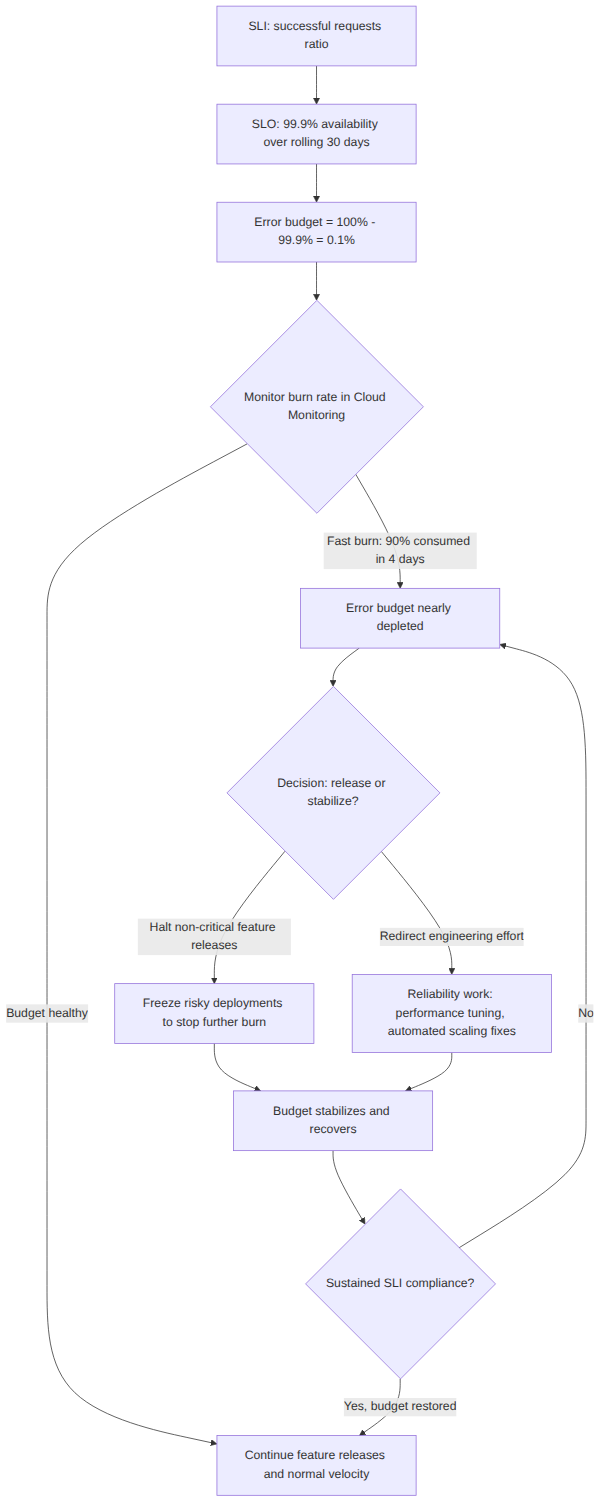
Key Advantages and Capabilities
- Data-driven alignment: Provides an objective standard to resolve priority conflicts between product developers (who want speed) and operations teams (who want stability).
- Proactive risk management: Prevents critical customer-facing outages by triggering remediations before the complete SLO is breached.
- Incentivizes resilient architecture: Encourages development teams to build self-healing, well-instrumented, and fault-tolerant cloud services.
Why This Is Optimal
Using the error budget burn rate to throttle releases and prioritize operational excellence directly adheres to Google Cloud and SRE best practices, ensuring long-term service health without arbitrarily blocking innovation when budgets are healthy.
Try 10 interactive questions like this one, free
Answer them yourself and get your score the moment you finish. No account needed.
Full access includes
- 2,335 practice questions across all 6 exam domains
- Every answer explained: why it is right, and why the others are not
- Scout, an AI tutor that answers your follow-up questions
- Readiness tracking by domain, so you know when to book the exam
Related questions
Keep the momentum going with these hand-picked practice scenarios
IntermediateProfessional Cloud Architect
Parallel Composite Uploads
Configuration for data transfer and latency
IntermediateProfessional Cloud Architect
Instance Template and Regional Managed Instance Group
Infrastructure orchestration, resource configuration, and patch management
IntermediateProfessional Cloud Architect
Governance with Organization Policy, Assured Workloads, and FinOps
Decision-making processes
IntermediateProfessional Cloud Architect
GKE Enterprise Fleets and Config Sync
Flexibility of cloud resources
IntermediateProfessional Cloud Architect
BigQuery Partition Expiration and Cloud Storage Lifecycle
Data growth planning
AdvancedProfessional Cloud DevOps Engineer
Build-Time vs Runtime Secret Injection
Build versus runtime secret injection
Last updated