Intermediate
Prepare and test your skills
Intermediate
Prepare and test your skills
Cloud Governance with FinOps and Policy Guardrails
Free sample question, answered and explained below. The Professional Cloud Architect practice bank has 2,335 more like it. Try 10 free: instant score, no account.
A financial enterprise is establishing a cloud governance framework and decision-making model for its migration to Google Cloud. The initiative must satisfy distinct requirements across multiple stakeholder groups:
- Finance and Procurement: Require automated cost tracking, clear chargeback mechanisms to individual business units, and proactive budget overrun alerts.
- Security and Compliance: Require automated enforcement of data residency constraints and baseline regulatory controls across all cloud environments.
- Engineering and Operations: Require deployment agility to optimize resources locally while adhering to enterprise standards.
Which governance strategy should the enterprise implement to align these stakeholders across the decision-making lifecycle?
Explanations
Assign all infrastructure provisioning and governance exclusively to the central security team, grant developers viewer-only access across all environments, and utilize Cloud Billing reports without resource labeling.
Assign all infrastructure provisioning and governance exclusively to the central security team, grant developers viewer-only access across all environments, and utilize Cloud Billing reports without resource labeling.
What This Approach Does
This model concentrates all provisioning, configuration, and governance tasks entirely within a central security team, restricting all engineering personnel to read-only (roles/viewer) permissions across development and production environments, while using basic Cloud Billing reports without a structured tagging or labeling schema.
Why It Fails the Requirements
- Engineering Bottlenecks: Developers cannot deploy, test, or optimize applications independently, creating severe operational friction and stifling business innovation.
- Inaccurate Cost Allocation: Viewing raw Cloud Billing reports without consistent labels and tags prevents the finance team from contextualizing spending by business unit, product, or cost center.
- Misaligned Stakeholder Roles: Forcing the security team to handle routine provisioning takes focus away from strategic risk assessment, threat detection, and compliance monitoring.
Key Characteristics and Limitations
- Overburdens security personnel with operational implementation tasks.
- Eliminates local engineering accountability for resource efficiency.
- Fails to deliver granular financial chargeback data.
This Answer Would Be Correct If
The cloud environment were an immutable, highly restricted archive requiring zero developer interaction and no internal department billing attribution.
Delegate all architectural, security, and financial policy decisions entirely to autonomous application teams without organization policies, managing cost through individual project-level alerts.
Delegate all architectural, security, and financial policy decisions entirely to autonomous application teams without organization policies, managing cost through individual project-level alerts.
What This Approach Does
This option implements a completely decentralized, unconstrained operating model where individual application teams make independent decisions regarding architecture, regulatory controls, and cloud spending without centralized standards or automated organization policies.
Why It Fails the Requirements
- Regulatory and Security Vulnerability: Without central organization policies and security baselines, individual teams may deploy resources in unauthorized geographic regions, directly violating data residency laws and industry compliance obligations.
- Fragmented Financial Governance: Lacking centralized cost allocation rules, unified billing exports, and standardized labeling frameworks prevents finance teams from accurately tracking corporate spend and executing corporate-wide chargeback.
- Operational Inconsistency: Leads to divergent operational standards, unmanaged technical debt, and siloed security configurations across the organization.
Key Characteristics and Limitations
- Disregards unified corporate risk management and governance frameworks.
- Exposes the business to severe compliance penalties and unauthorized data residency transfers.
- Prevents executive and financial stakeholders from obtaining a single pane of glass for cloud expenditures.
This Answer Would Be Correct If
The organization were a loose incubator of disconnected prototype projects where compliance, data residency, and central financial auditing were not required.
Establish a centralized FinOps practice that standardizes cost allocation tooling and budgets while delegating resource optimization, enforce compliance and data residency via Organization Policy Service and Assured Workloads, and structure access through a formal resource hierarchy.
Establish a centralized FinOps practice that standardizes cost allocation tooling and budgets while delegating resource optimization, enforce compliance and data residency via Organization Policy Service and Assured Workloads, and structure access through a formal resource hierarchy.
What the Cloud Governance and FinOps Framework Is
A cross-functional cloud governance framework integrates technical, financial, and compliance controls into the organizational decision-making lifecycle. By pairing a central FinOps practice with automated cloud-native governance tools like the Google Cloud resource hierarchy, Organization Policy Service, and Assured Workloads, enterprises establish clear guardrails that align enterprise objectives with decentralized operational execution.
How It Meets the Requirements
- Financial Accountability and Chargeback: A centralized FinOps framework standardizes billing datasets, resource labeling, and Cloud Billing budgets and alerts. Delegating optimization accountability to engineering teams while standardizing cost allocation tooling allows finance to maintain fiscal governance and chargeback tracking without blocking daily development.
- Automated Regulatory and Security Controls: Implementing Organization Policy Service constraints (such as
gcp.resourceLocations) alongside Assured Workloads automatically restricts workloads and data at rest to compliant geographic regions, satisfying strict compliance mandates systematically. - Operational Agility: Structuring environments under a structured resource hierarchy (Organizations, Folders, Projects) provides granular access control via IAM, allowing engineering teams autonomy within predefined policy guardrails.
Resource Hierarchy Guardrails Model
Layered Stack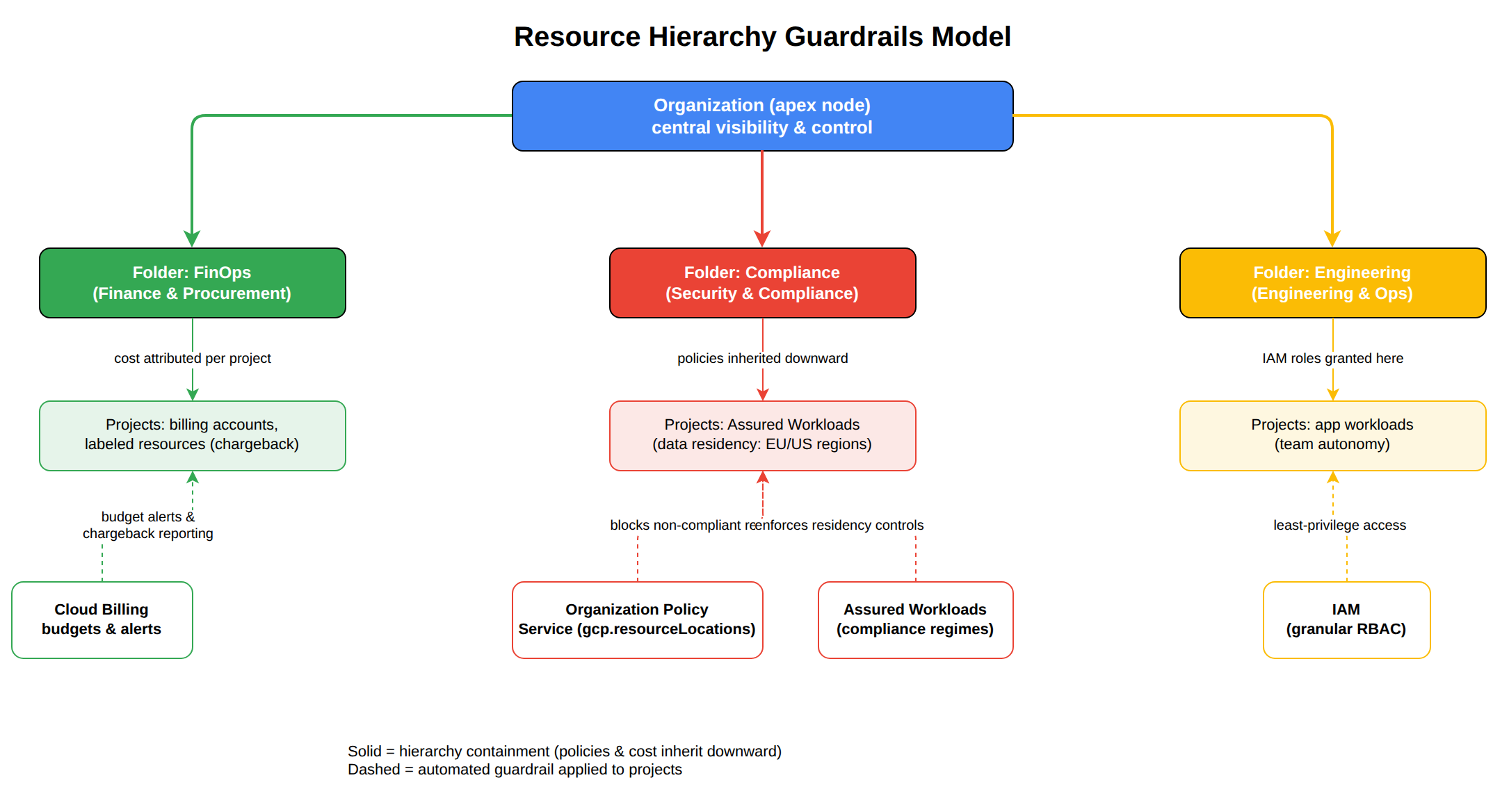
Key Advantages and Capabilities
- Standardized Cost Visibility: Centralizes spending analytics via Cloud Billing exports and Looker dashboards while encouraging team-level ownership.
- Policy as Code and Automated Guardrails: Automatically prevents misconfigurations and non-compliant resource provisioning before deployment.
- Cross-Functional Stakeholder Alignment: Bridges communication gaps between executive finance, compliance auditors, security officers, and DevOps practitioners.
- Scalable Resource Segmentation: Uses folder and project hierarchies to mirror business units and enforce role-based access control (RBAC).
Why This Is Optimal
This strategy balances centralized oversight with decentralized operational agility. Instead of creating administrative bottlenecks, it embeds automated technical guardrails and standardized financial tooling, satisfying all regulatory, financial, and operational criteria simultaneously.
Mandate that all infrastructure provisioning requests undergo manual approval by a centralized Change Advisory Board (CAB), consolidate all workloads into a single project, and perform quarterly manual billing reconciliations.
Mandate that all infrastructure provisioning requests undergo manual approval by a centralized Change Advisory Board (CAB), consolidate all workloads into a single project, and perform quarterly manual billing reconciliations.
What This Approach Does
This option relies on traditional IT service management (ITSM) patterns characterized by a centralized Change Advisory Board (CAB) reviewing every infrastructure request, placing all enterprise workloads into a single shared Google Cloud project, and relying on manual spreadsheets for quarterly financial reconciliations.
Why It Fails the Requirements
- Operational Inefficiency: Manual gatekeeping and CAB approval queues severely impair engineering velocity and contradict cloud operating models designed for automated delivery.
- Poor Security and Compliance Isolation: Consolidating all workloads into a single project creates a broad blast radius, violates the principle of least privilege, and prevents the enforcement of granular Organization Policy boundaries.
- Lack of Financial Accountability: Relying on quarterly manual reconciliations lacks real-time cost transparency and fails to provide automated budget alerts or reliable chargeback capabilities.
Key Characteristics and Limitations
- Creates significant operational bottlenecks for deployment and optimization.
- Increases administrative overhead for infrastructure changes.
- Compromises compliance posture due to lack of environment segregation.
This Answer Would Be Correct If
The organization were operating a single, monolithic legacy application with minimal change frequency and no requirement for multi-department cost attribution or agility.
Try 10 interactive questions like this one, free
Answer them yourself and get your score the moment you finish. No account needed.
Full access includes
- 2,335 practice questions across all 6 exam domains
- Every answer explained: why it is right, and why the others are not
- Scout, an AI tutor that answers your follow-up questions
- Readiness tracking by domain, so you know when to book the exam
Related questions
Keep the momentum going with these hand-picked practice scenarios
IntermediateProfessional Cloud Architect
SLOs, TCO, and Proof of Concept Assessment
Decision-making processes
IntermediateProfessional Cloud Architect
Cloud Pub/Sub vs Self-Managed Messaging
Decision-making processes
IntermediateProfessional Cloud Architect
Object Lifecycle Management SetStorageClass
Cost optimization
IntermediateProfessional Cloud Architect
Aggregated Log Sinks and Exclusion Filters
Monitoring and logging
IntermediateProfessional Cloud Architect
Service Monitoring SLIs SLOs Error Budgets
Success measurements (e.g., key performance indicators [KPI], return on investment [ROI], and metrics)
FundamentalAssociate Data Practitioner
Cloud Storage Archive Storage
Evaluate Google Cloud services for archiving data given business requirements
Last updated