Intermediate
Prepare and test your skills
Intermediate
Prepare and test your skills
Multi-Region Spanner for Global ACID Transactions
Free sample question, answered and explained below. The Professional Cloud Architect practice bank has 2,335 more like it. Try 10 free: instant score, no account.
A multinational financial services company is redesigning its core transaction processing backend on Google Cloud. The architecture must accommodate rapid international expansion and satisfy the following technical requirements:
- Provide strong relational consistency (ACID compliance) with SQL querying across multiple continents.
- Scale write and read throughput horizontally on demand by adding nodes without requiring manual database sharding or application-level partitioning.
- Deliver high availability with synchronous data replication across multiple geographical regions.
Which Google Cloud database service should the architect select to meet these requirements?
Explanations
Deploy AlloyDB for PostgreSQL with cross-region secondary clusters
Deploy AlloyDB for PostgreSQL with cross-region secondary clusters
What AlloyDB for PostgreSQL is
AlloyDB for PostgreSQL is a fully managed, PostgreSQL-compatible relational database service designed for demanding enterprise transactional and analytical workloads, featuring a disaggregated compute and storage architecture.
Why it doesn't meet the requirement
- Single Primary Write Node: AlloyDB separates compute and storage and allows horizontal scaling of read pools, but all transactional write operations are processed by a single primary read/write instance per cluster.
- Cross-Region Asynchronous Replication: Secondary clusters in other regions are read-only and updated asynchronously from the primary cluster, which does not provide global multi-region active-active transactional write scaling.
- Horizontal Write Limits: You cannot add write nodes to scale out write throughput horizontally for a single primary database.
Key characteristics and limitations
- Read Pool Scalability: Scales read workloads horizontally within a region by dynamically adding compute nodes to read pools.
- Storage Tier Decoupling: Uses an intelligent, log-processing distributed storage layer optimized for NVMe performance and fast recovery.
- PostgreSQL Compatibility: Provides complete drop-in compatibility with standard PostgreSQL engines and extensions.
This answer would be correct if
The application required full PostgreSQL compatibility with high vertical transactional throughput and scalable intra-region read performance, without requiring multi-region active-active horizontal write scaling.
Deploy Cloud Spanner with a multi-region instance configuration
Deploy Cloud Spanner with a multi-region instance configuration
What Cloud Spanner is
Cloud Spanner is Google Cloud's fully managed, mission-critical, enterprise-grade relational database service. It uniquely combines the benefits of traditional relational database structure—such as ACID transactions, relational schemas, and SQL support—with the horizontal scalability and high availability typically found only in non-relational distributed databases.
How it meets the requirements
- Horizontal Scalability: Cloud Spanner separates compute from storage, allowing you to scale processing nodes horizontally to increase both read and write capacity linearly without requiring application refactoring or manual sharding.
- Global Consistency and Multi-Region Availability: Spanner uses synchronized atomic clocks (TrueTime API) and Paxos consensus to deliver external consistency across multi-region and global deployments.
- High Availability: A multi-region Cloud Spanner instance configuration provides up to 99.999% availability SLA with automatic, transparent synchronous replication across regions.
Spanner Multi-Region Synchronous Replication
System Architecture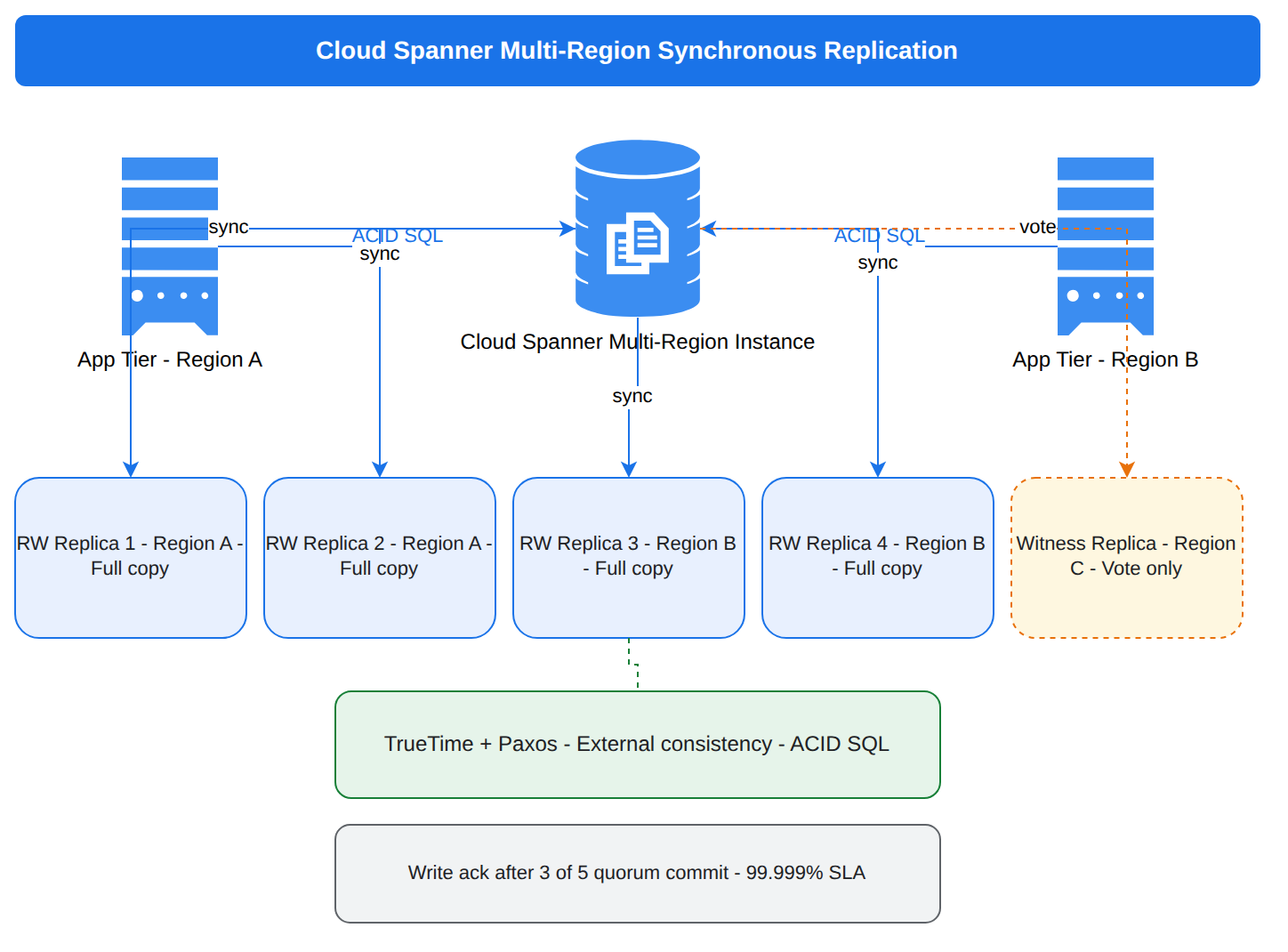
Key advantages and capabilities
- Automatic Data Sharding: Spanner automatically splits and balances data across splits as data volume grows.
- Zero Downtime Maintenance: Schema updates, node scaling, and software patches occur transparently without maintenance windows or system downtime.
- Standard ANSI SQL: Developers can use familiar relational queries, indexes, and constraints across petabyte-scale data sets.
- No Sharding Overhead: Eliminates the operational complexity of managing application-level partitioning or complex replication pipelines.
Why this is optimal
Compared to single-master relational engines like Cloud SQL or AlloyDB, which rely on vertical compute scaling and asynchronous read replicas, Cloud Spanner is the only Google Cloud relational engine architected to scale write workloads horizontally across multiple global regions while maintaining strict transactional consistency.
Deploy Cloud SQL for MySQL with cross-region read replicas and automated vertical scaling
Deploy Cloud SQL for MySQL with cross-region read replicas and automated vertical scaling
What Cloud SQL is
Cloud SQL is a fully managed relational database service supporting MySQL, PostgreSQL, and SQL Server. It is designed for standard enterprise workloads requiring managed relational functionality, automatic backups, and high availability within regional boundaries.
Why it doesn't meet the requirement
- Vertical Write Bottleneck: Cloud SQL relies on a single primary instance to process all write operations. Scaling write throughput requires vertical scaling (increasing vCPU and RAM), which has physical hardware limits and cannot scale out horizontally across nodes.
- Asynchronous Multi-Region Replication: Cross-region read replicas in Cloud SQL use asynchronous replication, which can introduce replication lag and cannot provide synchronous global multi-region write consistency.
- Manual Sharding Required for Massive Growth: Accommodating massive write throughput growth beyond single-instance limits requires complex application-level sharding architectures.
Key characteristics and limitations
- Compute Scaling Limits: Instances can scale up in vCPU and memory, but compute capacity cannot be partitioned across parallel transactional write nodes.
- Read Scalability Only: Adding read replicas scales read throughput but does not scale write throughput.
- Failover Boundaries: High availability failover is limited to zones within the same region rather than cross-continent synchronous write clusters.
This answer would be correct if
The workload were confined to a single geographic region, possessed read-heavy access patterns that could be offloaded to read replicas, and had write volumes that fit within a vertically scaled database instance.
Deploy Cloud Bigtable with multi-cluster routing across multiple regions
Deploy Cloud Bigtable with multi-cluster routing across multiple regions
What Cloud Bigtable is
Cloud Bigtable is a sparsely populated, distributed NoSQL wide-column store designed for high-throughput, low-latency analytical and operational workloads at petabyte scale.
Why it doesn't meet the requirement
- Lack of Relational ACID Features: Cloud Bigtable is a NoSQL key-value/wide-column database and does not support multi-row ACID transactions, relational joins, secondary indexes, foreign keys, or complex SQL schemas.
- Consistency Model: Multi-cluster Cloud Bigtable routing provides eventual consistency across clusters rather than strict external ACID consistency for multi-row operations across global regions.
- Query Flexibility: Access is optimized around single-row operations and row-key range scans rather than general-purpose transactional SQL queries.
Key characteristics and limitations
- Single-Row Atomicity: Atomicity and consistency guarantees in Bigtable apply only at the individual row level.
- No SQL Engine: Requires application code to handle key design and data relationships without relational schema enforcement.
- High-Throughput Focus: Ideal for time-series, IoT, ad-tech, and streaming data rather than transactional financial ledger systems.
This answer would be correct if
The application required massive ingestion of unstructured or semi-structured time-series/sensor data with sub-10ms read/write latencies and did not require relational queries or multi-row transactional integrity.
Try 10 interactive questions like this one, free
Answer them yourself and get your score the moment you finish. No account needed.
Full access includes
- 2,335 practice questions across all 6 exam domains
- Every answer explained: why it is right, and why the others are not
- Scout, an AI tutor that answers your follow-up questions
- Readiness tracking by domain, so you know when to book the exam
Related questions
Keep the momentum going with these hand-picked practice scenarios
IntermediateProfessional Cloud Architect
Global External Application Load Balancer Premium Tier
Scalability to meet growth requirements
IntermediateProfessional Cloud Architect
Compute Engine Autoscaler Multi-Signal Max Rule
Scalability to meet growth requirements
IntermediateProfessional Cloud Architect
Cloud Run Serverless Containers
Cloud-first design approach
IntermediateProfessional Cloud Architect
Google Cloud Transfer Appliance
Movement of data
IntermediateProfessional Cloud Architect
Persistent Disk IOPS vCPU and Capacity Limit
Data storage allocation
AdvancedProfessional Cloud Security Engineer
Service Account Disable Before Delete
Creating, disabling, and authorizing service accounts.
Last updated