Intermediate
Prepare and test your skills
Intermediate
Prepare and test your skills
StreamingPull Flow Control for High Throughput Subscribers
Free sample question, answered and explained below. The Professional Cloud Architect practice bank has 2,335 more like it. Try 10 free: instant score, no account.
A global retail company is architecting an event-driven transaction processing system on Google Cloud to handle millions of checkout events per minute during seasonal flash sales. The event processing workload runs on Google Kubernetes Engine (GKE) worker pods.
The architecture must meet the following requirements:
- Deliver maximum throughput and lowest end-to-end delivery latency for high-volume message streams
- Prevent subscriber worker pods from exhausting memory and crashing during sudden traffic bursts
- Dynamically regulate the rate of delivered messages by bounding outstanding unacknowledged messages per worker
Which Pub/Sub consumption pattern and configuration should the cloud architect implement?
Explanations
Configure a Pub/Sub push subscription targeting an HTTPS endpoint exposed by an ingress load balancer in GKE
Configure a Pub/Sub push subscription targeting an HTTPS endpoint exposed by an ingress load balancer in GKE
What push subscriptions are
Pub/Sub push subscriptions deliver messages by having the Pub/Sub service initiate outbound HTTPS POST requests to a publicly accessible webhook or load balancer endpoint.
Why it doesn't meet the requirement
- Throughput and latency overhead: Push subscriptions use individual HTTPS POST requests per message or small batch, which introduces HTTP connection and TLS overhead compared to persistent gRPC streams.
- Slow-start congestion control: Push delivery uses a slow-start algorithm that scales back delivery rates when push request latencies rise or error rates increase, causing latency spikes during sudden flash sales.
- Lack of direct subscriber flow control: Push endpoints cannot enforce dynamic, memory-based client flow control to actively pull only what local memory buffers allow.
Key characteristics and limitations
- Operates over standard HTTP/HTTPS POST endpoints.
- Governed by an automated push window algorithm rather than explicit client resource metrics.
- Triggers global subscription push backoff delays when unacknowledged deadlines expire or errors occur.
This answer would be correct if
The subscriber service was a serverless target such as Cloud Run or Cloud Functions that auto-scales based on incoming HTTP requests and handles steady, moderate traffic volumes.
Additional context
Push subscriptions are ideal for webhook-driven architectures, but they lack the low overhead and client-driven backpressure management required for high-throughput containerized workers.
Configure an Eventarc trigger routed to a Cloud Workflows destination that pulls Pub/Sub messages sequentially using scheduled sleep steps
Configure an Eventarc trigger routed to a Cloud Workflows destination that pulls Pub/Sub messages sequentially using scheduled sleep steps
What Eventarc with Cloud Workflows is
Eventarc captures events from Google Cloud services and routes them to destinations like Cloud Workflows, which orchestrates multi-step business logic and service integrations using declarative YAML or JSON workflows.
Why it doesn't meet the requirement
- Throughput bottleneck: Cloud Workflows is designed for service orchestration and coordinating APIs, not for ingesting millions of high-frequency transactional messages per minute.
- Polling delays: Introducing scheduled sleep cycles into workflow loops severely degrades end-to-end processing latency.
- Error handling caveats: Workflows acknowledges messages upon workflow instantiation; if subsequent execution steps fail, messages are not automatically retried by Pub/Sub unless custom workflow retry logic is written.
Key characteristics and limitations
- Tailored for asynchronous task orchestration and state machine management.
- Inefficient for microsecond/millisecond real-time event streaming.
- Adds unnecessary execution latency and orchestration overhead to high-volume message consumption.
This answer would be correct if
The requirement was to orchestrate long-running, multi-step business workflows across disparate enterprise services (such as approval chains or multi-system database updates) triggered by low-frequency events.
Additional context
While Eventarc and Workflows provide excellent decoupling for control-plane and integration events, core high-volume data-plane ingestion requires native Pub/Sub streaming subscribers.
Configure a Pub/Sub pull subscription using the high-level client library with StreamingPull and subscriber flow control limits enabled
Configure a Pub/Sub pull subscription using the high-level client library with StreamingPull and subscriber flow control limits enabled
What StreamingPull with Flow Control is
Pub/Sub StreamingPull is a bidirectional streaming RPC mechanism implemented by Google Cloud high-level client libraries. It establishes a persistent, open gRPC connection between the subscriber client and Pub/Sub servers, allowing messages to be streamed immediately to the subscriber as soon as they are published. Subscriber flow control is a client-side setting that limits the maximum number of outstanding unacknowledged messages or total message bytes held in memory simultaneously.
StreamingPull with Flow Control Sequence
Sequence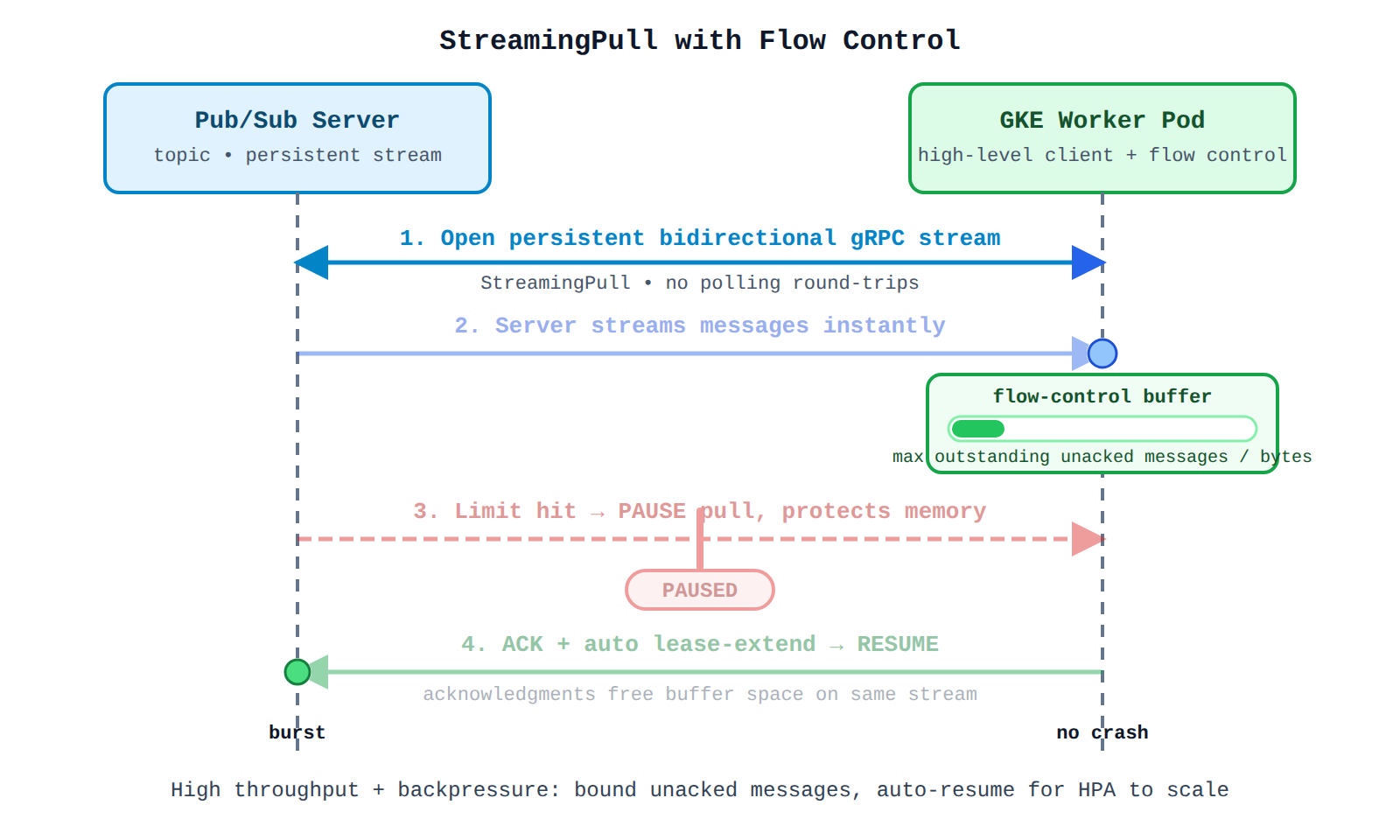
How it meets the requirements
- Maximum throughput and lowest latency: StreamingPull avoids the overhead of repeated HTTP/unary RPC roundtrips by keeping persistent streams open, achieving high-throughput and sub-second delivery latencies.
- Burst protection and resource safety: Subscriber flow control enforces upper bounds on outstanding messages, preventing workers from fetching more data than their CPU and memory buffers can process during sudden spikes.
- Dynamic regulation: The high-level client library pauses pulling additional messages when configured flow control limits are reached and resumes automatically as existing messages are acknowledged.
Key advantages and capabilities
- Bidirectional communication: Utilizes efficient gRPC streams to deliver messages and send acknowledgments back over the same channel.
- Automated lease management: High-level client libraries automatically extend message acknowledgment deadlines while processing is ongoing.
- Client-side concurrency: Enables fine-grained tuning of parallel processing threads alongside memory protection.
- Integrated autoscaling signals: Can be paired with Horizontal Pod Autoscaler (HPA) using undelivered message metrics.
Why this is optimal
Compared to push subscriptions or unary pull loops, StreamingPull via high-level client libraries provides optimal performance for heavy enterprise workloads, ensuring resilient backpressure handling and avoiding worker crashes under high load.
Configure a Pub/Sub pull subscription using the unary Pull API in a synchronous loop with the returnImmediately parameter enabled
Configure a Pub/Sub pull subscription using the unary Pull API in a synchronous loop with the returnImmediately parameter enabled
What synchronous unary pull is
Synchronous unary pull uses standard request-response RPC calls (projects.subscriptions.pull) where the client sends a separate request to the Pub/Sub API and waits for a single response containing zero or more messages.
Why it doesn't meet the requirement
- Inefficient polling and latency: Unary pull requires continuous request-response cycles. Setting deprecated parameters like
returnImmediately=truecauses tight polling loops that burn CPU and frequently return zero messages. - Complex manual orchestration: To achieve high throughput with unary pull, an application must maintain multiple simultaneous outstanding requests manually, which is error-prone and resource-intensive.
- Suboptimal flow control: Unary polling does not offer the seamless, automatic streaming flow control provided by high-level client libraries.
Key characteristics and limitations
- Employs a one-to-one request-response pattern instead of persistent streaming.
- Deprecated flags like
returnImmediatelydegrade efficiency and cause empty responses even when a backlog exists. - Lacks automatic acknowledgment deadline extension and background buffer management.
This answer would be correct if
The application were a batch script or a resource-constrained client that only needs to fetch a fixed number of messages intermittently and exit immediately.
Additional context
Unary pull APIs are intended for niche use cases with strict synchronous programming requirements rather than low-latency, mission-critical event streaming.
Try 10 interactive questions like this one, free
Answer them yourself and get your score the moment you finish. No account needed.
Full access includes
- 2,335 practice questions across all 6 exam domains
- Every answer explained: why it is right, and why the others are not
- Scout, an AI tutor that answers your follow-up questions
- Readiness tracking by domain, so you know when to book the exam
Related questions
Keep the momentum going with these hand-picked practice scenarios
IntermediateProfessional Cloud Architect
Apigee Adapter for Envoy
Supporting the application design
IntermediateProfessional Cloud Architect
GKE Fleet-Based Rollout Sequencing
Supporting the application design
IntermediateProfessional Cloud Architect
Cloud Storage Object Lifecycle Management
Data retention and data lifecycle management
IntermediateProfessional Cloud Architect
Declarative Infrastructure as Code
Data and system migration and management tooling
IntermediateProfessional Cloud Architect
BigQuery Partition Expiration and Cloud Storage Lifecycle
Data growth planning
AdvancedProfessional Cloud Security Engineer
OAuth Token Revocation and Session Control
Creating a password and session management policy for user accounts.
Last updated