Intermediate
Prepare and test your skills
Intermediate
Prepare and test your skills
Canary Deployment of Model Garden Models to Vertex AI Endpoints
Free sample question, answered and explained below. The Professional Cloud Architect practice bank has 2,335 more like it. Try 10 free: instant score, no account.
An enterprise is designing a deployment workflow to integrate an open-source machine learning model discovered in Vertex AI Model Garden into an existing cloud-native application. The architecture must satisfy several key operational requirements:
- Continuous Delivery: Automate deployment workflows with progressive canary rollouts and fast rollback capabilities to minimize release risk.
- Scalable Serving: Provide low-latency, real-time online inference capable of automatically adapting to dynamic traffic demands.
- Security: Enforce least-privilege identity access so the application service account can securely invoke model prediction APIs.
Which deployment and integration strategy should you recommend?
Explanations
Deploy the Model Garden model container directly to Cloud Run behind an external Application Load Balancer with Cloud CDN caching enabled, and assign the BigQuery Admin role to the calling service account.
Deploy the Model Garden model container directly to Cloud Run behind an external Application Load Balancer with Cloud CDN caching enabled, and assign the BigQuery Admin role to the calling service account.
What this option is/does
This option attempts to host the model container as a serverless web service using Cloud Run, placing it behind an external Application Load Balancer with Cloud CDN caching, while granting broad BigQuery privileges to the client service account.
Why it doesn't meet the requirement
- Accelerated Inference Limitations: Many complex Model Garden models (such as LLMs or large computer vision models) require dedicated, heavy GPU accelerators and specialized container environments that are purpose-built on Vertex AI Prediction infrastructure.
- Overly Permissive and Irrelevant IAM Permissions: Granting the BigQuery Admin role gives excessive administrative permissions over data analytics resources and fails to grant the required permissions to invoke machine learning prediction endpoints.
- Ineffective Caching: Cloud CDN is designed for caching static web assets and idempotent cacheable HTTP GET responses; it cannot handle dynamic, real-time generative or analytical POST prediction requests.
Key characteristics and limitations
- Cloud Run is ideal for lightweight, stateless HTTP microservices rather than intensive deep learning inference requiring large GPU memory.
- It lacks native Vertex AI Model Registry integration, automated drift monitoring, and ML-specific canary traffic splitting.
This answer would be correct if
You were hosting a lightweight microservice or static web application that serves cached assets and performs data warehousing administration in BigQuery.
Export the model artifacts to Cloud Storage, deploy them on Compute Engine using preemptible Spot VMs in an unmanaged instance group, and embed static API keys in the client application headers for authentication.
Export the model artifacts to Cloud Storage, deploy them on Compute Engine using preemptible Spot VMs in an unmanaged instance group, and embed static API keys in the client application headers for authentication.
What this option is/does
This configuration downloads model binaries onto standalone Compute Engine virtual machines running as Spot VMs inside an unmanaged instance group, relying on static API keys in client request headers for authentication.
Why it doesn't meet the requirement
- High Risk of Availability Outages: Spot VMs can be reclaimed by Google Cloud at any time with little notice, making them unsuitable for latency-sensitive, real-time production online prediction workloads.
- Lack of MLOps Automation: Unmanaged instance groups lack native progressive canary release mechanisms and automated CI/CD integration provided by Cloud Deploy and Vertex AI endpoints.
- Security Risk: Using embedded static API keys violates modern cloud security standards, introducing significant credential exposure risks compared to managed IAM service account authentication.
Key characteristics and limitations
- Spot VMs are designed for fault-tolerant, asynchronous batch processing or stateless distributed training rather than real-time serving SLAs.
- Unmanaged VM groups require substantial manual operations for load balancing, health checking, and version rollouts.
This answer would be correct if
The workload were an asynchronous, low-cost batch processing job that could tolerate sudden node preemption and retries.
Register the model in BigQuery ML using a SQL CREATE MODEL statement, execute scheduled recurring batch queries every minute for predictions, and assign the Vertex AI Feature Store Admin role to the service account.
Register the model in BigQuery ML using a SQL CREATE MODEL statement, execute scheduled recurring batch queries every minute for predictions, and assign the Vertex AI Feature Store Admin role to the service account.
What this option is/does
This architecture creates a model definition inside BigQuery ML and uses a scheduled SQL query execution pipeline every minute to process inference requests, while assigning administrative permissions for Vertex AI Feature Store.
Why it doesn't meet the requirement
- High Latency for Online Serving: Scheduled batch queries run on minute-level intervals and cannot provide the millisecond/sub-second response times required for synchronous, interactive application user experiences.
- Excessive Administrative Privileges: The Vertex AI Feature Store Admin (
roles/aiplatform.featurestoreAdmin) role grants broad configuration rights over feature management rather than the least-privilegeroles/aiplatform.userrole needed to invoke model predictions. - Architectural Mismatch: BigQuery ML is optimized for SQL-based analytical scoring across large structured datasets stored in BigQuery, rather than serving real-time application requests for Model Garden foundation models.
Key characteristics and limitations
- Batch prediction mechanisms incur queuing and startup latencies.
- It does not provide real-time endpoint autoscaling or progressive canary rollouts for cloud application integration.
This answer would be correct if
The goal was to run offline analytical batch scoring jobs once an hour or daily on large structured data tables directly within BigQuery.
Automate packaging and progressive canary deployments to a Vertex AI endpoint using Cloud Build and Cloud Deploy, configure accelerator-optimized compute instances with autoscaling, and grant the application service account the Vertex AI User (roles/aiplatform.user) role.
Automate packaging and progressive canary deployments to a Vertex AI endpoint using Cloud Build and Cloud Deploy, configure accelerator-optimized compute instances with autoscaling, and grant the application service account the Vertex AI User (roles/aiplatform.user) role.
What this solution is
This architecture leverages Google Cloud's native CI/CD and MLOps toolset to manage the deployment lifecycle of Vertex AI Model Garden assets. It combines Cloud Build for automated packaging and testing with Cloud Deploy for controlled delivery to Vertex AI endpoints, while securing model access using IAM roles.
How it meets the requirements
- Continuous Delivery and Safe Releases: Cloud Deploy provides structured release pipelines that support canary release strategies on Vertex AI endpoints. This allows you to route a subset of production traffic to a new model version, evaluate performance and error rates, and seamlessly roll back if anomalies are detected.
- Scalable Serving: Deploying the model to a managed Vertex AI endpoint with tailored machine types and accelerators (such as NVIDIA GPUs) ensures high-throughput, low-latency inference. Vertex AI prediction nodes automatically autoscale based on incoming request metrics to handle demand fluctuations.
- Security: Applying the Vertex AI User (
roles/aiplatform.user) role to the client application's dedicated service account satisfies the principle of least privilege, enabling secure token-based authentication to invoke online predictions without exposing credentials.
Canary Rollout with Traffic Split
Process Flow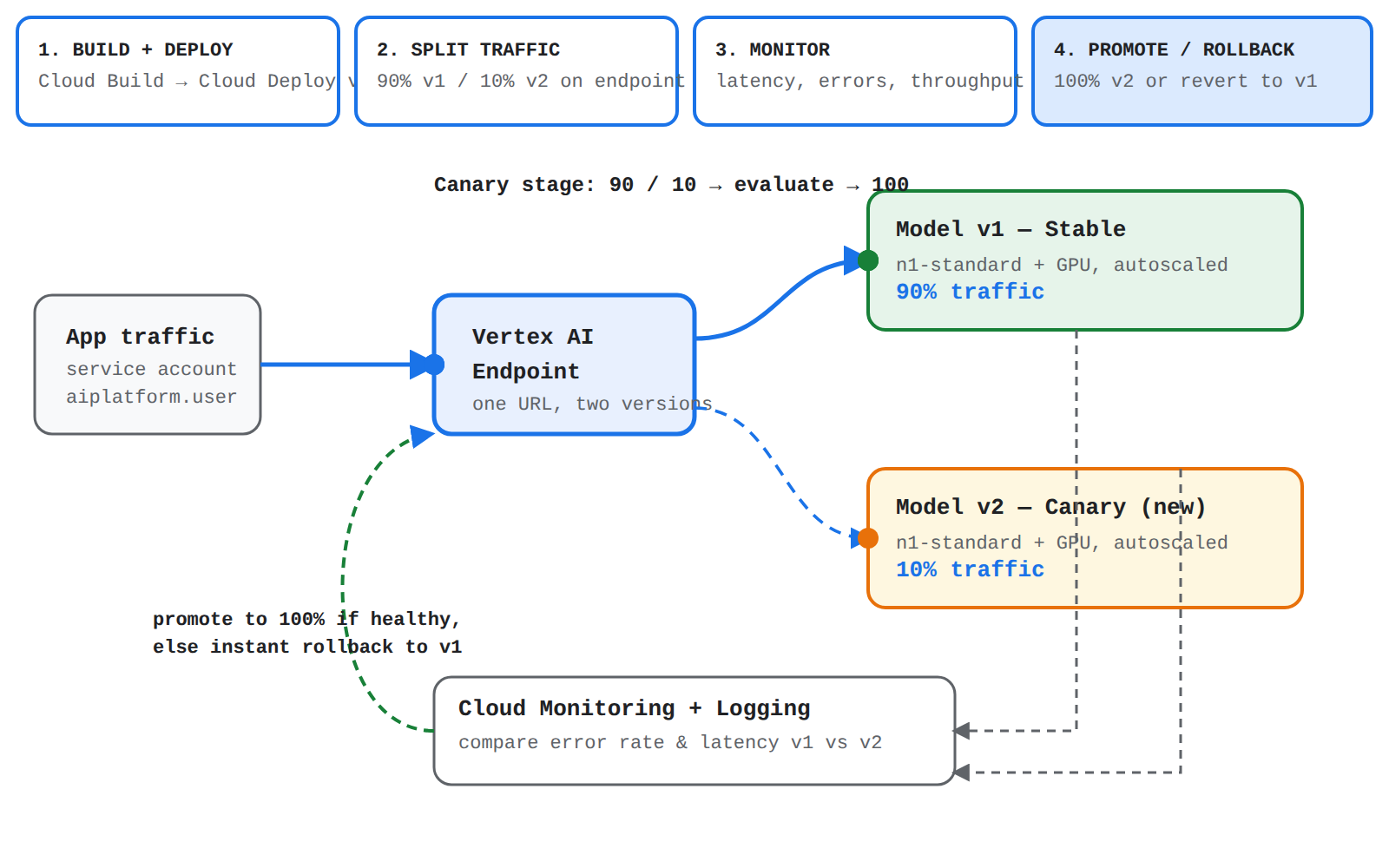
Key advantages and capabilities
- Automated orchestration: Cloud Build automates testing, container validation, and evaluation against quality benchmarks before triggering release pipelines.
- Fine-grained traffic management: Vertex AI endpoints natively allow multiple model versions to share a single endpoint while splitting traffic percentages during canary stages.
- Managed infrastructure: Vertex AI abstracts node management, health checking, and underlying hardware provisioning for prediction workloads.
- Enterprise observability: Seamlessly integrates with Cloud Monitoring and Cloud Logging for monitoring latency, throughput, and error rates.
Why this is optimal
This approach aligns with Google Cloud architecture best practices for operational excellence in machine learning. It avoids manual operational overhead and fragmented infrastructure while delivering an enterprise-grade serving environment tailored for foundation and open-source models.
Try 10 interactive questions like this one, free
Answer them yourself and get your score the moment you finish. No account needed.
Full access includes
- 2,335 practice questions across all 6 exam domains
- Every answer explained: why it is right, and why the others are not
- Scout, an AI tutor that answers your follow-up questions
- Readiness tracking by domain, so you know when to book the exam
Related questions
Keep the momentum going with these hand-picked practice scenarios
IntermediateProfessional Cloud Architect
Parameter-Efficient Fine-Tuning with LoRA
Integrating AI models from Model Garden into the solution
IntermediateProfessional Cloud Architect
Llama 4 Maverick 17B-128E
Integrating AI models from Model Garden into the solution
IntermediateProfessional Cloud Architect
VPC Service Controls Ingress and Egress Rules
Extending to a multicloud environment that may include Google Cloud-to-Google Cloud communication
IntermediateProfessional Cloud Architect
Sole-Tenant Nodes for BYOL
Determining software license implications and financial impact
IntermediateProfessional Cloud Architect
Intra-Region Synchronous, Inter-Region Asynchronous Replication
Familiarity with the Google Cloud Well-Architected Framework
AdvancedProfessional Data Engineer
BigQuery Omni BigLake External Tables
Designing for data and application portability (e.g., multi-cloud and data residency requirements)
Last updated